![Dysprosium Uses: 15+ Critical Applications in Magnets, Nuclear & Electronics [2025 Guide]](https://ik.imagekit.io/lxsotwajc/wpmedia/wp-content/uploads/2025/08/featrured-image-1280x640.webp)
Last Updated on August 22, 2025 by Hemanth
Table of Contents
Dysprosium may not be a household name, but it’s the secret ingredient that makes modern technology reliable under extreme stress. From keeping EV motors stable at scorching temperatures to enabling direct-drive offshore wind turbines, this rare earth element ensures performance where others fail.
It also plays a critical role in nuclear control systems, advanced defence electronics, and everyday devices like hard drives and headphones. In this guide, you’ll discover why dysprosium is indispensable for magnets, energy, and security—and why supply risks make it one of the most closely watched rare earths today.
Overview
Forget lithium and cobalt, behind India’s clean energy revolution lies a rare, often overlooked element: Dysprosium (Dy). This silvery rare earth metal is a powerhouse in critical technologies, from permanent magnets that keep electric vehicle motors running hot, to nuclear reactor control rods safeguarding energy systems, to defense electronics ensuring national security.
Dysprosium’s unique magnetic and thermal properties enable magnets to retain strength at temperatures where others fail, making it essential for electric vehicles, wind turbines, and advanced electronics. Yet global supply is almost entirely controlled by China (Future Market Insights, 2025), creating strategic vulnerabilities for countries like India that rely heavily on imports despite having rich reserves.
This article unpacks dysprosium’s uses across seven critical domains, clean energy, nuclear safety, defense tech, electronics, medical imaging, and emerging quantum research, showing how this modestly produced element underpins technologies vital to India’s energy independence and technological sovereignty.
Key Takeaway: Dysprosium stands out not for its abundance, but for how essential small quantities become in applications where magnetic performance under extreme conditions determines system reliability.
What Makes Dysprosium Unique: Magnetic and Thermal Properties
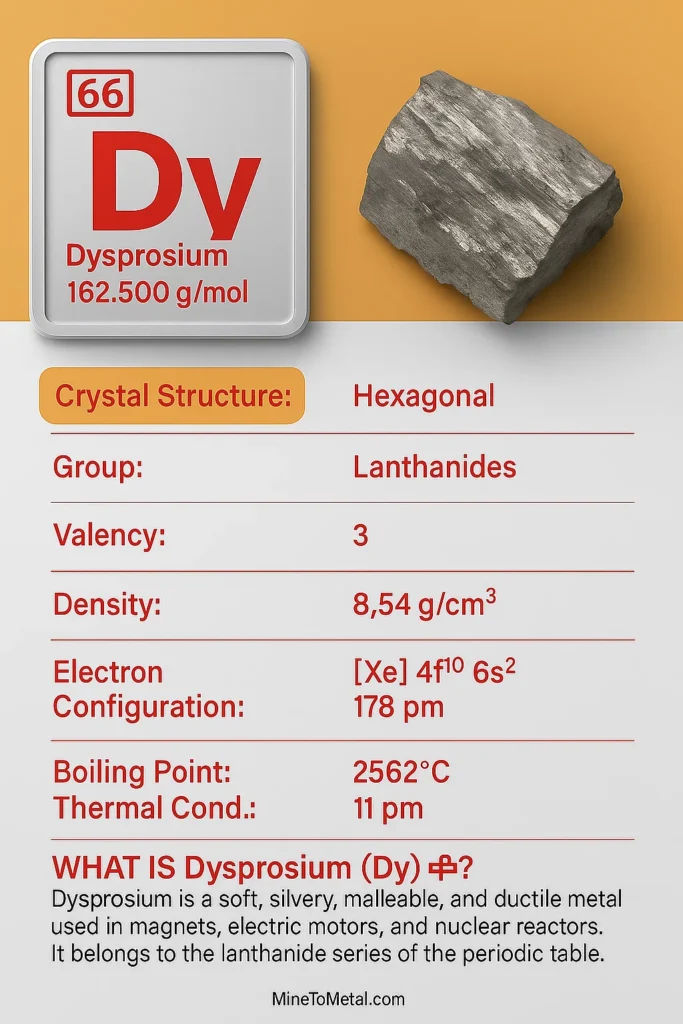
Dysprosium (chemical symbol Dy, atomic number 66) exhibits magnetic behaviour unlike any other element. Its magnetic moment ranks among the highest of all naturally occurring elements, particularly at low temperatures, yet it’s the element’s performance under thermal stress that sets it apart in industrial applications.
This rare earth metal undergoes distinct magnetic phase transitions as temperature changes: simple ferromagnetic ordering below 90.5 K, helical antiferromagnetic behaviour between 90.5 K and 179 K, and paramagnetic properties above 179 K. These transitions, combined with thermal conductivity of 10.7 W/(m K) (Spedding et al., 1968) and thermal expansion coefficient of 9.9 × 10⁻⁶ K⁻¹, create a material that remains magnetically stable across demanding temperature ranges.
Intrinsic Coercivity: The Science Behind Heat-Resistant Magnets
Dysprosium’s true value emerges when added to neodymium-iron-boron (NdFeB) magnets. The element increases intrinsic coercivity — the resistance to demagnetisation — allowing magnets to maintain their strength at elevated temperatures. Without this enhancement, permanent magnets lose effectiveness above 80°C, limiting their use in motors and generators that generate substantial heat.
Recent studies demonstrate dysprosium-enhanced magnets achieving coercivity values of 2.38 T with temperature coefficients as low as 0.531%/°C. This means the magnets retain 95% of their magnetic properties even under thermal stress while delivering maximum energy products of 43.6 MGOe.
The enhancement occurs through a sophisticated microstructural design:
| Structure Component | Composition | Contribution to Performance |
|---|---|---|
| Core | Dy-lean | Maintains high remanent magnetisation |
| Shell | Dy-rich | Enhances coercivity and thermal stability |
| Grain boundary | RE-rich, low-Fe | Creates synergistic magnetic performance |
This core-shell arrangement forms during sintering through solid-state diffusion and solution reprecipitation. The dysprosium-rich shell provides thermal stability while the dysprosium-lean core preserves magnetic strength — a balance critical for applications like electric vehicle motors and wind turbine generators.
Thermal Transitions and Crystallographic Behaviour
Along its c-axis, dysprosium exhibits complex thermal conductivity patterns with dramatic changes at magnetic transition points. The most significant occurs at the ferromagnetic-antiferromagnetic transition, where thermal conductivity drops sharply before increasing as the material approaches paramagnetic behaviour.
At 1,654 K, the crystal structure transforms from hexagonal close-packed to body-centred cubic, while the melting point of 1412°C (1685 K) and boiling point of 2567°C ensure structural integrity across most industrial operating temperatures.
Recent breakthroughs in dysprosium complex chemistry have achieved magnetic memory retention up to 100 K — the highest temperature recorded for single-molecule magnets. This advance, enabled by linear N-Dy-N bond arrangements, points toward revolutionary improvements in data storage density.
In short: Dysprosium combines exceptional magnetic strength with thermal stability, enabling permanent magnets to operate reliably where conventional materials fail — a property that has become essential for clean energy technologies and high-performance electronics.
Permanent Magnets in EVs and Wind Turbines

The clean energy transition has created an insatiable appetite for dysprosium, but not for the reasons most expect. While batteries grab headlines, the real bottleneck lies in permanent magnets — specifically, the challenge of maintaining magnetic strength when temperatures soar during operation.
Electric Vehicle Motor Applications
Electric vehicle motors face a fundamental physics problem: heat destroys magnetism. Standard neodymium-iron-boron (NdFeB) magnets lose their grip at temperatures above 100°C, yet EV motors routinely operate beyond 200°C during peak performance. Dysprosium solves this thermal dilemma. For the complementary role of Nd-Pr-Fe-B magnets in EVs, see praseodymium’s magnet applications.
Adding just 1-2% dysprosium to NdFeB magnets transforms their high-temperature behaviour, enabling them to ‘lock in’ magnetic alignment under thermal stress. Each permanent magnet synchronous motor (PMSM) requires 60-350g of dysprosium depending on power output and thermal requirements. The improvement is dramatic — these enhanced magnets maintain reliable performance at temperatures exceeding 200°C, where conventional magnets would fail completely.
Permanent magnet motors offer inherent advantages that directly translate to better electric vehicles. They start with “free” magnetic energy, delivering superior efficiency and more compact packaging. This translates to extended driving range and improved vehicle design — critical factors determining consumer adoption of electric mobility.
The scale of this dependency is substantial. Electric vehicles now consume approximately 30-35% of global dysprosium resources, with each permanent magnet synchronous motor (PMSM) requiring 60-350g depending on power output and thermal requirements, with demand climbing as adoption accelerates. Yet approximately 90% of refined dysprosium originates from China, creating potential supply vulnerabilities for automakers worldwide.
Wind Turbine Generator Requirements
Wind power presents an even more demanding environment for magnetic materials. Direct-drive wind turbine generators must convert kinetic energy to electricity with maximum efficiency while enduring constant temperature fluctuations, vibrations, and weather extremes. You can also compare Nd-Pr-Fe-B usage in offshore turbines here.
The wind energy sector devours approximately 33% of global dysprosium resources, concentrated in permanent magnet generators that deliver four key advantages over conventional alternatives:
| Operational Benefit | Impact on Wind Energy |
|---|---|
| Maintenance-free operation | Reduced service costs for offshore installations |
| Silent performance | Lower noise pollution for community acceptance |
| High power density | Compact, lightweight generator design |
| Temperature stability | Reliable operation across climate variations |
The numbers reveal the magnitude of this demand. In 2010 alone, China’s wind turbine installations consumed approximately 15% of that year’s global dysprosium production. Modern turbines intensify this pressure — larger 6-8 megawatt towers require about 500 kg of NdFeB magnets per megawatt output.
NdFeB Magnet Optimisation and Industry Innovations
Supply chain volatility has sparked innovation in magnet manufacturing, with three breakthrough approaches emerging to reduce dysprosium dependence while maintaining performance:
Grain Boundary Diffusion: The dysprosium diffusion method confines dysprosium to grain boundary regions rather than distributing it throughout the magnet. This targeted approach increases local coercivity, limits remanence reduction, and decreases overall dysprosium requirements.
Selective Application: Advanced techniques place dysprosium only at edges and faces of magnets where demagnetisation factors are largest. Research demonstrates that a 200 nm thick dysprosium film sputtered onto commercial NdFeB magnets and post-annealed at 600-700°C significantly improves performance.
Nano-structuring: This approach increases intrinsic coercivity without dysprosium, though limitations emerge above 16,000 Oe (1275 kA/m).
The engineering challenge remains formidable: electric vehicles and wind energy have become essential to global decarbonisation efforts, yet both depend on dysprosium-enhanced magnets that maintain strength at elevated temperatures. This dependency makes dysprosium one of the most strategically important elements in modern clean technology.
Nuclear Reactor Control Systems
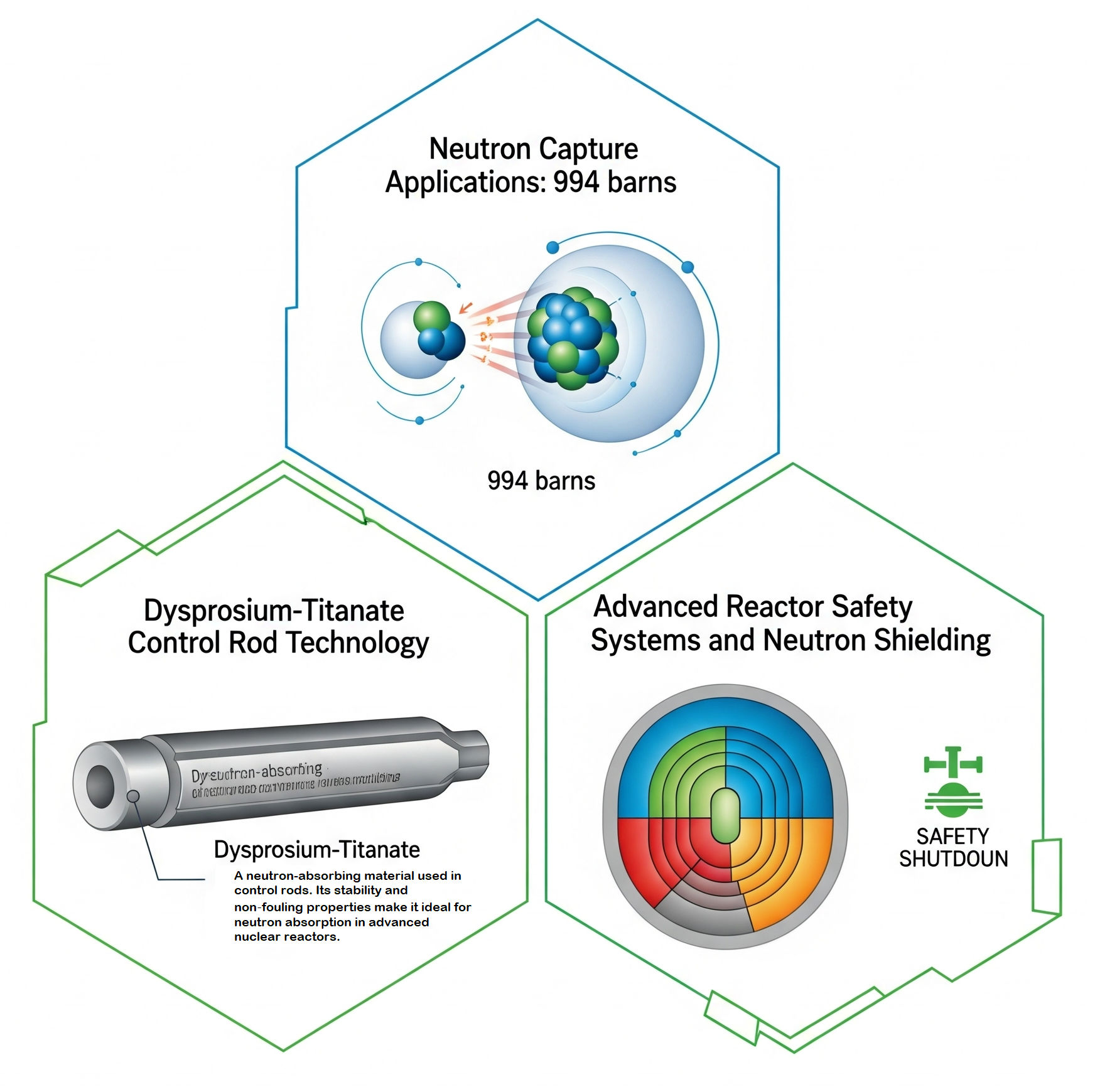
Nuclear reactors require precise control over billions of neutrons racing through their cores every second. Most elements either ignore these neutrons or absorb them weakly. Dysprosium is different. With a thermal absorption cross-section of 994 barns, it captures neutrons with exceptional efficiency, making it indispensable for controlling nuclear reactions and ensuring reactor safety.
This neutron-hungry behaviour transforms dysprosium from a specialty magnet additive into a critical component of nuclear infrastructure worldwide. For context, see how gadolinium (¹⁵⁷Gd/¹⁵⁵Gd) and europium are used in control rods and why engineers combine absorbers.
Neutron Capture Applications: 994 barns
Among dysprosium’s seven naturally occurring isotopes, ¹⁶⁴Dy (abundance 28.26%) exhibits the highest thermal neutron capture cross-section of 2650 ± 8 barns at 0.0253 eV, while natural dysprosium averages 994 barns.
Recent experimental measurements have pushed precision further, determining the cross-section at 0.0334 eV to be 2322 ± 140 barns, values exceeding theoretical predictions by approximately 4.3% compared to standard nuclear data libraries.
This neutron absorption capacity remains effective throughout the element’s service life, unlike boron-based materials which deplete rapidly. The sustained performance makes dysprosium ideal for long-term reactor operation where control rod replacement represents both cost and safety considerations.
Nuclear Insight: Dysprosium continues absorbing neutrons effectively throughout its service life, unlike boron which depletes rapidly — making it ideal for long-term reactor operation.
Dysprosium-Titanate Control Rod Technology
Dysprosium titanate (Dy₂TiO₅) has emerged as superior control rod material compared to conventional alternatives. The compound exhibits insignificant swelling under irradiation, whilst boron carbide experiences substantial dimensional changes. Its melting point of approximately 1870°C provides adequate thermal margin, and notably, neutron efficiency declines by only 15% over 4-5 years compared to 50% degradation in boron carbide systems.
The material produces no outgassing and shows no cladding interaction above 1000°C — addressing two major failure modes that plague alternative control rod materials.
Performance history validates these advantages. Dysprosium titanate control rods have operated reliably for 17 years in the MIR reactor and 4 years in VVER-1000 reactors without operational issues. Following extensive post-irradiation examinations, this technology received recommendation for both VVER and RBMK reactor designs.
Advanced Reactor Safety Systems and Neutron Shielding
Beyond control rod applications, dysprosium compounds excel in neutron shielding applications. When doped into PbO-B₂O₃-SiO₂ glasses, Dy₂O₃ significantly enhances neutron radiation protection. Studies demonstrate that 5 mol% Dy₂O₃-doped glass exhibits superior neutron shielding characteristics, with effective removal cross-section values increasing proportionally with dysprosium oxide concentration.
Dysprosium-doped sodium-based oxyfluoride glass systems outperform oxide glass systems in neutron shielding applications. This characteristic proves particularly valuable for applications requiring both neutron protection and optical transparency — enabling reactor monitoring systems that must function in high-radiation environments.
For advanced safety systems, dysprosium integration into the Advanced Heavy Water Reactor (AHWR) fuel assembly achieves negative coolant void reactivity. This engineering approach redistributes thermal neutron flux upon coolant voiding, ensuring reactor safety maintenance even during potential cooling system failures.
Key Takeaway: Dysprosium’s exceptional neutron absorption properties, coupled with dysprosium titanate’s dimensional stability under irradiation, make it fundamentally important for safe, reliable, and long-term nuclear reactor operation — a critical advantage as global energy demands necessitate safer nuclear power generation.
Dysprosium Uses in Defence and Aerospace Technologies
Modern warfare depends on technological precision measured in microseconds and millimetres. Behind the sophisticated guidance systems, underwater detection arrays, and satellite communications that define military superiority lies an element most defence planners have never heard of — dysprosium.
This rare earth metal enables the magnetostrictive alloys and high-temperature magnets that convert electrical signals into mechanical action with extraordinary speed and accuracy. Without it, the precision-guided munitions, sonar systems, and radar arrays that project military power would lose their technological edge.
Military SONAR and Maritime Navigation Systems
Underwater detection capabilities rely on Terfenol-D, an alloy containing dysprosium, terbium, and iron that exhibits remarkable magnetostrictive properties. When exposed to magnetic fields, this material changes shape reversibly — a characteristic that makes it 200 times faster than conventional mechanical systems.
The practical advantage becomes clear in sonar applications. Terfenol-D transducers convert electrical energy to mechanical sound waves with exceptional efficiency, enabling both high-power transmission and sensitive reception. These alloys improve sonar sensitivity and accuracy by providing more stable magnetic fields under the thermal and pressure extremes of deep-ocean operations.
The strategic implications extend beyond performance metrics. Naval superiority increasingly depends on acoustic detection capabilities, where dysprosium-enhanced systems provide decisive advantages in submarine warfare and maritime domain awareness.
Precision-Guided Munitions and Targeting Applications
Missile guidance systems demonstrate dysprosium’s role in weapons precision. The AIM-9 Sidewinder incorporates rare-earth magnets in its four forward fins for flight trajectory control, while AIM-120 air-to-air missiles use samarium-cobalt actuators for movable flight surfaces.
Surface-to-air systems like the Stinger employ rare-earth magnet motors to control fins based on infrared sensor data. Tomahawk cruise missiles connect guidance systems to tail-control fins using direct-drive, rare-earth magnetic actuators.
| Weapon System | Dysprosium Function | Operational Advantage |
|---|---|---|
| AIM-9 Sidewinder | Forward fin control magnets | Enhanced trajectory stability |
| AIM-120 AMRAAM | Mid-fuselage surface actuators | Improved target acquisition |
| FIM-92 Stinger | Fin control motors | Precise heat-seeking capability |
| BGM-109 Tomahawk | Direct-drive actuators | Superior guidance accuracy |
Advanced Radar and Satellite Communication Systems
Defence radar systems — including fire-control, surveillance, and phased-array technologies — depend on dysprosium for reliable operation across temperature extremes. These systems provide critical anti-collision, weather detection, and navigational capabilities for aircraft and naval vessels.
The Patriot Missile Air Defence System uses radio frequency circulators that magnetically control electronic signal flow in both radar units and interceptor missiles. Dysprosium’s thermal stability enables compact yet powerful components for data storage, robotics, and defence electronics.
Satellite communication systems similarly rely on dysprosium-enhanced components that maintain performance in the thermal cycling and radiation environment of space-based platforms.
See also erbium in fibre amplifiers—the backbone of long-haul secure optical comms.
Key Takeaway: Military technological superiority increasingly depends on dysprosium-enabled systems that provide precision in guidance, enhanced detection capabilities, and reliable performance under extreme conditions. This dependency creates strategic vulnerabilities for nations lacking secure access to dysprosium supplies.
Dysprosium Uses in Electronics, Data Storage, and Advanced Materials

You won’t find dysprosium listed on any product specification sheet, but this rare earth element plays a hidden yet essential role in the electronic devices that define modern life. From the hard drive storing your photos to the vibration motor in your smartphone, dysprosium’s unique magnetic properties enable the miniaturisation of powerful technologies into compact, portable forms.
The element’s high coercivity — its resistance to demagnetisation — becomes crucial when magnetic components must maintain performance despite being packed into increasingly smaller spaces alongside heat-generating processors and circuits.
Hard Disc Drives and Computer Data Storage
Modern hard drives depend on dysprosium-enhanced magnetic materials to achieve the data densities that make today’s compact laptops possible. Without this element’s thermal stability, magnetic storage media would lose data integrity under the operating conditions of high-density drives.
Related read: Pr³⁺ in optical systems and storage
The strategic value of dysprosium in data storage has prompted innovative recovery efforts. Western Digital and Microsoft have pioneered a recycling programme that achieves 90% recovery rates of rare earth materials from discarded hard drives, highlighting both the element’s value and the industry’s recognition of supply vulnerabilities.
Magnetostrictive Materials and Precision Actuators
Terfenol-D, containing dysprosium alongside terbium and iron, demonstrates the highest room-temperature magnetostriction of any known material with a magnetostrictive coefficient of approximately 2000 ppm (parts per million). This property — changing shape in response to magnetic fields — enables precision actuators that respond 200 times faster than conventional mechanical systems.
These components appear in applications ranging from high-precision liquid-fuel injectors to wide-band mechanical resonators, forming the foundation of industrial automation and Internet of Things (IoT) devices where rapid, precise mechanical responses are essential.
Advanced Material Sciences and Nanofibre Applications
Dysprosium nanofibers exhibit exceptional strength-to-weight ratios and surface area properties, making them valuable as reinforcement materials and catalysts. Dysprosium oxide fluoride fibres, produced by heating aqueous solutions of DyBr3 and NaF to 450°C under pressure, maintain stability for over 100 hours in aqueous solutions exceeding 400°C.
Dysprosium orthoferrite (DyFeO3) nanofibers show particular promise for advanced information storage due to their multiferroic behaviour — the ability to exhibit both magnetic and ferroelectric properties simultaneously, potentially enabling new forms of data storage with higher density and lower energy consumption.
Consumer Electronics: Smartphones, Gaming, and Wearables
| Device Type | Dysprosium Application | Performance Advantage |
|---|---|---|
| Smartphones | Vibration motors, speakers | Compact yet powerful haptic feedback |
| Headphones | Speaker drivers | Superior sound quality in smaller form factors |
| Smart watches | Vibration motors | Effective notifications in minimal space |
| Gaming hardware | Cooling fans, motors | Efficient thermal management in slim designs |
The miniaturisation enabled by dysprosium becomes particularly evident in wearable technology, where space constraints demand maximum performance from minimal components. Smart watch vibration motors, for instance, must deliver noticeable haptic feedback while consuming minimal battery power and occupying virtually no space, and for the display side of phones/TVs, explore europium’s red phosphors and colour-critical roles.
Key Takeaway: Dysprosium enables the miniaturisation of electronic components without performance compromise, supporting the development of increasingly powerful yet compact consumer devices that have become essential to modern connectivity and productivity.
Dysprosium Uses in Medical and Industrial Process Applications
!Internal view of a laptop hard drive showing the platter and read/write head assembly on a white background.
Image Source: CCDC
Beyond its magnetic prowess in energy and defence systems, dysprosium quietly enables life-saving medical technologies and precision industrial processes. The same properties that make it indispensable for wind turbines and missile guidance also unlock breakthrough applications in healthcare diagnostics and specialised manufacturing.
MRI contrast enhancement and medical imaging
Dysprosium complexes function as highly effective magnetic resonance imaging (MRI) contrast agents, particularly as T2* or magnetic susceptibility agents. These compounds enhance contrast in functional and perfusion imaging by altering T1 and T2 relaxation rates in vivo. The element’s high magnetic moment (μ10.6 BM) provides exceptional sensitivity for clinical applications.
DyDTPA-BMA (Sprodiamide) represents a significant advancement as a nonionic heart and brain imaging agent, offering improved safety profiles compared to traditional contrast materials.
| Contrast Agent Type | Key Advantage | Clinical Application |
|---|---|---|
| Gadolinium Complex | T1 relaxation | Anatomical imaging |
| Dysprosium Complex | T2 susceptibility | Functional/perfusion imaging |
| Carbon-coated DyO | Efficient T2 contrast | High-field MRI |
The clinical impact extends beyond standard imaging. Dysprosium-enhanced MRI imaging helps differentiate between morphologically intact and necrotic tumour tissue with remarkable precision, enabling more accurate treatment planning and monitoring.
Cancer treatment and neutron capture therapy
Experimental cancer treatment protocols increasingly explore dysprosium compounds, particularly in neutron capture therapy (NCT). This targeted approach selectively destroys cancer cells through neutron irradiation, with the isotope 165Dy offering a moderate neutron capture cross-section suitable for treating tumours with high dysprosium uptake.
Current research focuses on dysprosium oxide nanoparticles for cancer research, drug screening, and targeted drug delivery. These applications represent the convergence of dysprosium’s nuclear properties with advanced nanotechnology platforms.
Industrial catalysis and ultra-low temperature systems
Dysprosium(III) catalysis provides unique pathways in organic synthesis, offering selectivity and reaction control that traditional catalytic systems cannot match. These properties prove particularly valuable in pharmaceutical development and advanced materials synthesis.
For scientific research requiring extreme conditions, dysprosium garnets serve as magnetocaloric materials in adiabatic demagnetisation refrigeration (ADR) systems. These systems address the supply shortages and prohibitive costs of 3He-based cooling technologies, with ADR cryostats using dysprosium compounds achieving temperatures below 0.3K — essential for quantum research and advanced scientific instrumentation.
Key Takeaway: Dysprosium’s magnetic properties translate directly into medical diagnostic capabilities and precision industrial processes, demonstrating how a single element can simultaneously advance healthcare outcomes and enable cutting-edge scientific research.
Optical and Quantum Research Applications

Beyond industrial applications, dysprosium opens doors to some of the most advanced optical technologies and fundamental physics research happening today. Its luminescent properties bridge everyday lighting innovations with quantum physics laboratories pushing the boundaries of human knowledge.
LED lighting and advanced illumination systems
Dysprosium-doped materials produce white light through carefully orchestrated electron transitions. When activated by ultraviolet light at 365 nm, dysprosium ions exhibit characteristic emissions at 480 nm (blue), 573 nm (yellow), and 670 nm (red). These transitions occur between the 6F9/2 excited level and ground levels 6H15/2, 6H13/2, and 6H11/2 respectively.
This multi-band emission capability makes dysprosium exceptional for white light-emitting diodes with superior colour rendering and tunability. Unlike conventional phosphor-based LEDs that rely on blue light conversion, dysprosium-activated systems can operate for over 100,000 hours—more than 11 years of continuous use.
The precision of these spectral emissions allows lighting engineers to fine-tune colour temperature and rendering index, creating illumination systems tailored to specific applications from surgical theaters to art galleries.
Industrial lasers and infrared technologies
Dysprosium-based laser systems deliver exceptional mid-infrared performance with tunability spanning 2.8 to 3.4 μm with peak efficiency at 2.94 μm for medical and industrial cutting applications.. These achieve continuous wave powers exceeding 10W with remarkable slope efficiencies greater than 73%.
The mid-infrared region contains characteristic molecular vibrations, making these lasers valuable across multiple domains:
| Application | Advantage | Field |
|---|---|---|
| Spectroscopy | High-sensitivity detection | Environmental monitoring |
| LIDAR | Atmospheric transmission | Defence systems |
| Materials processing | Molecular bond targeting | Manufacturing |
This spectral range proves particularly useful for detecting trace gases, analysing chemical composition, and processing materials at the molecular level—applications that require both precision and power.
Quantum research and scientific applications
Ultracold dysprosium atoms represent one of the most exciting frontiers in quantum physics research. With their complex electronic structure and large magnetic moment (J=8), these atoms enable fundamental studies that were impossible with simpler atomic systems.
These quantum systems facilitate generation of non-classical spin states and simulation of quantum Hall effects, opening pathways to understanding exotic phases of matter and potential quantum computing architectures.
Dysprosium compounds also serve in radiation dosimeters for measuring ionising radiation. Calcium sulphate or calcium fluoride crystals doped with dysprosium exhibit luminescence proportional to radiation exposure, providing precise measurement tools for nuclear medicine, space exploration, and radiation safety applications.
The element’s magnetic complexity, which poses challenges in some applications, becomes an asset in quantum research where controllable complexity enables new experimental possibilities and theoretical insights.
Scientific Impact: Dysprosium’s optical properties span the spectrum from practical illumination to fundamental physics, demonstrating how a single element can simultaneously improve everyday technologies and unlock new scientific understanding.
Supply Chain and Market Overview
The strategic vulnerability becomes stark when examining dysprosium’s supply landscape. China’s overwhelming dominance extends beyond mere market share — it controls over 95% of global production, creating what industry analysts describe as a single point of failure for critical technologies spanning clean energy, defence, and electronics.
Global Market Dynamics and Strategic Challenges
Market valuations tell only part of the story. While the global dysprosium market reached approximately US$1 billion in 2024 and projects growth to US$1.75 billion by 2035 at 5.2% CAGR, price volatility reveals deeper structural problems. Between 2003 and 2011, dysprosium prices surged from US$35/kg to nearly US$3,500/kg — a 10,000% increase that sent shockwaves through manufacturing supply chains.
The trajectory ahead suggests even greater pressure. Recent forecasts indicate dysprosium prices could surge 340% by 2034, potentially reaching US$9,281/kg. This isn’t merely inflation — it reflects the collision between rising demand from electric vehicle adoption, wind energy expansion, and defence modernisation programmes against constrained supply sources.
Indian Supply Chain Dependency and Policy Framework
India’s position exemplifies the strategic challenge facing major economies. Despite holding the world’s fifth-largest rare earth reserves at 6.9 million tonnes, India produced just 2,900 tonnes in 2023 — a stark mismatch between resource endowment and industrial capability.
The policy response has been comprehensive but faces implementation hurdles. India’s National Critical Minerals Mission targets over 100 mineral block auctions and offshore exploration initiatives. Yet import dependency persists: rare earth compound imports reached ₹1,105.38 million in 2023, with permanent magnet imports alone rising 49% year-over-year.
This dependency creates strategic vulnerabilities across multiple sectors where dysprosium-enhanced magnets prove irreplaceable — from indigenous defence programmes to renewable energy targets and electronics manufacturing ambitions.
Future Applications and Market Projections
The demand horizon presents both challenges and opportunities. Emerging applications in passenger drones and humanoid robotics will intensify pressure on already tight supplies. These sectors demand the same high-temperature magnetic performance that makes dysprosium essential in current applications.
However, technological innovation offers pathways toward supply security. Companies like Urban Mining Co. and Hitachi have developed sophisticated recovery technologies that extract dysprosium from end-of-life products with minimal environmental impact. These recycling approaches could eventually supply 30-40% of market demand, reducing primary mining dependency.
Material substitution research continues, though breakthrough alternatives remain elusive for high-temperature applications where dysprosium’s unique properties prove most valuable.
Key Takeaway: The concentration of dysprosium supply in a single country creates systemic risk for technologies central to global decarbonisation and defence modernisation. Countries developing domestic recycling capabilities, alternative supply sources, and strategic stockpiles will hold significant advantages in the emerging clean technology competition.
Conclusion
From the humming magnets spinning inside wind turbines to the invisible neutron shields guarding nuclear reactors, this rare earth element is the unseen backbone of modern civilization. Though just a few thousand tonnes are produced globally each year, its influence stretches across electric vehicles, defense systems, cutting-edge medical imaging, and emerging quantum technologies.
Yet, almost all dysprosium flows through a single geopolitical bottleneck — a reality that makes countries like India vulnerable despite abundant reserves. This element’s story is not just about chemistry or industry; it’s a lesson in the fragility and resilience of modern technology and the geopolitics that shape it.
As the world races to decarbonize and defend itself with smarter tech, securing dysprosium supply chains, pioneering recycling, and investing in innovation are not optional—they are imperative. Because in the story of materials that build the future, dysprosium is a small actor playing a giant role.
Will we recognize its power before it’s too late?
Key Takeaway: Dysprosium exemplifies how modern technological progress depends on materials most people have never heard of, yet whose steady supply determines whether nations can achieve energy independence, maintain defence capabilities, and compete in advanced manufacturing sectors.
FAQs
What are the main uses of dysprosium?
Dysprosium uses include permanent magnets for electric vehicles (30-35% of global supply), wind turbine generators (25-30%), nuclear reactor control rods, defense systems, and electronics. Its high-temperature magnetic stability makes it essential for applications operating above 100°C.
Why is dysprosium important for electric vehicles?
Dysprosium enhances permanent magnet performance at high temperatures, allowing EV motors to maintain efficiency above 200°C. Each electric vehicle motor requires 60-350g of dysprosium depending on power output and thermal requirements.
Does India produce dysprosium?
India holds 6.9 million tonnes of rare earth reserves but produced only 2,900 tonnes in 2023. The country imports virtually all dysprosium requirements, creating strategic dependency on Chinese supplies that control 95% of global production.
How does dysprosium enhance the performance of electric vehicle motors?
Dysprosium is added to neodymium-iron-boron magnets in electric vehicle motors to maintain their magnetic properties at high temperatures. This allows the motors to operate efficiently even when they generate significant heat during use, improving overall vehicle performance and range.
What role does dysprosium play in wind turbine technology?
Dysprosium is crucial for wind turbines, particularly in direct-drive generators. It enhances the performance of permanent magnets, allowing them to maintain strength in varying temperatures and conditions. This results in more efficient and reliable wind energy production, especially in large offshore installations.
How is dysprosium used in nuclear reactor control systems?
Dysprosium is utilised in nuclear reactor control rods due to its exceptional neutron-absorbing properties. Dysprosium titanate, in particular, offers superior performance compared to conventional materials, maintaining effectiveness over long periods and enhancing reactor safety and control.
What are the applications of dysprosium in consumer electronics?
Dysprosium is essential in miniaturising electronic components without compromising performance. It’s used in hard disc drives, speakers, and vibration motors in devices like smartphones and smartwatches, enabling powerful functionality in compact designs.
How does dysprosium contribute to medical imaging technologies?
Dysprosium compounds are used as contrast agents in magnetic resonance imaging (MRI). They enhance image contrast, particularly in functional and perfusion imaging, helping to differentiate between healthy and diseased tissues with high precision. This aids in more accurate diagnoses and treatment planning.