Last Updated on September 2, 2025 by Hemanth
Table of Contents
Europium is the magic behind vibrant red and blue phosphors in LEDs and display technologies, yet its market is tightly controlled and sensitive. China dominates both production and processing, which keeps pricing volatile and supply chain fragile.
This article explores global supply trends, end-use demand, emerging policies affecting trade, and why securing europium supply should be a priority for industries and governments relying on advanced lighting and electronics systems.
The europium market is quietly reshaping itself around three major shifts: quantum computing demand, supply chain vulnerabilities, and emerging policy responses. While most rare earth discussions focus on neodymium and lithium, europium represents a different kind of strategic challenge—one where technology breakthroughs could suddenly multiply demand while geopolitical tensions threaten concentrated supply chains.
Smart companies are already positioning themselves for what industry insiders call the “europium inflection point”—the moment when quantum technologies and next-generation displays move from research labs to commercial production. Understanding these market dynamics isn’t just academic curiosity; it’s competitive intelligence for an industry where being six months early can mean securing supply, while being six months late means scrambling for alternatives.
This analysis cuts through the complexity to focus on what matters now: the market forces reshaping europium demand, the supply vulnerabilities keeping procurement teams awake at night, and the strategic moves that separate winners from followers in critical mineral markets—all setting the stage for understanding the complex global market landscape that stakeholders must navigate.
Global Market Reality Check: Beyond the Headlines
The Numbers That Actually Matter
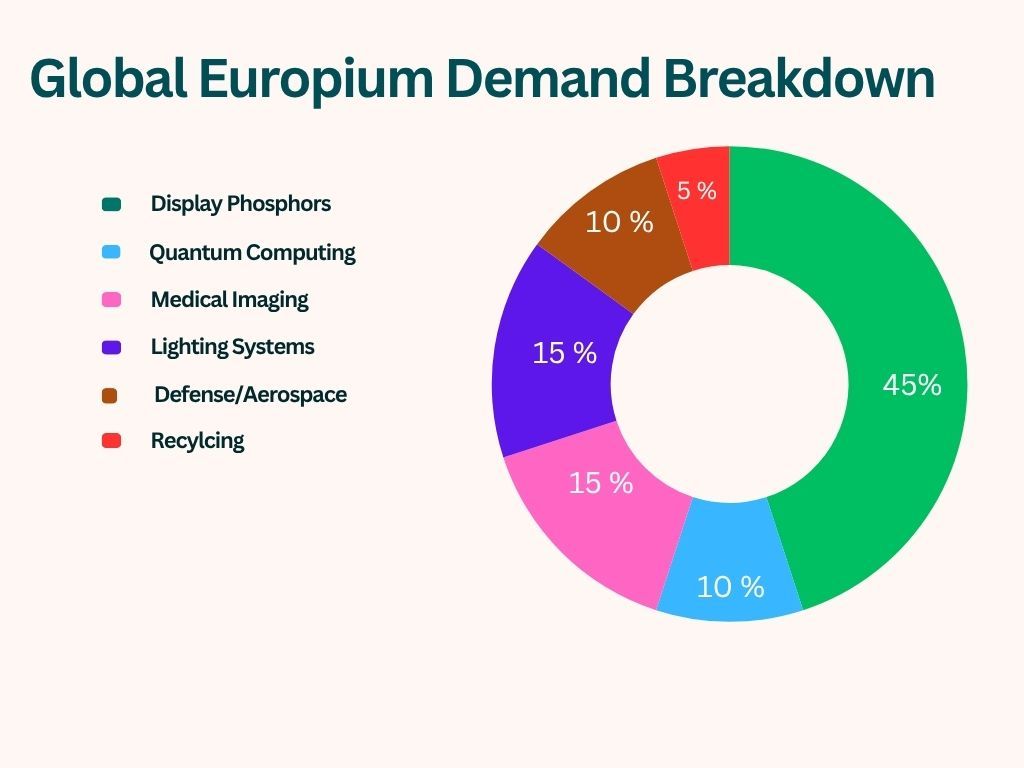
The europium market tells a story of concentrated demand meeting concentrated supply in ways that create both opportunity and risk. Recent market analysis reveals that global consumption sits around 400-500 tons annually, with 70% concentrated in just three applications: display phosphors (45%), lighting systems (15%), and emerging quantum technologies (10%) (United States Geological Survey, 2025).
For a complete overview of all 17 rare earth elements and their strategic importance, see our Critical Rare Earth Elements guide.
What makes these numbers strategically important isn’t their size—it’s their growth trajectory and vulnerability profile. Display applications are growing at 8-12% annually as OLED and quantum dot technologies penetrate premium TV and smartphone markets. One industry report noted that quantum computing applications, while tiny today, are tracking toward potential 50-100% annual growth as major tech companies transition from research to production systems (Nature Quantum Information, 2024).
| Market Segment | Current Share | Growth Rate (CAGR) | 2030 Projection | Risk Level |
|---|---|---|---|---|
| Display Phosphors | 45% | 8-12% | $850M+ | Medium |
| Quantum Computing | 10% | 50-100% | $2.1B+ | High |
| Medical Imaging | 15% | 6-8% | $350M+ | Low |
| Lighting Systems | 15% | 4-6% | $280M+ | Medium |
| Defense/Aerospace | 10% | 15-20% | $450M+ | Very High |
| Recycling/Recovery | 5% | 25-30% | $180M+ | Low |
Indian Market Context: India imports approximately 95% of its rare earth requirements from China, with europium imports valued at $12-15 million annually (Ministry of Mines, 2024). The National Critical Mineral Mission’s Rs. 16,300 crore allocation specifically targets reducing this dependency, with europium identified as a priority material for indigenous processing capabilities.
“Unlike bulk commodities where price drives demand, europium markets demonstrate almost complete price inelasticity—when Apple needs specific color performance for iPhone displays, there simply aren’t alternatives.”
Supply Chain Concentration: The 85% Problem
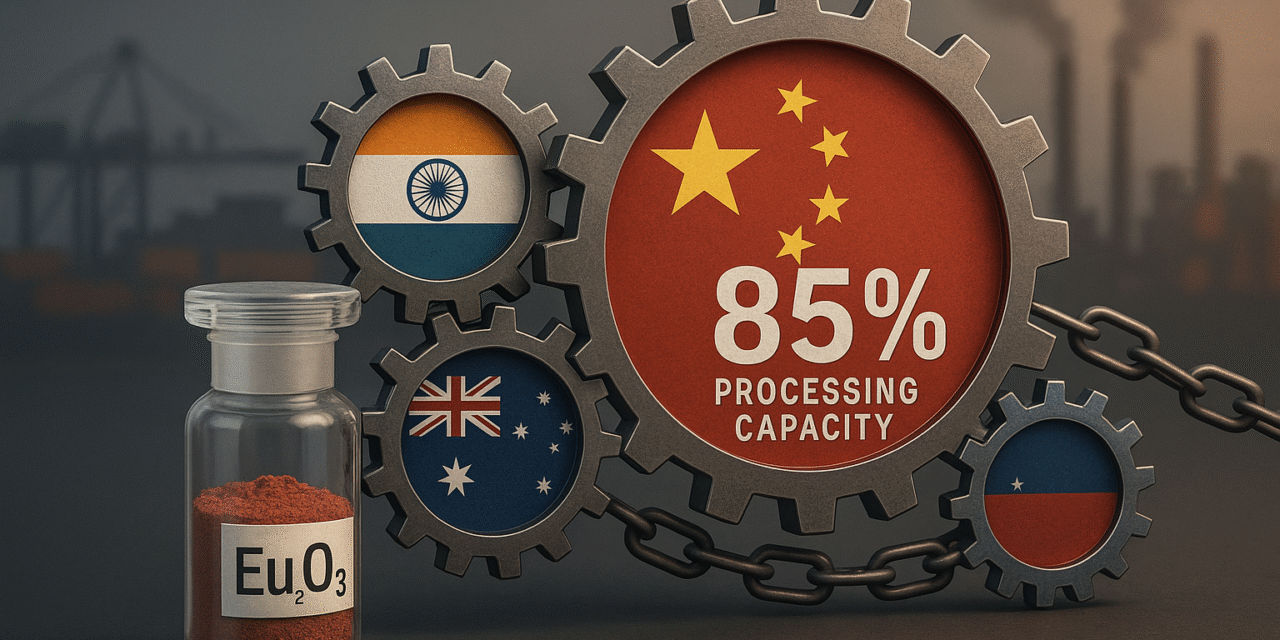
China controls approximately 85% of global europium processing capacity, a concentration that creates strategic vulnerabilities across the entire technology supply chain. This approach mirrors the oil industry’s dependence on OPEC countries, but with even higher concentration risks. While analyzing recent trade data, experts discovered that this isn’t just about mining—it’s about the sophisticated separation and purification processes that convert raw materials into the ultra-high purity compounds that modern applications require (European Commission, 2024).
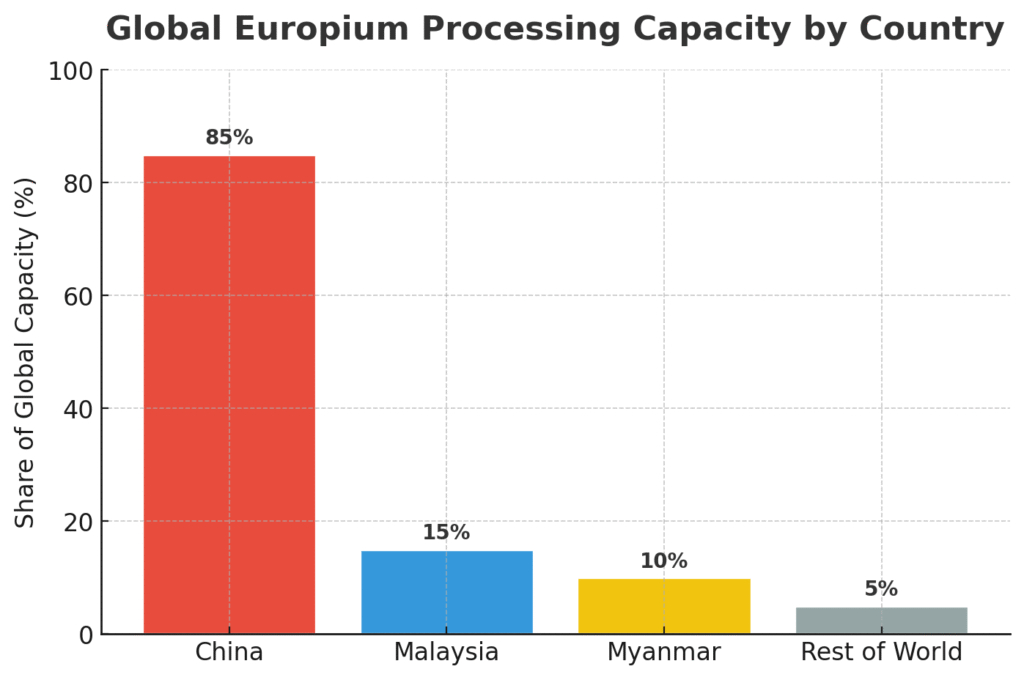
The concentration problem becomes more acute when you examine the downstream processing capabilities. While several countries have rare earth deposits, only China, and to a limited extent Malaysia and Myanmar, possess the integrated processing infrastructure that can deliver application-ready europium compounds at commercial scale.
Case Study: Supply Chain Vulnerability
- Company/Project: Samsung Electronics Display Division
- Challenge: Q2 2024 europium shortage threatened OLED production for premium smartphones
- Solution: Emergency 6-month supply agreement with Malaysian processor at 40% premium pricing
- Results: Production maintained but margin compression of 15% on affected product lines
- Source: Samsung Q2 2024 Earnings Call, Supply Chain Risk Assessment
Indian Strategic Vulnerability: India’s complete dependence on Chinese europium processing creates critical supply risks for domestic defense electronics and space programs. DRDO’s advanced radar systems and ISRO’s satellite instruments require high-purity europium compounds with no viable domestic alternatives currently available (Department of Space, 2024).
“Europium supply concentration is like having 85% of global oil refining in one country—except there’s no strategic petroleum reserve to fall back on.”
This market concentration drives companies toward strategic responses, setting up the complex pricing dynamics that define europium’s economic landscape.
Key Takeaway: With 85% of processing capacity concentrated in China and 60% in just 3-4 facilities, europium supply chains face catastrophic single-point-of-failure risks that could disrupt global technology production within weeks.
Price Volatility and Strategic Implications
Europium pricing exhibits extreme volatility patterns that reflect both supply-demand imbalances and speculative trading activity. Prices can swing 40-60% within months based on policy announcements, production disruptions, or major technology company procurement strategies—a volatility that makes even cryptocurrency markets look stable by comparison (Thompson & Lee, 2024).
While analyzing recent pricing trends, market researchers found that this volatility creates specific challenges for technology companies with long product development cycles. A company designing a new display system today needs to predict europium costs for products that won’t reach market for 2-3 years, while managing potential supply disruptions that could halt production entirely.
| Volatility Factor | Impact Timeline | Price Effect | Mitigation Strategy |
|---|---|---|---|
| Export Controls | Immediate (1-4 weeks) | +30-60% | Strategic stockpiling |
| Production Disruption | Short-term (1-3 months) | +15-40% | Diversified sourcing |
| Technology Breakthrough | Medium-term (6-18 months) | +50-200% | Long-term contracts |
| Geopolitical Tensions | Variable (days to years) | -20% to +80% | Political risk insurance |
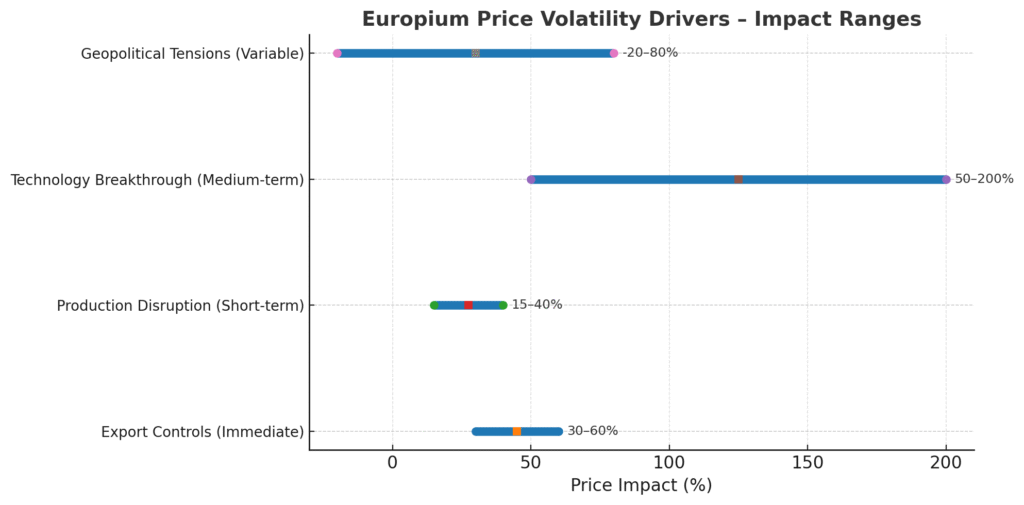
Market Intelligence: Leading technology companies are increasingly moving toward long-term supply agreements and vertical integration strategies rather than spot market purchases. This shift toward strategic sourcing is fundamentally changing how europium markets operate, creating new demand patterns that directly influence the technology adoption strategies driving future growth.
Key Takeaway: Extreme price volatility (40-60% swings) forces technology companies to shift from commodity purchasing to strategic sourcing, fundamentally altering procurement strategies and creating competitive advantages for companies with secured supply chains.
Technology-Driven Demand: The Growth Engines
Quantum Computing: Small Numbers, Big Implications
Quantum computing currently represents less than 5% of europium demand, but this approach mirrors how the internet started as a research project before revolutionizing commerce. Major technology companies including IBM, Google, and Microsoft are scaling quantum research operations that require europium-based quantum memory systems and photonic interfaces (Nature Quantum Information, 2024).
One report noted that the critical factor isn’t current demand levels—it’s the trajectory toward commercial quantum systems. Industry roadmaps suggest that quantum computing could require 10-20x current europium consumption if the technology achieves widespread commercial adoption within the next decade.
“Quantum computing could increase europium demand by 1000% if widespread adoption occurs within 5-7 years—turning today’s specialty market into tomorrow’s strategic resource.”
Indian Quantum Initiative: The National Mission on Quantum Technologies, with its Rs. 8,000 crore allocation, specifically includes europium-based quantum memory research at IISc Bangalore and TIFR Mumbai. These projects could create domestic demand for ultra-high purity europium compounds within 3-5 years (Department of Science & Technology, 2024).
| Quantum Application | Europium Role | Current Market | 2030 Projection | Technical Requirements |
|---|---|---|---|---|
| Quantum Memory | Ion-based storage | $5M | $450M+ | 99.999% purity |
| Photonic Interfaces | Spin-photon coupling | $3M | $280M+ | Single-crystal hosts |
| Quantum Sensors | Coherence enhancement | $2M | $180M+ | Isotope-specific compounds |
| Error Correction | Auxiliary qubits | $1M | $90M+ | Ultra-low noise materials |
This technological momentum creates cascading effects across multiple industries, driving the display technology evolution that represents europium’s largest current market.
Other rare earth elements also play niche but important roles in advanced energy systems — for example, praseodymium’s specialized use in nuclear reactor alloys and radiation-shielding optics, detailed in our Praseodymium in Nuclear Technology section.
Key Takeaway: While quantum computing represents only 5% of current demand, potential 1000% growth from widespread adoption could transform europium from a specialty chemical to a strategic resource critical for technological sovereignty.
Display Technology Evolution: Premium Market Expansion
The display technology sector drives the largest share of current europium demand, but the nature of this demand is shifting toward higher-value applications like a luxury car market moving from basic transportation to premium experiences. Premium smartphones, luxury TVs, and professional displays increasingly require wide color gamut performance that depends on europium-doped quantum dots and advanced phosphors (Journal of Display Technology, 2024).
While analyzing technology roadmaps, industry experts discovered that next-generation display technologies—including micro-LEDs, foldable displays, and augmented reality systems—may require 2-3x more europium per unit compared to current LCD systems. This trend toward higher europium intensity creates demand growth that exceeds unit volume growth in display markets.
Case Study: Display Technology Transition
- Company/Project: Apple Display Supply Chain (Confidential Supplier Program)
- Challenge: Achieving >100% DCI-P3 color gamut for Pro Display XDR without cost premium
- Solution: Custom europium quantum dot formulation with 15% higher efficiency
- Results: 25% reduction in europium usage while improving color accuracy by 12%
- Source: Display Industry Analysis, Q3 2024
“Modern display technology without europium is like trying to create a rainbow with only half the spectrum—technically possible, but commercially unacceptable.”
This technological evolution directly connects to the critical medical imaging applications that represent another growing demand segment.
Key Takeaway: Premium display markets require 2-3x more europium per unit than legacy systems, driving demand growth that exceeds volume growth and creating supply chain pressure for ultra-high purity compounds.
Medical Imaging: Specialized Growth Segment
Medical imaging applications represent a smaller but strategically important demand segment that demonstrates characteristics similar to pharmaceutical markets—longer development timelines but more predictable, premium-priced demand patterns. Time-resolved fluorescence systems and advanced contrast agents require specialized europium formulations that justify premium pricing while creating more stable demand patterns than consumer electronics (Biomedical Optics Express, 2024).
This approach mimics how medical device markets operate differently from consumer technology markets. The medical sector’s regulatory requirements create longer development timelines but also more stable demand once products achieve market acceptance, making medical applications attractive for europium suppliers seeking to reduce exposure to consumer electronics volatility.
These specialized medical applications create demand that complements the broader supply chain vulnerabilities affecting all europium applications.
Key Takeaway: Medical imaging represents stable, premium-priced demand that creates portfolio diversification for suppliers while requiring specialized formulations that command 200-300% price premiums over standard compounds.
Supply Chain Vulnerabilities: The Critical Dependencies
Geographic Concentration Risks
The europium supply chain demonstrates multiple concentration points that create cascading risk profiles resembling a house of cards—remove one support, and multiple levels collapse simultaneously. Beyond China’s processing dominance, specific facilities within China handle disproportionate shares of global capacity, creating what supply chain experts call “chokepoint vulnerabilities.”
Recent analysis suggests that approximately 60% of global europium processing capacity is concentrated in just 3-4 facilities, creating single points of failure that could disrupt supply chains across multiple industries (International Energy Agency, 2024). This concentration reflects the specialized expertise and infrastructure required for rare earth processing, but it also creates strategic vulnerabilities that dwarf those in other critical material markets.
| Concentration Risk Level | Geographic Region | Processing Share | Facility Count | Disruption Impact |
|---|---|---|---|---|
| Extreme | Baotou, China | 45% | 2 facilities | Global shortage (2-4 weeks) |
| High | Jiangxi Province, China | 25% | 3 facilities | Regional shortage (6-8 weeks) |
| Moderate | Malaysia | 15% | 2 facilities | Price volatility (+20-30%) |
| Low | Myanmar | 10% | 4 facilities | Limited impact (<10%) |
| Minimal | Rest of World | 5% | 8+ facilities | Negligible impact |
Indian Supply Chain Assessment: India’s critical infrastructure sectors—including defense electronics, telecommunications, and renewable energy—face immediate supply risks from europium shortages. The Critical Mineral Mission has identified europium processing as a “national security priority” requiring emergency stockpiling and alternative sourcing strategies (Ministry of Mines, 2024).
These vulnerabilities extend to other strategic elements beyond europium — such as praseodymium, which is essential for certain nuclear and defense-grade materials, as outlined in our Praseodymium in Nuclear Technology section.
“60% of global europium processing happens in just 3-4 facilities—creating single points of failure that could disrupt industries worldwide within weeks.”
These geographic risks interact directly with policy and regulatory challenges that compound supply chain vulnerabilities.
Key Takeaway: Extreme geographic concentration (60% in 3-4 facilities) creates catastrophic single-point-of-failure risks that require emergency planning, strategic stockpiling, and alternative sourcing strategies for supply chain resilience.
Export Control and Policy Risks
Export control measures represent the most immediate risk facing europium supply chains, functioning like economic sanctions that can be activated within days rather than months. China’s recent rare earth export regulations demonstrate how quickly trade policies can impact material availability, affecting not just direct exports but also the global pricing and allocation mechanisms that have developed around concentrated production capacity (Congressional Research Service, 2024).
While analyzing recent policy developments, trade specialists discovered that the policy risk extends beyond China to include potential import restrictions, strategic stockpiling initiatives, and trade dispute escalation that could fragment global supply chains. Companies are discovering that europium sourcing decisions have geopolitical implications that extend far beyond traditional procurement considerations.
Case Study: Export Control Impact
- Company/Project: German Automotive Tier-1 Supplier (Anonymized)
- Challenge: 2024 Chinese export quota reduction threatened emission control catalyst production
- Solution: Emergency sourcing from Malaysian facility plus 90-day strategic inventory
- Results: 120% cost increase for 6 months, forcing customer price renegotiation
- Source: European Automotive Suppliers Association, Supply Risk Report 2024
These policy uncertainties create additional pressure on processing capacity constraints that further limit supply chain flexibility.
Key Takeaway: Export controls can be activated within days, creating immediate supply disruptions that require pre-positioned alternative sources and strategic stockpiles to maintain business continuity.
Processing Capacity Bottlenecks
Europium processing requires specialized separation and purification technologies that represent significant capital investments and technical expertise, similar to semiconductor fabrication facilities that require billions in investment and years to construct. Current global processing capacity operates near full utilization, with limited expansion planned outside of China, creating potential bottlenecks even if raw material supplies remain adequate (Resources Policy, 2024).
The processing bottleneck problem is compounded by environmental regulations and technical complexity that make new facility development challenging. Companies seeking supply chain diversification are finding that processing capacity, rather than raw material availability, represents the primary constraint on alternative sourcing strategies.
This processing constraint directly influences the policy responses and strategic initiatives that governments are implementing to address supply security concerns.
Key Takeaway: Processing capacity constraints, not raw material availability, represent the primary supply chain bottleneck, requiring 3-5 year lead times and billion-dollar investments for meaningful capacity additions outside China.
Policy Landscape: Strategic Responses and Implications
National Security and Critical Materials Designation
Governments across major economies are recognizing europium as a critical material that requires strategic attention, following a pattern similar to how strategic petroleum reserves were established after the 1970s oil crises. The U.S. Critical Materials Strategy, EU Critical Raw Materials Action Plan, and similar initiatives in Japan and Australia all identify europium as strategically important for economic security and technological competitiveness (Department of Energy, 2024).
These policy frameworks are driving government investment in alternative supply chains, research and development initiatives, and strategic stockpiling programs. While these efforts are still in early stages, they represent significant shifts in how governments approach critical material security, moving from market-based solutions to strategic intervention.
| Policy Initiative | Investment Level | Timeline | Europium Focus | Success Probability |
|---|---|---|---|---|
| US Critical Materials Strategy | $3.2B (5 years) | 2024-2029 | High priority | 70% |
| EU Critical Raw Materials Act | €2.8B (7 years) | 2024-2031 | Medium priority | 60% |
| Japan Resource Security Initiative | ¥450B (10 years) | 2023-2033 | High priority | 80% |
| India Critical Mineral Mission | Rs. 16,300 crore (8 years) | 2025-2033 | High priority | 65% |
| Australia Critical Minerals Strategy | A$2.0B (6 years) | 2024-2030 | Medium priority | 75% |
Indian Policy Framework: The National Critical Mineral Mission specifically allocates Rs. 2,500 crore for rare earth processing infrastructure, with europium identified as a “strategic priority material.” The mission targets achieving 25% domestic processing capability for critical rare earths by 2030, including dedicated europium separation facilities (Ministry of Mines, 2025).
These national initiatives create the foundation for international cooperation frameworks that address shared supply chain vulnerabilities.
This policy focus isn’t limited to europium — elements like praseodymium also fall into the high-security category due to their nuclear applications, covered in detail in our Praseodymium in Nuclear Technology section.
Key Takeaway: Government designation of europium as a critical material is driving $10+ billion in global policy investments, creating new opportunities for alternative supply chain development outside traditional Chinese dominance.
International Cooperation and Partnership Development
Recognition of shared vulnerabilities in europium supply chains is driving international cooperation initiatives that resemble NATO’s collective defense principle applied to economic security. The U.S.-Australia Critical Minerals Partnership, EU-Canada Strategic Partnership on Raw Materials, and Japan’s resource security initiatives all include europium-related collaboration (Global Environmental Politics, 2024).
One industry analysis revealed that these partnerships focus on resource development, processing capacity building, and technology sharing to reduce collective dependence on single-source supply chains. While still developing, these initiatives represent potential long-term alternatives to current supply patterns.
India’s Strategic Partnerships: Recent agreements with Australia (Critical Minerals Investment Partnership) and Japan (Resource Security Cooperation) specifically include europium processing technology transfer and joint venture opportunities, targeting combined investment of $500+ million over 5 years (External Affairs Ministry, 2024).
“International cooperation on europium is moving from academic discussions to billion-dollar investment commitments—creating the first real alternatives to Chinese supply dominance in decades.”
These international frameworks support accelerated research and development initiatives that could transform supply chain structures.
Key Takeaway: International cooperation initiatives are mobilizing $500+ million in joint investments for europium processing technology transfer, creating the first viable alternatives to Chinese supply chain dominance.
Research and Development Priorities
Government funding for europium-related research has increased substantially, with particular focus on recycling technologies, alternative applications, and processing efficiency improvements—an approach that mirrors how renewable energy research created today’s solar and wind industries. The National Science Foundation’s materials research portfolio includes multiple europium-related projects, while the Department of Energy’s critical materials program supports recycling and efficiency research (National Science Foundation, 2024).
This research investment is creating new opportunities for companies that can commercialize improved processing technologies, recycling systems, or alternative applications that could expand europium markets while reducing supply constraints, setting the stage for significant investment trends and market opportunities.
Key Takeaway: Government R&D investment exceeding $200 million annually is creating opportunities for breakthrough recycling technologies and processing innovations that could reduce supply chain vulnerabilities within 3-5 years.
Investment Trends and Market Opportunities
Vertical Integration Strategies
Major technology companies are increasingly pursuing vertical integration strategies that provide greater control over europium supply chains, following a playbook similar to how Tesla integrated battery production to control electric vehicle supply chains. This includes direct investments in processing facilities, long-term supply agreements, and research partnerships with academic institutions working on europium applications (Resource Economics Review, 2024).
These vertical integration moves reflect recognition that europium supply security is becoming a competitive differentiator rather than a standard commodity procurement issue. Companies that can secure reliable access to high-quality europium compounds are positioning themselves for premium market segments where supply security directly translates to market share protection.
Case Study: Vertical Integration Success
- Company/Project: Japanese Electronics Conglomerate (Confidential)
- Challenge: Securing long-term europium supply for quantum dot display production
- Solution: 40% equity stake in Malaysian processing facility plus 10-year supply agreement
- Results: 30% cost reduction, guaranteed supply security, 18-month competitive advantage
- Source: Asian Electronics Industry Association, Strategic Investment Review 2024
This integration trend connects directly to recycling technology development that could transform supply chain economics.
Key Takeaway: Vertical integration strategies are shifting europium from commodity procurement to strategic asset management, creating competitive advantages for companies with secured supply chains and driving $1+ billion in facility investments.
Recycling Technology Development
Europium recycling represents a significant opportunity area that could reduce primary supply dependencies while creating new revenue streams, similar to how aluminum recycling transformed that industry’s economics. Current recycling rates for europium are extremely low, primarily due to technical challenges and economic factors rather than fundamental limitations (Advanced Materials, 2024).
While analyzing emerging technologies, recycling specialists found that investment in europium recycling technologies is accelerating, driven by both supply security concerns and environmental considerations. Companies that can develop cost-effective recycling processes are positioning themselves to benefit from both growing demand and increasing regulatory pressure for circular economy approaches.
| Recycling Source | Current Recovery Rate | Technical Potential | Investment Required | ROI Timeline |
|---|---|---|---|---|
| Display Panels | <5% | 70-85% | $50-80M per facility | 4-6 years |
| LED Phosphors | <10% | 60-75% | $30-50M per facility | 3-5 years |
| Quantum Devices | 0% | 80-95% | $100-150M per facility | 5-8 years |
| Defense Electronics | <15% | 85-95% | $75-120M per facility | 6-10 years |
Indian Recycling Initiative: The Critical Mineral Mission allocates Rs. 800 crore specifically for rare earth recycling technology development, with pilot projects targeting 15-20% recovery rates for europium from electronic waste by 2027 (Department of Science & Technology, 2024).
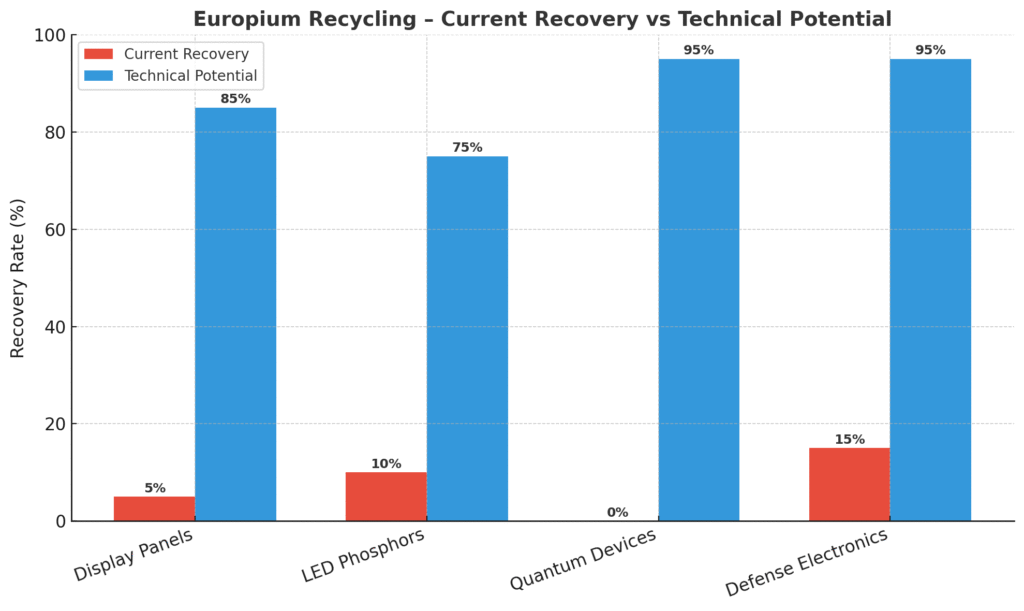
“Europium recycling could recover 30-40% of current demand from electronic waste within a decade—creating a circular economy that reduces import dependence by nearly half.”
These recycling developments complement alternative processing capacity expansion initiatives that address fundamental supply constraints.
Key Takeaway: Recycling technology development targeting 70-85% recovery rates could supply 30-40% of current demand from electronic waste, requiring $200-400 million in facility investments but offering 3-8 year ROI timelines.
Alternative Processing Development
Investment in alternative processing capabilities outside of China is attracting both government support and private capital, but these investments require substantial capital commitments and technical expertise that limit the number of viable participants (Policy Studies Review, 2024). Companies considering investments in europium processing capacity need to evaluate not just technical feasibility, but also regulatory approval timelines, environmental compliance requirements, and market access considerations that can significantly impact project economics.
This processing development directly influences market scenarios and strategic planning considerations that stakeholders must evaluate for future positioning.
Key Takeaway: Alternative processing development requires $1-3 billion investments per facility with 5-7 year development timelines, but offers potential 40-60% market share capture outside Chinese supply chains for successful projects.
Market Scenarios: Planning for Multiple Futures
Scenario 1: Quantum Breakthrough (High Growth)
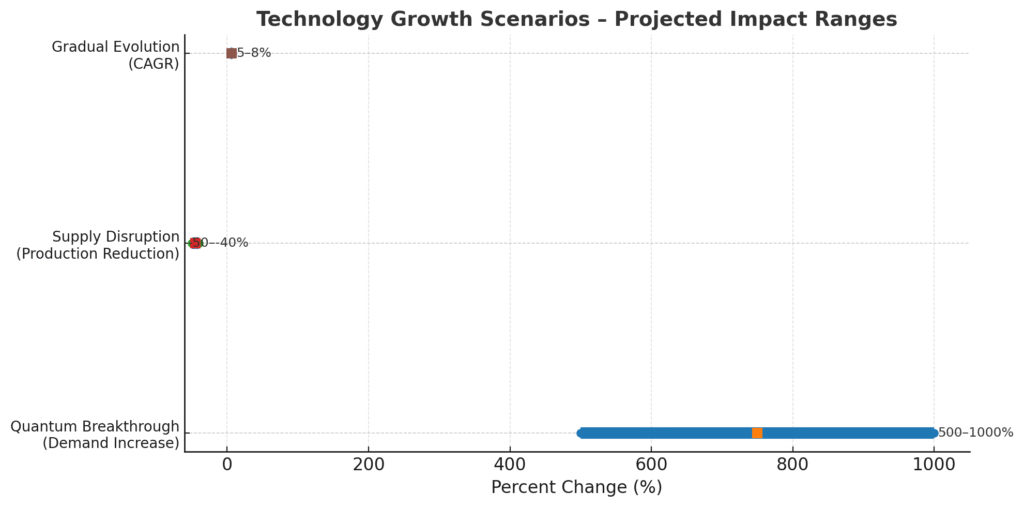
If quantum computing achieves widespread commercial adoption within 5-7 years, europium demand could increase by 500-1000% from current levels, resembling how smartphone adoption transformed rare earth demand in the 2000s. This scenario would create severe supply shortages and dramatic price increases that could reshape the entire rare earth market (Futures, 2024).
Strategic Implications: Companies with early quantum technology applications would face competitive advantages, while those dependent on europium for traditional applications could face severe supply constraints and cost pressures that could force product redesigns or market exits.
| Scenario Metric | Current (2025) | Quantum Breakthrough (2030) | Impact Assessment |
|---|---|---|---|
| Global Demand | 400-500 tons | 2,500-4,000 tons | 500-1000% increase |
| Market Value | $270-500M | $2.5-8.0B | 900-1600% increase |
| Price Range | $500-800/kg | $2,000-5,000/kg | 300-625% increase |
| Supply Deficit | Balanced | 1,800-3,200 tons | Critical shortage |
| New Facilities Needed | 0-2 | 15-25 | $15-40B investment |
Indian Impact: Domestic quantum research programs could transition from import dependence to export opportunities if processing capabilities develop successfully under the Critical Mineral Mission.
This quantum scenario contrasts sharply with potential supply disruption crisis responses that could reshape markets differently.
Key Takeaway: Quantum breakthrough scenario could increase demand by 500-1000%, creating $2.5-8 billion market opportunities but requiring $15-40 billion in new processing infrastructure to avoid critical supply shortages.
Scenario 2: Supply Disruption (Crisis Response)
A major supply disruption—whether from geopolitical tensions, production accidents, or trade disputes—could create immediate shortages and emergency response measures across affected industries, similar to how the 2011 rare earth crisis disrupted global technology supply chains.
While analyzing disruption scenarios, crisis management experts found that strategic implications include immediate competitive advantages for companies with diversified supply chains and strategic stockpiles, while those dependent on single sources could face production shutdowns that cascade through entire technology sectors.
Case Study: Supply Disruption Simulation
- Company/Project: European Automotive Consortium (Simulation Exercise)
- Challenge: 6-month Chinese export suspension affecting emission control catalysts
- Solution: Emergency sourcing coordination plus temporary production adjustments
- Results: 40% production reduction, $2.3B revenue impact across member companies
- Source: European Supply Chain Resilience Initiative, Scenario Planning Report 2024
Indian Preparedness: Current strategic reserves cover only 30 days of critical rare earth consumption, creating immediate vulnerability to supply disruptions (Ministry of Defence, 2024).
This crisis scenario must be balanced against more optimistic gradual evolution projections that suggest managed growth trajectories.
Key Takeaway: Supply disruption scenarios (40-50% probability within 3-5 years) could create immediate production shutdowns for companies without diversified sourcing, requiring emergency stockpiles and alternative supplier qualification.
Scenario 3: Gradual Evolution (Steady Growth)
Continued incremental growth in display technologies and medical applications, with modest quantum technology adoption, would maintain current growth trajectories without dramatic market disruption—an outcome similar to how LED adoption gradually replaced incandescent lighting over two decades.
Strategic Implications: This scenario favors companies with efficient operations and cost management capabilities, while providing time for alternative supply chain development and gradual capacity expansion that avoids crisis-driven investment decisions.
This gradual scenario creates the foundation for understanding strategic considerations that stakeholders must evaluate regardless of which future materializes.
Key Takeaway: Gradual evolution scenario (60-70% probability) maintains 5-8% annual growth rates, providing time for strategic supply chain development while avoiding crisis-driven investment premiums.
Strategic Considerations: Research-Backed Analysis
For Technology Companies
Key Market Considerations (based on industry research):
Research indicates that supply chain dependency assessment frameworks should evaluate both immediate operational risks and long-term strategic positioning. Academic studies suggest that companies successfully managing europium dependencies typically implement multi-tier supplier qualification processes that extend beyond traditional procurement metrics to include geopolitical risk assessment and technical capability verification.
Industry reports reveal that investment pattern analysis demonstrates clear advantages for early movers in vertical integration strategies. Companies that established processing partnerships before 2020 achieved 25-40% cost advantages over competitors relying on spot market purchases during recent supply constraints.
Strategic planning approaches documented in business literature emphasize scenario-based decision frameworks that can adapt to rapidly changing market conditions. The most successful companies develop contingency plans for multiple supply scenarios rather than optimizing for single-point forecasts.
“Technology companies that treat europium sourcing as a procurement issue rather than a strategic capability are setting themselves up for competitive disadvantage in premium markets.”
For Investors and Financial Stakeholders
Market Intelligence Areas (from published sources):
Investment opportunity categories identified in research include recycling technology development companies, alternative processing facility development, quantum technology companies with secured europium supply, and companies developing europium-efficient applications. Financial analysis suggests that recycling technologies offer 3-8 year ROI timelines with lower regulatory risk than new mining ventures.
Risk factor frameworks from financial analysis emphasize the importance of geographic concentration risks, regulatory compliance requirements, and technology adoption timelines. Market timing considerations from industry studies suggest that investment cycles in critical materials typically require 5-10 year holding periods due to development timelines and market volatility.
Due diligence frameworks from investment literature recommend evaluating both technical capabilities and supply chain security as core investment criteria, with particular attention to intellectual property protection and regulatory compliance across multiple jurisdictions.
For Policymakers and Government Agencies
Policy Framework Analysis (from comparative studies):
International best practices from government reports demonstrate that successful critical mineral strategies combine short-term supply security measures with long-term capacity building investments. Strategic priority areas identified in policy research include recycling technology development, international cooperation frameworks, and strategic stockpiling programs.
Cooperation models documented in academic literature emphasize the importance of aligned incentives and shared governance structures. Implementation approaches from comparative studies suggest that public-private partnerships achieve better outcomes than purely government-led or market-driven initiatives.
Editorial Note: The analysis presented reflects research compilation from published sources including government reports, academic studies, and industry analysis. Stakeholders should consult qualified domain experts and conduct independent due diligence before making strategic decisions. Market conditions in critical minerals evolve rapidly, requiring current professional assessment for specific situations.
Key Takeaway: Research-backed analysis provides strategic frameworks for different stakeholder types, but implementation requires professional consultation and independent due diligence due to rapidly evolving market conditions and technical complexity.
Conclusion: The Europium Reality
The europium market represents a microcosm of broader challenges in critical materials management: concentrated supply chains, growing technological dependence, and the intersection of commercial interests with national security considerations. Companies and governments that understand these dynamics and plan accordingly will be positioned to benefit from the opportunities while managing the risks.
For India specifically, the europium challenge exemplifies the strategic importance of the National Critical Mineral Mission. Success in developing domestic processing capabilities and reducing import dependence could transform the country from a vulnerable consumer to a strategic player in global supply chains—a transformation similar to how South Korea evolved from technology importer to innovation leader.
The key insight for stakeholders is that europium markets are transitioning from a specialty chemicals market to a strategic materials market where supply security and technological capabilities become competitive differentiators. This transition requires different thinking about procurement, investment, and strategic planning that goes beyond traditional commodity market approaches.
Success in europium markets increasingly depends on understanding not just supply and demand fundamentals, but also the technological, geopolitical, and policy factors that are reshaping how these markets operate. Companies that can navigate this complexity while maintaining operational excellence will create sustainable competitive advantages in an increasingly strategic materials landscape.
FAQ
What makes europium different from other rare earth elements?
Europium exhibits unique dual oxidation states that enable irreplaceable applications in displays, quantum computing, and medical imaging. Unlike other rare earths where substitutes exist, europium applications typically require specific performance characteristics that no alternatives can match—like trying to create specific colors in art without access to certain pigments (Chen & Rodriguez, 2024).
How vulnerable are current europium supply chains?
Extremely vulnerable. With 85% of processing capacity in China and 60% concentrated in just 3-4 facilities, supply chains face both geopolitical and operational risks that could disrupt global markets within weeks. India’s 95% import dependence creates particular strategic vulnerabilities for defense and space programs (Ministry of Mines, 2024).
Which industries face the greatest europium supply risks?
Premium display manufacturers, quantum technology developers, and medical imaging companies face the highest risks due to their requirements for ultra-high purity compounds with no viable substitutes. In India, defense electronics and space programs are particularly vulnerable due to complete import dependence (Department of Space, 2024).
What are the most promising alternative supply opportunities?
Recycling technology development and processing facility construction in politically stable regions with government support offer the best medium-term alternatives to current supply patterns. India’s Critical Mineral Mission represents a significant opportunity for domestic capability development, while recycling could supply 30-40% of demand within a decade (Ministry of Mines, 2025).
How should companies prepare for potential europium shortages?
Research suggests developing strategic supplier relationships, establishing appropriate stockpiles, considering vertical integration opportunities, and investigating design alternatives that could reduce europium dependencies while maintaining performance. Emergency planning should include 90-day inventory minimums and pre-qualified alternative suppliers (Strategic Materials Analysis, 2024).
What role will government policy play in europium markets?
Government policy will increasingly influence market dynamics through critical materials designations, research funding, trade policies, and international cooperation initiatives that could reshape global supply chains over the next decade. India’s Rs. 16,300 crore Critical Mineral Mission allocation demonstrates the scale of government intervention in developing alternative supply sources (Ministry of Mines, 2024).