Last Updated on August 21, 2025 by Hemanth
Table of Contents
🔎 30-Second Summary
You may not have heard of praseodymium, but it’s quietly powering the technology around us,from the magnets inside EV motors to the alloys used in jet engines and the green-tinted glass protecting welders’ eyes. This rare-earth metal punches far above its weight in modern engineering.
In this article, we’ll break down where praseodymium is used, why it’s so valuable, and how countries like China and India are shaping its future. We also explore real-world examples, like the Tesla Model 3, to show why this element is too important to ignore.
The Hidden Power Behind Modern Technology
A Powerful Yet Overlooked Element
An element that quietly powers wind turbines, aircraft engines, and electric vehicle motors, yet exists at just 9.1 parts per million in Earth’s crust — praseodymium uses stretch across critical industries while remaining virtually unknown to most people.
Despite being labelled a rare-earth metal, praseodymium actually ranks as the sixth-most abundant rare-earth element and fourth-most abundant lanthanide. Its “rarity” stems not from absolute scarcity but from its dispersed distribution compared to common minerals like lime and magnesia.
A Versatile Industrial Workhorse
This silvery-white metal’s versatility enables applications that would otherwise be impossible with conventional materials. Aircraft engines rely on praseodymium-magnesium alloys that deliver exceptional strength-to-weight ratios.
Wind turbines and electric vehicles depend on its role in high-intensity permanent magnets that provide superior torque and efficiency.
Catalytic converters use praseodymium oxide to enable cleaner emissions through enhanced redox chemistry. Even carbon arc lights in film studios incorporate this element for precise lighting control.
Small Use, Huge Significance
Praseodymium stands out not for how much we use, but for how critical even small amounts become in high-performance systems where substitution remains difficult or impossible. From aerospace defence systems to renewable energy infrastructure, this element bridges the gap between laboratory chemistry and industrial reality.
This is why India now classifies praseodymium among its officially recognized critical minerals. So why is something so important still so invisible? And why are countries like India now classifying it as “strategically vital” despite its geological abundance?
To find out, we need to explore praseodymium’s unique chemistry, its applications, and the fragile global supply chains that keep this metal quietly running the modern world.
Elemental Profile: What Makes Praseodymium Unique

Praseodymium (atomic number 59) occupies a special position in the lanthanide series, where its electron configuration of [Xe]4f³6s² creates properties that conventional metals simply cannot match.
The partially filled 4f orbital grants praseodymium its paramagnetic behaviour—a trait that proves essential in magnetic applications where other materials fail.
Unlike transition metals, praseodymium’s 4f electrons remain shielded deep within the atom, creating predictable chemical behaviour while maintaining unique magnetic properties. This electron arrangement also produces the characteristic lanthanide contraction, where atomic radius decreases across the series due to poor nuclear charge shielding by 4f electrons.
The element’s distinctive light absorption in the yellow-orange spectrum gives praseodymium compounds their recognisable green colour—a property that extends beyond aesthetics to practical applications in optical systems.
Thermal and Physical Properties
Praseodymium’s thermal conductivity of 12.5 W/mK positions it strategically between lead and stainless steel, enabling controlled heat transfer in precision applications. Its density of 6.77 g/cm³ delivers approximately 60% the weight of lead while offering superior performance characteristics.
The metal’s melting point of 931°C and boiling point of 3,520°C create an exceptionally wide working temperature range—crucial for applications in jet engines and catalytic systems where thermal stability determines performance limits.
Despite these robust thermal properties, praseodymium remains soft enough to cut with a knife at room temperature, facilitating processing into various industrial forms.
Redox Chemistry and Oxidation Versatility
One of praseodymium’s secret strengths is its flexible oxidation behavior. Most of the time, it exists in a stable +3 state (Pr³⁺), but it can also shift into a +4 state (especially in the oxide form PrO₂). This flexibility allows it to easily give and take electrons—a trait that’s crucial for making industrial catalysts work.
What really sets praseodymium apart is how it reacts with oxygen. Instead of rusting like iron does, it forms a greenish oxide layer that protects the metal underneath. This self-made shield stops further corrosion and helps components last longer—even in harsh environments like engine exhaust systems.
Most metals either rust away or resist oxygen altogether. Praseodymium hits a sweet spot: it controls oxidation in a way that boosts performance instead of destroying it. That’s why it’s a go-to material for things like emission control and fuel conversion technologies.
Key Takeaway: Praseodymium combines predictable chemistry with versatile redox behaviour, creating opportunities for precision engineering in magnetic, catalytic, and structural applications where conventional materials reach their limits.
Extraction and Processing from Rare Earth Ores
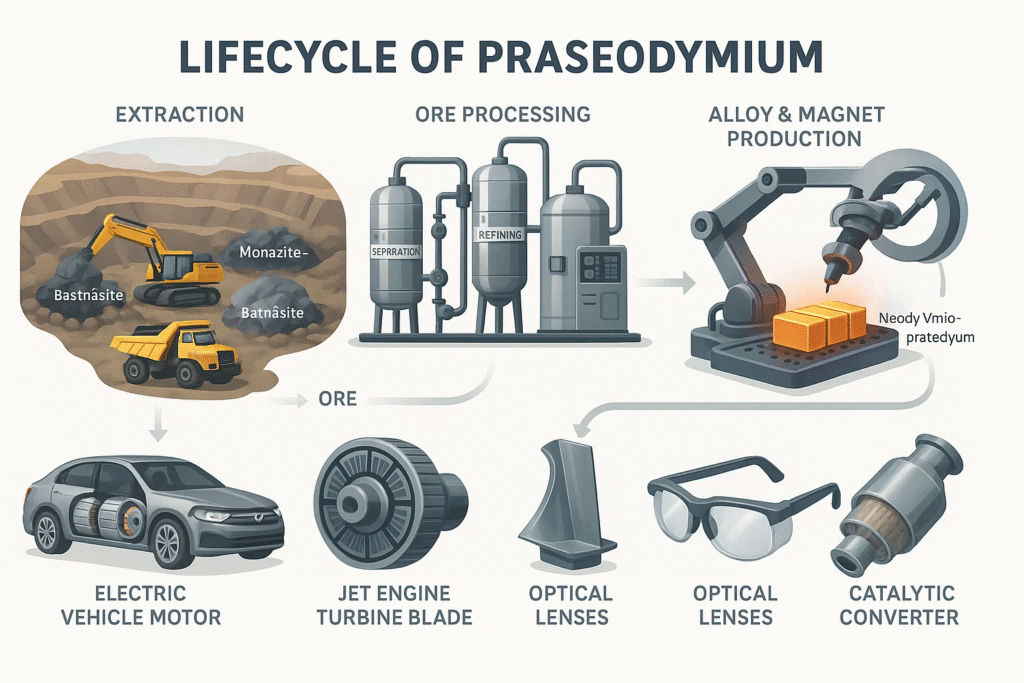
Transforming scattered atoms in mineral ores into pure praseodymium metal requires some of modern metallurgy’s most sophisticated chemical engineering. This element’s extraction demands precision at every stage—not because praseodymium is inherently difficult to work with, but because it shares nearly identical chemical behaviour with its lanthanide neighbours.
Source Minerals: Monazite and Bastnäsite
Praseodymium extraction begins with two primary mineral sources that contain complex mixtures of rare earth elements. Monazite and bastnäsite serve as the world’s main commercial sources, though neither provides praseodymium in isolation. These minerals concentrate in specific geological formations across China, Australia, India, and select regions in the Americas.
| Mineral | Chemical Formula | Pr Content | Primary Locations |
| Monazite | (Ce,La,Nd,Pr)PO₄ | 4-6% | India, Brazil, Australia |
| Bastnäsite | (Ce,La,Pr)CO₃F | 3-5% | China, USA, Vietnam |
The challenge becomes apparent when examining ore composition: praseodymium represents just 4-6% of monazite’s rare earth content, meaning a tonne of processed ore typically yields only 40-60 kg of mixed praseodymium compounds.
This low concentration, combined with the need for chemical separation from similar elements, drives up both processing costs and technical complexity.
Ion Exchange and Solvent Separation
Separation begins with crushing ore to 200-mesh particle size, followed by acid leaching using concentrated sulphuric acid at 200-250°C. This dissolves rare earth content while leaving silicate and phosphate gangue minerals largely untouched. The resulting rare earth solution then faces the industry’s most technically demanding challenge: separating chemically similar lanthanides.
Ion exchange processes exploit minute differences in how various rare earth ions bind to resin materials. Praseodymium (Pr³⁺) has an ionic radius of 0.99 Å, compared to neodymium’s 0.98 Å and cerium’s 1.01 Å—differences so small they require hundreds of sequential separation stages.
Solvent extraction further refines this separation using organic solvents that selectively complex with specific rare earth elements. Tributyl phosphate (TBP) and di(2-ethylhexyl)phosphoric acid (D2EHPA) serve as common extractants, each requiring precise pH control and multiple counter-current extraction stages.
Calcium Reduction of PrCl₃ to Metallic Form
Converting praseodymium compounds to metallic form employs calcium reduction of anhydrous praseodymium chloride. This metallothermic process occurs in sealed steel reactors under inert atmospheres to prevent oxidation:
2PrCl₃ + 3Ca → 2Pr + 3CaCl₂
Reaction temperatures reach 1000°C, generating sufficient heat to melt the products and enable separation of metallic praseodymium from calcium chloride slag. The process requires precise temperature control—too low and the reaction remains incomplete, too high and product quality suffers through volatilisation losses.
Electrolysis of PrF₃ for High-Purity Applications
Applications demanding ultra-high purity employ molten salt electrolysis of praseodymium fluoride (PrF₃). Operating at 1000-1100°C in fluoride salt baths, this process deposits pure praseodymium metal at graphite cathodes while liberating fluorine gas at anodes.
Electrolytic reduction achieves purities exceeding 99.9%—essential for permanent magnet applications where trace impurities can significantly degrade magnetic properties. However, the process consumes approximately 13-15 kWh per kilogram of praseodymium produced, making it economically viable only for high-value applications.
Key Takeaway:
The multi-stage refinement of praseodymium exemplifies how subtle chemical differences create major industrial challenges. Each separation step adds cost and complexity, yet remains necessary to produce materials that meet stringent performance specifications.This processing intensity partly explains why praseodymium supply chains remain concentrated in countries with established rare earth expertise and infrastructure.
These refined materials then enable praseodymium’s most strategically important application: permanent magnets that power electric vehicles, wind turbines, and countless electronic devices essential to modern life.
Advanced Magnetics: Motors, Turbines, and Cryogenics
“Because of its magnetic and alloy-enhancing properties, praseodymium plays a critical role in the green energy transition, high-speed transport, and next-gen electronics. It’s a metal that punches well above its weight.” — Strategic Metals Invest Editorial Team, Industry analysts specialising in rare earths and strategic metals
Praseodymium’s magnetic properties drive some of today’s most critical energy technologies. From electric vehicle motors to offshore wind generators, this element enables magnetic performance that conventional materials simply cannot match.
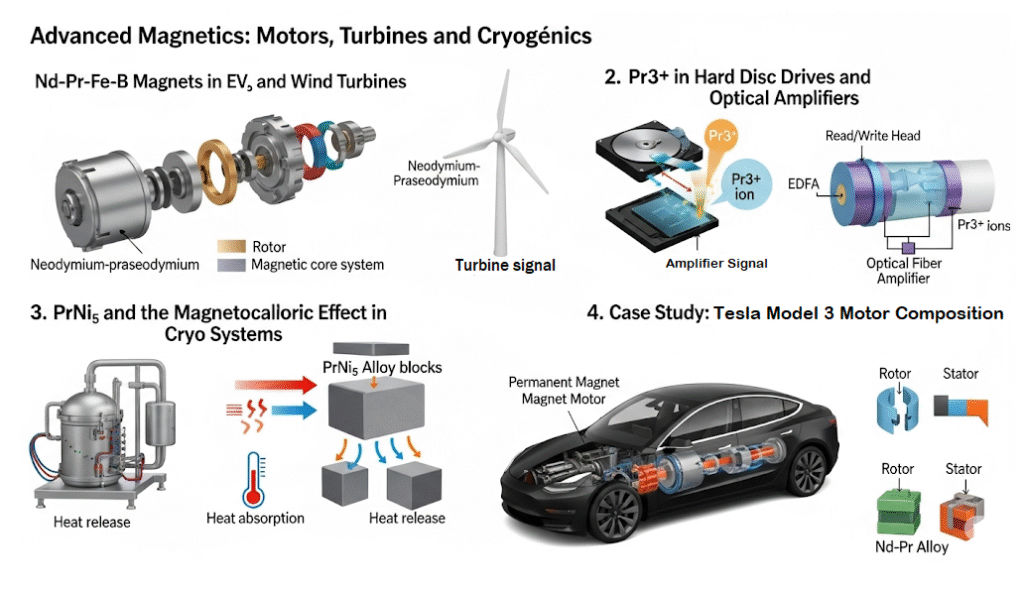
Nd-Pr-Fe-B Magnets in EVs and Wind Turbines
Neodymium-praseodymium-iron-boron (Nd-Pr-Fe-B) magnets represent the backbone of clean energy systems. Praseodymium typically replaces 25-30% of neodymium content, delivering superior magnetic performance while reducing material costs. A standard electric vehicle motor requires approximately 2kg of these magnets, containing roughly 750g of combined neodymium/praseodymium oxide, two of the most essential critical rare earth elements used across the clean energy sector. At high operating temperatures, these magnets depend on dysprosium for thermal stability—a critical pairing in electric mobility.
Market dynamics shifted dramatically when Tesla adopted permanent magnets for the Model 3 in 2018, which “completely changed the dynamics of the market” according to industry analysts.
The performance advantages proved decisive—by 2021, over 92% of electric vehicles used permanent magnet synchronous motors (PMSM). Rare earth magnet adoption accelerated in electric vehicles, particularly after Tesla’s strategic shift.
Wind power follows the same trajectory. Permanent magnet generators now power 76% of offshore installations and 32% of land-based turbines. To maintain magnetic strength in these high-output turbines, dysprosium is often added to prevent demagnetization under heat and load stress. The scale of demand creates supply pressure: when EV sales reach 10 million annually, the industry will need an additional 16,500 tonnes of rare earth oxides—a 35% increase over current global production.
Pr³⁺ Role in Hard Disc Drives and Optical Amplifiers
The Pr³⁺ ion delivers unique optical properties that enable specialised applications in data storage and telecommunications. These compounds exploit praseodymium’s distinctive light absorption and emission characteristics for precision optical systems.
PrNi₅ and the Magnetocaloric Effect in Cryo Systems
Praseodymium-nickel alloy (PrNi₅) exhibits an extraordinary magnetocaloric effect—materials that change temperature when exposed to magnetic fields. This property makes PrNi₅ invaluable for ultra-low temperature refrigeration, enabling scientists to reach within one thousandth of a degree of absolute zero.
The mechanism works through magnetic domain alignment: magnetisation heats the material as domains align, while demagnetisation cools it as domains randomise. This enables magnetic refrigeration without conventional refrigerants—critical for scientific applications requiring extreme precision.
Case Study: Tesla Model 3 Motor Composition
Company / Project: Tesla Model 3 Long Range
Challenge: Designing an efficient motor without excessive rare earth use
Solution: Permanent magnet motor using neodymium–praseodymium (Nd‑Pr) compounds
Results:
- Higher power density
- Greater efficiency and acceleration
- Extended vehicle range
- Sparked a 40% price spike in neodymium in 2017
Impact:
Tesla’s pivot from induction motors (Model S/X) to permanent magnet designs in the Model 3 triggered a significant shift in EV drivetrain architecture. This move placed upward pressure on rare earth markets, where demand for neodymium already exceeded supply by 3,300 tonnes as of 2017 (Reuters, 2018).
Why This Matters:
Tesla’s decision set a new industry benchmark. By 2021, over 92% of EVs globally had adopted permanent magnet synchronous motors (PMSM), validating the performance advantage—and exposing strategic weaknesses in rare earth supply chains.
Key Takeaway:
The Tesla Model 3 case underscores how a single design choice can reshape global material demand, validate the strategic value of elements like praseodymium, and accelerate supply chain vulnerability in critical minerals.
Aerospace and Structural Alloys
Praseodymium’s most impressive engineering contribution lies in its ability to enhance lightweight structural materials where every gram matters. Aerospace demands materials that deliver maximum strength while minimising weight—a challenge where this rare earth element proves indispensable.
Pr-Mg Alloys for Jet Engines and Automotive Parts
Adding praseodymium to magnesium creates high-strength alloys that surpass conventional materials in demanding aerospace environments. Just 1 wt.% praseodymium added to ZRE1 magnesium alloy hardness increases significantly from 47 HV to 58.5 HV. This dramatic improvement occurs through grain refinement, with praseodymium reducing grain size by approximately 37%.
A mere 1% praseodymium addition transforms magnesium’s microstructure, creating alloys that maintain structural integrity at temperatures reaching 250°C—critical for jet engine components operating under extreme thermal stress. Similar lightweight performance alloys using beryllium have seen comparable adoption in defense and aerospace.
These enhanced materials extend beyond aerospace into automotive applications where lightweight construction directly translates to fuel efficiency and performance. Yet aircraft engines represent where these alloys achieve their greatest impact.
Corrosion Resistance in High-Temperature Environments
Standard magnesium alloys fail in harsh environments, but praseodymium-modified versions demonstrate exceptional corrosion resistance. Research confirms that praseodymium-rich oxide layers on magnesium surfaces act as effective barriers against environmental degradation. This protective capability makes these alloys valuable in hostile operating conditions where conventional materials would deteriorate rapidly.
| Alloy Type | Temperature Resistance | Corrosion Performance | Primary Applications |
| Standard Mg | Up to 150°C | Poor in saltwater | Limited aerospace use |
| Pr-Mg | Up to 250°C | Enhanced in aggressive environments | Engine components, transmission casings |
| Elektron 21 (Pr-containing) | Up to 200°C | Superior in saltwater | Aircraft applications, non-primary structures |
Case Study: Airbus A320 Engine Alloy Design
Company / Project: Airbus Commercial Aircraft
Challenge: Identify lightweight, high-performance alloys for non-primary aircraft components
Solution: Airbus evaluated magnesium alloys Elektron 21 and Elektron WE43, both containing praseodymium-based rare earths.
Results: Airbus approved the use of these alloys on the A380 for non-primary structural applications, following rigorous performance and fire-safety testing (FAA, 2007).
These alloys deliver approximately 30% weight savings over conventional aluminum components while offering mechanical stability at temperatures up to 200 °C (Luxfer MEL Technologies). Their corrosion resistance and thermal performance make them ideal for aerospace environments where material fatigue and fuel efficiency are critical concerns.
Impact:
This shift demonstrates industry confidence in praseodymium-enhanced magnesium alloys as viable, high-performance alternatives. Their adoption marks a move toward lighter, safer, and more efficient aircraft construction.
Why This Matters:
Weight reduction directly translates to lower fuel consumption and reduced emissions. Praseodymium enables the balance between strength and weight, supporting aerospace goals for cleaner, more efficient flight.
Key Takeaway:
Praseodymium plays a critical role in advancing next-generation structural alloys, enabling lighter aircraft designs without compromising performance or safety.
Catalysts in Emission Control and Green Chemistry

Praseodymium’s redox chemistry creates catalytic capabilities that conventional materials cannot match. Its ability to switch between oxidation states enables cleaner combustion, more efficient chemical processes, and breakthrough solutions for carbon reduction.
Pr₆O₁₁ as a Redox Catalyst in Auto Exhaust Systems
Praseodymium oxide (Pr₆O₁₁) delivers exceptional performance in automotive emission control through its superior oxygen storage and release capacity. The element’s ability to shift between Pr³⁺ and Pr⁴⁺ oxidation states creates a natural oxygen buffer that transforms harmful exhaust gases into less toxic compounds. Pr₆O₁₁ possesses the highest oxygen mobility among all undoped rare earth oxides, surpassing even cerium dioxide in catalytic efficiency.
The binding energy of adsorbed oxygen in Pr₆O₁₁ sits lower than that of CeO₂, enabling faster desorption of active oxygen species crucial for catalytic reactions. This property translates directly into better emission control performance.
Modern three-way catalytic converters incorporating praseodymium-containing formulations achieve oxygen storage capacities of 850-1,000 μmol O₂/g—significantly higher than conventional cerium-zirconium catalysts that manage only 200-350 μmol O₂/g.
This performance difference enables more complete conversion of carbon monoxide, nitrogen oxides, and unburned hydrocarbons.
Pr-Based Catalysts in CO₂ Reduction and Cracking Reactions
Carbon dioxide reduction presents one of chemistry’s most challenging problems, yet praseodymium catalysts show remarkable promise. Recent studies on rare earth praseodymium single-atom catalysts achieve faradaic efficiency for CO production up to 93% at low potentials, whilst maintaining over 83% efficiency after 12 hours of continuous operation.
Hydrocarbon processing applications demonstrate similar excellence. Praseodymium oxide-supported alumina catalysts achieve conversion rates of approximately 92% in waste cooking oil cracking at 350°C.
This performance enables biofuel production that meets international fossil fuel specifications without requiring additives.
Synergy with Ceria and Zirconia in Fuel Refining
The most effective catalytic formulations combine praseodymium with cerium and zirconium oxides, creating synergistic effects that surpass individual component performance. These mixed-oxide systems deliver:
| Property | Function | Benefit |
| Pr³⁺/Pr⁴⁺ redox pairs | Enhanced oxygen mobility | Improved catalytic oxidation |
| Zr⁴⁺ addition | Thermal stability | Operating temperatures up to 1050°C |
| Ce-Pr interaction | Lower binding energy of oxygen | Enhanced reaction rates |
Key Takeaway:
Praseodymium’s redox versatility enables breakthrough performance in emission control and green chemistry applications, where its ability to cycle between oxidation states creates catalytic efficiency unmatched by conventional materials.
Energy Storage and Fuel Cell Potential
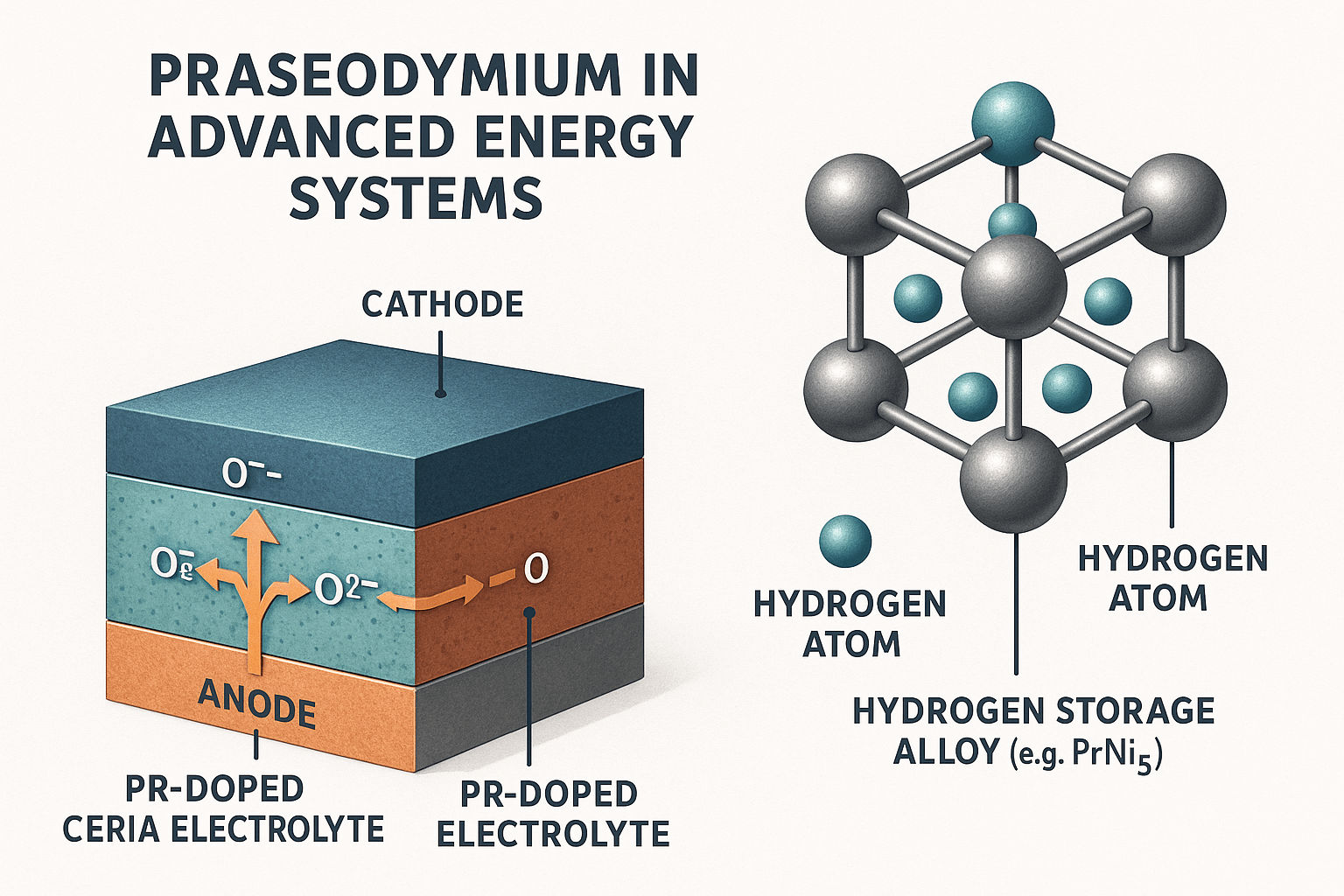
Praseodymium’s electrochemical properties enable breakthrough performance in next-generation energy systems where conventional materials fall short. While permanent magnets capture headlines, this element’s role in fuel cells and hydrogen storage represents equally critical applications for the clean energy transition.
Pr-Doped Ceramics in Solid Oxide Fuel Cells (SOFCs)
Solid oxide fuel cells convert chemical energy directly into electricity through high-temperature electrochemical reactions. Praseodymium doping transforms the performance of these systems by fundamentally altering oxygen vacancy formation in perovskite materials.
When incorporated into Bi₀.₈Sr₀.₂FeO₃, praseodymium creates Bi₀.₆Pr₀.₂Sr₀.₂FeO₃-δ compositions that achieve polarisation resistance of just 0.043 Ω cm² at 700°C—the lowest among comparable formulations.
The mechanism involves praseodymium’s ability to lower oxygen vacancy formation energy at the molecular level, enabling faster oxygen ion transport through the ceramic structure.
Iron-based perovskites containing praseodymium consistently demonstrate the highest electrical conductivity amongst rare-earth-doped variants.
Fuel cells incorporating Pr-doped cathodes deliver power densities reaching 761 mW cm⁻² at 700°C while maintaining stability and CO₂ resistance over extended operation.
| Material | Polarisation Resistance | Max Power Density | Temperature |
| Standard Bi₀.₈Sr₀.₂FeO₃ | Higher | Lower | 700°C |
| Pr-doped Bi₀.₆Pr₀.₂Sr₀.₂FeO₃-δ | 0.043 Ω cm² | 761 mW cm⁻² | 700°C |
Hydrogen Storage in Intermetallic Alloys
Hydrogen storage capacity improves dramatically when praseodymium substitutes for cerium in mischmetal alloys. The element reduces hysteresis loops and widens plateau pressure regions during hydrogen absorption-desorption cycles. Mm₀.₈Pr₀.₂Ni₃.₅₅Co₀.₇₅Mn₀.₄Al₀.₃ alloys achieve hydrogen storage capacity of 1.1 wt% at standard conditions—a significant improvement for automotive and stationary storage applications.
Electrochemical performance scales with praseodymium content. Discharge capacities increase from 156 mAh g⁻¹ for unmodified alloys to 217 mAh g⁻¹ with 20% praseodymium substitution. This 39% improvement demonstrates praseodymium’s effectiveness in enhancing both storage capacity and cycling performance.
Key Takeaway:
Praseodymium enables higher-efficiency fuel cells and improved hydrogen storage—two technologies essential for renewable energy integration and grid-scale storage solutions.
As the energy transition accelerates, these applications may become as strategically important as the element’s role in permanent magnets.
Praseodymium in Nuclear Technology
Beyond its role in clean energy and hydrogen storage systems, praseodymium also finds applications in the nuclear sector — a critical component of global energy security strategies. While its contribution is more specialized compared to its use in fuel cells or catalysts, praseodymium’s properties make it valuable in environments where extreme heat, radiation, and long-term stability are non-negotiable. These qualities position it as a discreet yet important player in both civilian nuclear energy and high-security defense programs.
Structural Alloys for Reactor Environments
Alloys of praseodymium with magnesium or zirconium offer exceptional resistance to corrosion under high-temperature, high-radiation conditions. These materials are used in select structural components inside nuclear reactors, where operational reliability over extended service periods is vital. The combination of mechanical strength and thermal stability helps ensure safe, consistent performance even in the most demanding environments.
Specialty Glass for Shielding and Optics
Praseodymium oxide is incorporated into radiation-shielding glass for reactor control rooms, hot cells, and nuclear research facilities. Its unique optical properties also enhance the performance of precision instrumentation and monitoring systems, enabling accurate measurements in high-radiation zones. This role is crucial for both operational safety and scientific data integrity.
“In nuclear systems, praseodymium works quietly behind the scenes — protecting, stabilizing, and enhancing performance where other materials fall short.”
Key Takeaway: Praseodymium’s role in nuclear technology lies in specialized alloys and optical systems that improve safety, reliability, and performance in extreme conditions. While niche, these applications strengthen the element’s profile as a material of strategic importance in the global energy landscape.
Glass, Ceramics, and Pigments
“Praseodymium may not be a household name, but it’s everywhere; from high-strength magnets in your headphones to the coloured glass in your welding goggles. It helps improve the performance of metal alloys and strengthens aircraft turbine blades.”
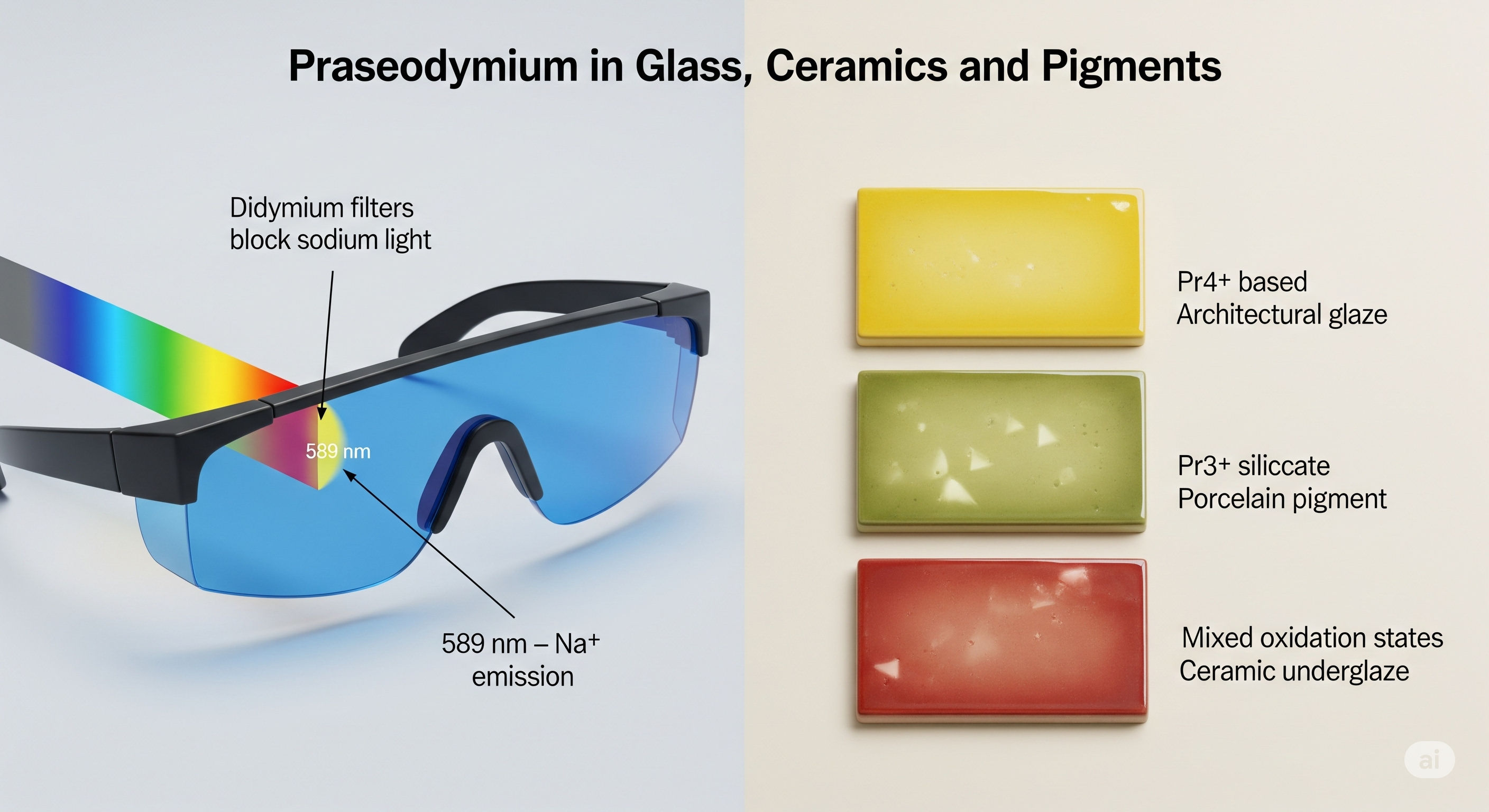
Praseodymium’s optical properties reveal themselves in unexpected places. Professional glassblowing studios, ceramic workshops, and specialised safety equipment all depend on this element’s ability to interact with light in ways that conventional materials simply cannot match.
Didymium Safety Glass: Filtering Danger at 589 nm
Glassblowers and welders face a specific challenge that praseodymium oxide uniquely solves. When sodium-containing glass reaches high temperatures, it emits intense yellow light at 589 nm that blinds workers and obscures their view of molten materials. Didymium glass, containing praseodymium oxide, selectively blocks this wavelength while allowing other colours to pass through.
Sir William Crookes discovered this protective capability, creating a safety standard that persists across industries involving intense heat and light.
Unlike conventional dark welding glasses that reduce overall visibility, didymium glass enables workers to observe true colours of heated materials—essential for judging temperature and workability.
This selective filtration demonstrates praseodymium’s precision in optical applications. The element doesn’t simply darken glass; it targets specific wavelengths that cause problems while preserving visual information that workers need.
Laser and Optical Communications
Praseodymium ions (Pr³⁺) support an unusually wide emission range—from visible green (520–540 nm) to near-infrared around 1.3 μm. This makes them one of the few rare earth elements able to cover both medical and telecom bands.
In healthcare, Pr³⁺ lasers are used in surgical and dental procedures where precision and controlled wavelengths are essential. In telecommunications, they serve as efficient sources near the 1.3 μm window, complementing erbium-doped fibre amplifiers to keep long-haul networks running at high speeds.
Pr³⁺ lasers also improve accuracy in spectroscopy and metrology, where stable narrow emissions enable scientists and engineers to measure materials with extreme precision.
Yellow Pigments: Replacing Toxic Alternatives
Ceramic manufacturers have found praseodymium particularly valuable as environmental regulations restrict traditional yellow pigments. Yellow consumption exceeds that of any other coloured pigment in ceramics, creating substantial demand for alternatives. Praseodymium zircon pigments deliver exceptional tinting strength and compatibility with glazes.
The transition gained urgency as lead antimonate (Pb₂Sb₂O₇), lead chromate (PbCrO₄), and cadmium sulphide (CdS) faced restrictions due to toxicity concerns. Antimony-based compounds face similar environmental scrutiny, which makes praseodymium-based pigments a sustainable upgrade.
Praseodymium zircon yellow now dominates applications previously served by vanadium-tin oxide and vanadium-zirconia yellows, offering more intense and reproducible colours.
| Property | Praseodymium | Neodymium |
| Colour effect | Yellow-green hue | Purple-blue tint |
| Primary applications | Glassblower goggles, ceramic pigments | Photography philtres, lasers |
| Light filtering | Absorbs yellow sodium flare (589 nm) | Enhances contrast, vibrance |
| Special characteristic | Creates “Heliolite” colour-changing glass | Used in high-power laser systems |
The shift illustrates how rare earth elements often replace hazardous materials in industrial applications. Praseodymium’s optical properties provide safer alternatives without compromising performance—a pattern repeated across multiple industries seeking both functionality and regulatory compliance.
Key Takeaway: Praseodymium’s optical versatility extends far beyond niche applications. From filtering harmful sodium light in protective glasses to powering precision lasers and creating safer ceramic pigments, it demonstrates how a single rare earth element can shape safety, technology, and design in everyday life.
Supply, Availability, and Strategic Importance
Praseodymium’s supply chain mirrors that of antimony and other critical minerals—geographically concentrated, politically sensitive, and increasingly vital to technological infrastructure worldwide.
Crustal Abundance vs Accessible Supply
Though praseodymium occurs at 9.2 parts per million in Earth’s crust—making it the fourth most abundant lanthanide after cerium, neodymium, and lanthanum—its supply picture tells a different story. Like many critical minerals, praseodymium’s challenge lies not in geological scarcity but in the complex economics and geopolitics of extraction and processing.
The element’s abundance exceeds familiar metals like tin and uranium, yet its dispersed distribution and demanding separation processes create supply bottlenecks that belie its crustal prevalence.
China’s Overwhelming Market Control
China dominates global praseodymium production with approximately 70% of worldwide mining output and an astonishing 89% of neodymium and praseodymium processing capacity. This control extends across the entire value chain—from raw material extraction to finished magnet manufacturing—creating a strategic chokepoint for industries dependent on high-performance magnets. A similar chokepoint exists in europium supply chains, where dependence on limited producers has long shaped global availability.
Other producers like Australia, the United States, Russia, India, and Vietnam operate at considerably smaller scales, leaving global supply vulnerable to decisions made in Beijing.
| Country | Mining Share | Processing Share | Strategic Position |
| China | 70% | 89% | Complete value chain dominance |
| United States | 11.5% | Limited | Mountain Pass mine operations |
| Australia | Growing | Limited | Lynas rare earth processing |
| Russia | Growing | Limited | Strategic reserve development |
Strategic Stockpiling and Supply Security
Recognition of supply vulnerabilities has prompted several nations to establish strategic reserves. Japan began stockpiling rare earths through JOGMEC in the 1980s, whilst South Korea expanded public reserves through its “Industrial Supply Chain 3050 Strategy”. The United States maintains a National Defence Stockpile for materials critical to defence applications.
These measures gained urgency after China’s 2010 export restrictions to Japan during territorial disputes—a wake-up call that drove Japan to reduce its rare earth dependency from nearly 100% to 58% by 2018.
Supply Risk Assessment
The British Geological Survey places rare earth elements at the top of its supply risk list, reflecting praseodymium’s critical status. This assessment weighs geopolitical factors, production concentration, and the environmental complexity of processing operations.
Recent events have validated these concerns. When China implemented export controls on seven rare earths in April 2024, processing delays stretched export licences to 45 days, effectively halting global exports for over two months. The disruption accelerated international interest in developing alternative supply chains outside Chinese control.
Case Study: Export Control Impact on Global Rare Earth Supply
Challenge:
In April 2025, China placed seven rare earth elements—including key REEs and magnets—under export control, requiring exporters to obtain licenses for shipments abroad (Reuters, Apr 4 2025)
Impact:
Licensing delays of up to 45 days led shipments to “grind to a halt,” with rare earth exports dropping for about two months. Magnet shipments slumped roughly 75%, forcing automakers to pause production lines in Asia, Europe, and North America (Reuters, Jun 27 2025)
Response:
Global companies and governments reacted by ramping up investment in non-Chinese rare earth processing—especially across the U.S., Europe, Australia, and India. Stockpiling initiatives and supply chain diversification efforts intensified in direct response (Reuters, Jun 5 2025)
Why This Matters:
This event underscored how rare earths—particularly elements like praseodymium—are not just raw materials, but strategic levers. Countries reliant on Chinese supply chains face real economic and national security risks when access is restricted. For the clean energy transition to succeed, resilient and diversified rare earth infrastructure is no longer optional—it’s essential.
Key Takeaway:
Despite praseodymium’s geological availability, its refinement remains heavily concentrated. As this case shows, control over processing—not just mining—defines who leads or lags in the global race toward electrification and green technology.
India’s Strategic Position in the Praseodymium Value Chain
Despite holding 6.9 million tonnes of rare earth oxide reserves—approximately 5.8% of global reserves—India produces less than 1% of worldwide rare earth output. Despite this, India includes praseodymium in its critical minerals of India framework, recognizing its future importance.
This stark disconnect between geological endowment and market reality positions India as a sleeping giant in the praseodymium sector, possessing substantial untapped potential while remaining strategically vulnerable to supply disruptions.
Monazite Reserves: Concentrated Coastal Wealth
India’s praseodymium potential lies primarily within monazite deposits concentrated along the coastal regions of Kerala (Chavara) and Odisha (Chhatrapur), with additional reserves identified in Tamil Nadu and Andhra Pradesh.
These monazite sands contain 0.5-0.7% praseodymium oxide, meaning a typical tonne yields approximately 4-5 kg of praseodymium oxide—modest concentrations that require sophisticated separation techniques to become commercially viable.
Prior to China’s market dominance, India was the world’s largest rare earth producer until the 1950s, demonstrating that the country once possessed both the geological resources and processing capabilities to lead global supply.
IREL’s Limited Processing Capacity
Indian Rare Earths Limited (IREL), operating under the Department of Atomic Energy, currently processes approximately 10,000 tonnes of monazite annually, producing mixed rare earth chlorides and carbonates rather than separated individual elements.
This basic processing approach leaves India unable to capture the higher value-added segments of the praseodymium value chain. The broader challenges in rare earth extraction in India stem from gaps in technology and capital.
| Processing Stage | India’s Capability | Market Value | Strategic Gap |
| Mining | ✓ Established | Low | None |
| Basic Processing | ✓ Limited scale | Medium | Capacity constraints |
| Element Separation | ✗ Absent | High | Critical technology gap |
| Finished Products | ✗ Absent | Highest | Complete dependency |
Policy Framework: KABIL and Critical Minerals Strategy 2023
The establishment of Khanij Bidesh India Limited (KABIL) in 2019 marked a strategic shift toward securing overseas critical mineral sources. More significantly, the Critical Minerals Strategy 2023 identifies rare earth elements, including praseodymium, as essential for economic development and national security.
This strategy outlines ambitious targets: doubling monazite processing to 20,000 tonnes annually by 2030 while developing full-spectrum separation capabilities.
Yet policy ambitions face substantial implementation challenges. The regulatory framework surrounding monazite processing remains complex due to its thorium content, which falls under atomic minerals regulations.
Additionally, India lacks the advanced separation technology needed to isolate individual rare earth elements at commercially viable scales.
Breaking Through the Technology Barrier
The capital intensity and environmental management requirements create significant barriers for private sector participation. Unlike China’s integrated approach, India’s rare earth sector remains fragmented between government-controlled mining and absent downstream processing.
Recent developments offer more promising pathways. The Andhra Pradesh Rare Earth Exploration project, developed through strategic collaboration with Australian technical expertise, has identified 7,555 tonnes of rare earth oxide reserves.
This initiative could establish India’s first commercial-scale rare earth processing facility outside IREL’s current operations.
Case Study: Technology Transfer and Strategic Partnerships
Challenge:
Develop economically viable technology for praseodymium separation and processing.
Approach:
India is pursuing joint exploration and technology partnerships with Australia and other nations to strengthen its rare earth ecosystem (Times of India, Jul 2025).
Early Results:
Explorations along Andhra Pradesh’s eastern coast have identified commercially promising rare earth deposits, including praseodymium-rich monazite sands (ResearchGate).
Strategic Implications:
Successful partnerships could position India to build its first integrated rare earth value chain, spanning extraction to refined materials (South Asia Voices, 2023; ORF, 2023).
Why This Matters:
India’s geological endowment—estimated at 6.9 Mt REO—translates into strategic advantage only if it can overcome regulatory hurdles, attract investment, and secure advanced separation tech.
Key Takeaway:
India possesses the raw materials to be a major praseodymium supplier, but fulfilling that potential requires policy clarity, financial incentives, and international technology collaboration—making this the country’s biggest opportunity and vulnerability in critical minerals.
Conclusion: From Element to Leverage Point
Praseodymium may only appear in grams inside the technologies we rely on—but its absence would disrupt entire industries. What makes it strategic is not how much we use, but how hard it is to replace. As countries scramble to localize supply chains and hedge against geopolitical risk, praseodymium becomes more than a material—it becomes leverage.
The real story is not just about chemistry or scarcity. It’s about who controls the bottlenecks, who can refine beyond the ore, and who will lead in tomorrow’s energy and defense systems. For India, bridging the gap between geological wealth and industrial capability is not just a mining challenge—it’s a national opportunity.
As you trace the supply chain from monazite sands to EV rotors and fuel cells, one truth becomes clear: rare earths like praseodymium don’t just shape magnets—they shape the balance of power.
What do you think?
Do you see India emerging as a major rare earth hub? What parts of the praseodymium value chain should we explore next—recycling, refining, or applications?
FAQs
Q1. What are the main industrial applications of praseodymium? P
raseodymium is primarily used in creating high-strength alloys for aircraft engines, permanent magnets for electric motors and wind turbines, and as a component in catalytic converters for emission control. It’s also utilised in speciality glasses and ceramics for optical applications.
Q2. How does praseodymium contribute to green energy technologies?
Praseodymium is a crucial component in the powerful Nd-Pr-Fe-B magnets used in electric vehicle motors and wind turbine generators. It also enhances the performance of solid oxide fuel cells and improves hydrogen storage capabilities in certain alloys, supporting the transition to cleaner energy systems.
Q3. What role does praseodymium play in advanced electronics?
In electronics, praseodymium is used in the production of fibre optic cables, enhancing signal transmission. It’s also found in certain types of lasers and in the magnets used in hard disc drives, contributing to data storage and processing technologies.
Q4. How is praseodymium used in the aerospace industry?
Praseodymium is added to magnesium alloys to create high-strength, lightweight materials used in aircraft engines and other aerospace components. These alloys offer improved hardness, corrosion resistance, and thermal stability, making them ideal for demanding aerospace applications.
Q5. What are the unique optical properties of praseodymium oxide?
Praseodymium oxide is used in the production of specialised safety glasses, particularly for welding goggles. It selectively philtres out the intense yellow light emitted by hot sodium, protecting workers’ eyes while allowing them to see other colours clearly. Additionally, it’s used as a yellow-green pigment in ceramics, glass, and enamels.