![The Surprising Truth About Beryllium Applications in Modern Technology [2025 Guide]](https://ik.imagekit.io/lxsotwajc/wpmedia/wp-content/uploads/2025/06/featured-Image3-1280x640.webp)
Last Updated on September 2, 2025 by Hemanth
Table of Contents
Beryllium is a lightweight yet incredibly strong metal that plays an outsized role in aerospace, defense, and advanced electronics. Its stiffness, thermal stability, and transparency to X-rays make it indispensable in satellites, fighter jets, nuclear reactors, and medical imaging devices.
This article explores beryllium’s unique properties, industrial and technological applications, and India’s position in processing and supply. It also examines safety and toxicity challenges, showing why this critical mineral is both a powerful enabler and a material that demands caution.
Ever wonder what makes a smartphone so tiny yet powerful, or how a space telescope can see billions of miles away? Often, the secret lies in a hidden element called Beryllium (Be). This isn’t your average metal; it’s a true marvel of material science, and its unique atomic structure gives it some incredible abilities.
Beryllium applications span a range of industries—medical imaging, aerospace systems, defence electronics, and high-performance alloys, where precision and reliability are non-negotiable.
Despite being one of the least talked-about elements, beryllium plays an outsized role in modern technology, quietly empowering industries that demand high-performance materials.
Lightweight yet remarkably strong, thermally conductive yet stable, beryllium’s properties are unlike any other element. That versatility enables beryllium to quietly power everything from flame-retardant plastics to precision alloys and medical compounds, often without being noticed by the end user.
India’s 2023 list of critical minerals places beryllium squarely in the spotlight, not just for its economic value but for its strategic role in defence, aerospace, electronics, and nuclear programmes. The stakes are high, and supply is tight. To truly understand why beryllium matters, we must look at what makes it unique, where it comes from, and how it shapes the world we live in.
What Makes Beryllium Unique
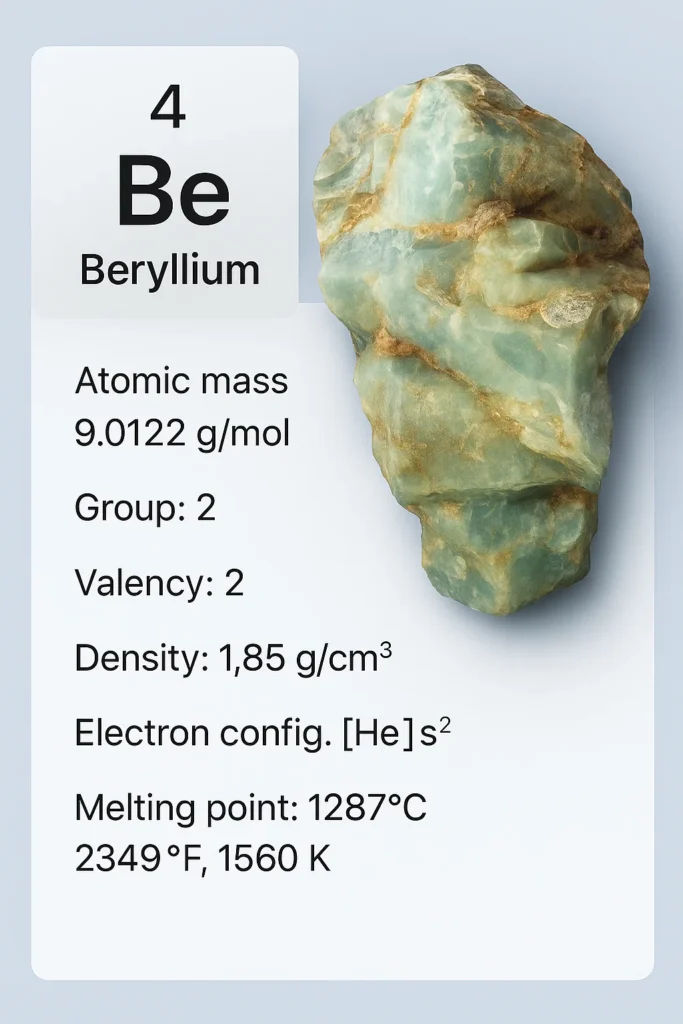
Beryllium (chemical symbol Be, atomic number 4) may be small on the periodic table, but its properties pack a serious punch. It is one of the rarest elements in Earth’s crust, occurring at an average concentration of just 0.0002% by weight (2 ppm).
Unlike more common industrial metals, it’s not found in pure metallic form. Instead, it occurs in trace amounts within mineral ores. The most significant sources include:
- Beryl (Be₃Al₂Si₆O₁₈): A hexagonal crystal also found in gemstones like emerald and aquamarine.
- Bertrandite (Be₄Si₂O₇(OH)₂): A softer, more abundant ore that has become the world’s primary source of industrial beryllium.
- Phenakite (Be₂SiO₄): Though rare, it is the richest known beryllium mineral, co ntaining up to 46 wt% BeO in its purest form.
While beryl is more widely known, bertrandite dominates industrial supply due to easier processing and higher availability — especially in the U.S.
Beryllium ores are generally lean, with BeO concentrations ranging from 0.03% to 2%, depending on the deposit and method of extraction. This low yield increases both extraction costs and the mineral’s strategic value contributes to its classification as both a critical and strategic mineral in many countries, particularly for defence, aerospace, and nuclear sectors, where substitution is extremely difficult.
How Beryllium is Extracted
As discussed earlier, beryllium is sourced from low-yield ores like beryl and bertrandite. Its extraction involves complex chemical steps, made more challenging by the toxicity of intermediate compounds. Extraction and Refining Process
Beryllium extraction begins with crushing and grinding of ores. The concentrated material is treated using acid or alkaline leaching to form intermediates like beryllium hydroxide (Be(OH)₂) or beryllium fluoride (BeF₂). These compounds are then purified and either thermally reduced or electrolytically processed to yield high-purity metal or ceramics. Due to the toxicity of beryllium dust and vapours, these steps are performed in sealed environments with rigorous air control. Industrial facilities often rely on proprietary processes, especially in countries like the United States and China, where refining capabilities are highly specialised.
👉 Explore the full extraction process in our dedicated blog post.
Recycling Challenges
While technically recyclable, beryllium poses serious exposure risks during recovery. Components must be dismantled in HEPA-filtered, negative-pressure enclosures to avoid airborne contamination.Improper handling can lead to Chronic Beryllium Disease (CBD), a serious lung condition caused by inhalation of beryllium dust. Exposure risks also pose challenges for safe recycling and environmental containment. Most recycling happens in aerospace and defence sectors, where value recovery justifies the complexity. However, circularity remains limited, and improper disposal remains a health and policy concern.
👉 For a deep dive into beryllium’s extraction chemistry, worker safety protocols, and global regulations, read our full guide on Beryllium Toxicity and Refining Risks.
Is Beryllium a Metal or Nonmetal?
Beryllium is a Group 2 alkaline earth metal, sharing its family with magnesium and calcium, but it stands apart because Its stiffness is far greater, and its density much lower. Yet its traits defy typical metallic behaviour.
It doesn’t spark when struck, barely corrodes, and responds unusually to heat and radiation. These unique traits make it invaluable in aerospace, nuclear, and electronic systems.
The Traits That Define Its Unique Performance:
Beryllium’s atomic arrangement, particularly its hexagonal close-packed (HCP) crystal structure and exceptionally strong interatomic bonds, gifts it a remarkable combination of characteristics. Think of it like a perfectly engineered brick wall – super light bricks, but arranged in the strongest possible pattern. This unique internal architecture is the root of its most famous, almost contradictory, properties:
Exceptional Stiffness-to-Weight Ratio
This is beryllium’s most celebrated property—its exceptional specific stiffness, or stiffness-to-weight ratio. It boasts the highest of any metal, nearly six times greater than that of steel, while remaining significantly lighter than aluminium.
Its modulus of elasticity reaches approximately 287 GPa, paired with a low density of just 1.85 g/cm³. This rare combination is ideal for applications that require minimal weight without sacrificing structural strength—from aerospace components to high-performance alloys like beryllium–aluminium (Be–Al) and and Beryllium–Magnesium (Be–Mg.
However, this advantage comes with a trade-off: beryllium is inherently brittle, exhibiting only ~2–4% tensile elongation at room temperature—a property it shares with certain metalloids like antimony that are prized for their rigidity but limited in ductility.

High Melting Point and Thermal Stability
With a melting point of 1287°C, beryllium stands out among light metals. This heat resistance ensures that components maintain their form and function even in aerospace-level thermal extremes.
Excellent Thermal Conductivity
Beryllium’s thermal conductivity (~216 W/m·K) ranks among the highest of all metals, making it exceptional at transferring heat, which is crucial for electronics, where efficient heat dissipation sets performance limits.
Its high thermal conductivity, paired with resistance to shape distortion under extreme temperatures, makes it indispensable in optical systems where precision is paramount.
These properties are also exploited in beryllium oxide (BeO) ceramics, which conduct heat up to 10× better than alumina and are used in high-frequency electronics and laser systems.
Non-magnetic and Corrosion-Resistant
Beryllium exhibits negligible magnetic permeability, making it essentially transparent to magnetic fields. This is a crucial trait for gyroscopes, satellites, and medical instruments, where magnetic interference must be avoided.
When exposed to air, beryllium also creates a thin, stable oxide layer, a self-healing passivation layer. This gives it natural protection against corrosion, shielding the metal from further oxidation even in harsh environments and making alloys like beryllium–nickel (Be–Ni) valuable in military electronics and high-wear, non-magnetic systems.
X-ray Transparency
Most metals block radiation, but beryllium is different. Thanks to its low atomic number, it allows high-energy X-rays to pass through almost completely. That’s why it’s used in X-ray tube windows, CT scanner heads, space optics, and particle accelerators, enabling clearer diagnostic images with reduced radiation exposure.
Ionization Energy and Reactivity
Beryllium has a high first ionisation energy of 9.32 eV, which makes it relatively inert in bulk form. However, it can be chemically reactive in powdered or alloyed form, particularly when heated. This duality makes it stable in structural uses while being reactive enough for compound synthesis.
In short: Beryllium combines the lightness of plastic with the durability of engineered alloys, creating a metal modern industries simply can’t do without.
Beryllium Applications in Everyday Life

Beryllium, a mineral of extraordinary properties, quietly underpins countless technologies that shape our modern world. From smartphones, household devices, cars, and audio systems etc., to the satellites in orbit, a unique combination of lightness, strength, and thermal stability makes it indispensable.
These physical traits enable a wide range of beryllium applications across consumer and industrial products that demand performance without compromise.
In the United States, consumer electronics and telecommunications account for nearly 45% of total beryllium consumption, according to the USGS Mineral Commodity Summary 2024. This underscores its vital role in everyday technology.
beryllium plays surprising multiple roles depending on its form — as a metal, an alloy, or a ceramic. first in our daily lives and then in the high-stakes world of advanced industrial technology. Here’s how that versatility plays out in the real world.
Smartphones and Consumer Electronics
That sleek smartphone, your lightning-fast laptop, or even your reliable Wi-Fi router often contains tiny but mighty Beryllium Copper (BeCu) alloys. These alloys are phenomenal conductors of electricity and heat, and they’re incredibly resilient.
This makes them perfect for electrical connectors, switches, relays, and tiny springs that need to perform flawlessly over millions of cycles, ensuring your devices stay connected and responsive. These BeCu alloys can withstand tensile strengths up to 1,400 MPa, combining high conductivity with mechanical endurance in compact designs.
Telecommunications Infrastructure
Beryllium quietly supports the digital backbone of global communication. For instance, undersea fiber optic cables, which carry more than 95% of the world’s internet traffic, rely on BeCu housings due to their exceptional resistance to seawater corrosion and ability to withstand immense deep-ocean pressures.
Additionally, 5G antennas and base stations frequently incorporate beryllium components for efficient signal transmission and shielding against electromagnetic interference.
Home Appliances and Everyday Devices
From your kitchen to your living room, beryllium plays a hidden role in enhancing electrical performance and durability. Thermostats, microwaves, HVAC control systems and various electronic switches often contain BeCu parts that enable miniaturized and heat-stable control systems. These parts endure frequent heating and cooling cycles without degradation, helping appliances remain safe, efficient, and long-lasting in the appliances
High-definition televisions and internet routers also benefit from beryllium-based connectors and internal circuitry for improved reliability and longevity.
Automobiles and Electric Vehicles
High-definition televisions and internet routers also benefit from beryllium-based connectors and internal circuitry for improved reliability and longevity. Learn more about how strategic minerals support modern electronics.
In the rapidly expanding electric vehicle (EV) sector, beryllium is also found in battery management systems and power distribution units, where its thermal conductivity and electrical stability help ensure safe, efficient operation under demanding load cycles. Explore other industrial minerals shaping EV technologies.
Audiophiles
For those serious about sound, beryllium is sometimes used in high-end audio speakers—specifically in the diaphragms of tweeters. Its exceptional stiffness-to-weight ratio allows for incredibly accurate, low-distortion sound reproduction at high frequencies. This gives audiophiles that crisp, detailed high-frequency response they value in premium setups.
Sports and Performance Equipment
Beryllium’s unique blend of strength, light weight, and vibration control has made it valuable in high-performance sports gear. Golf clubs have used beryllium–copper (BeCu) inserts in club faces to improve feel and reduce impact shock. Tennis racquets and premium bicycles have incorporated beryllium–aluminium alloys for stiffness and fatigue resistance during extended use.
In motorsports, McLaren’s Formula One team famously used beryllium pistons in 1998 for a performance edge, later banned due to regulation changes. Beryllium components have also been explored in high-end ski bindings and motocross suspensions, where strength-to-weight performance is critical in extreme conditions.
From smartphones to sports gear, beryllium quietly powers the performance of technologies we use every day—often without being seen or recognised. Despite its critical roles, the global beryllium market remains small, just 220 metric tonnes per year, reinforcing its status as a niche but strategically vital metal.
Yet beyond everyday life, beryllium plays an even more critical role in the world’s most demanding environments, from aerospace and defense to scientific instruments and nuclear systems.
High-Performance Industrial Applications of Beryllium
Beyond everyday consumer items, beryllium’s extreme properties make it indispensable in sectors demanding the highest levels of performance, precision, and durability. Beryllium is commercially used in three primary forms: as a pure metal, in beryllium-copper (BeCu) alloys, and as beryllium oxide (BeO) ceramics, each precisely tailored to different industrial demands.
These high-performance beryllium applications span from structural aerospace components and thermal shielding to optical assemblies and alloyed targeting systems in fighter jets.
Aerospace and Aviation Systems:
Materials like beryllium and graphite offer unmatched strength-to-weight ratios and thermal stability — both critical for aerospace structures, where every gram saved translates to better fuel efficiency and increased payload capacity
- Aircraft Components: Over 1,000 parts made from beryllium alloys are found in commercial and military aircraft, including rudders, wing boxes, and advanced avionics housings, contributing to their robustness and lightweight design.
- Spacecraft Structures & Heat Shields: NASA notably utilized large beryllium billets often paired with materials like graphite in thermal protection systems for critical components like capsule heat shields and the parachute systems in early manned missions such as Project Gemini.
- Advanced Optical Systems: The iconic James Webb Space Telescope (JWST) famously utilizes 18 hexagonal mirrors made from gold-plated beryllium. These mirrors, made of I-70H grade beryllium, maintain stable optical performance across a vast 400∘C temperature swing in the harsh vacuum of space, leveraging beryllium’s superior infrared reflectivity and dimensional stability (maintaining stability from −196∘C to 440∘F). Its lightweight was crucial for launch.
- Precision Targeting & Control: In advanced fighter jets like the F-35 Lightning II, beryllium-aluminum alloys (e.g., Beralcast®, a composite of 65% beryllium and 35% aluminum) are used in Electro-Optical Targeting System gimbal housings, enabling precise air-to-surface targeting by ensuring optical stability even under rapid maneuvers.
Defence and Military Hardware
Designated as a strategic material by defence ministries worldwide, beryllium is embedded in critical military and national security systems due to its rigidity, non-magnetic properties, and thermal stability, properties it shares with strategic materials like antimony used in defence-grade alloys.
- Missile Guidance Systems: These systems rely heavily on beryllium for its structural stiffness and ability to maintain precise targeting even during rapid directional changes, where even a 1% micron shift in the centre of mass can cause significant trajectory errors.
- Advanced Surveillance & Radar: Beryllium components are crucial in surveillance satellites and sophisticated radar systems for housing sensitive optics and instruments. Their exceptional dimensional stability ensures performance under vibration, shock, and thermal cycling in demanding operational environments.
- Electronic Warfare & Naval Systems: Beryllium’s non-magnetic nature is vital for applications where magnetic interference cannot be tolerated — such as in submarines, minesweepers, and electronic warfare systems where detectability and signal purity are mission-critical.
- Lightweight Tactical Equipment: Fighter aircraft and portable defence systems benefit from lightweight beryllium parts, which enhance manoeuvrability, responsiveness, and targeting accuracy without compromising durability.
Beryllium in Defence: Quick Reference
| Use Case | Beryllium’s Role |
|---|---|
| Missile Systems | High rigidity ensures accurate targeting under stress |
| Radar & Surveillance | Stabilises optics against vibration and thermal shifts |
| Naval Warfare | Non-magnetic, corrosion-resistant for stealth operations |
| Fighter Aircraft | Lightweight alloys improve agility and payload capacity |
Together, these beryllium applications form the backbone of next-generation defence hardware, where reliability under pressure is non-negotiable.
Nuclear Energy and Fusion Research
Beyond its use in missiles and optics, beryllium’s properties extend deep into nuclear science. Its low neutron absorption cross-sectionand unique interaction with neutrons make it indispensable in nuclear technology, particularly as a neutron moderator and reflector.
Fission Reactors: It is used to enhance neutron economy, effectively moderating neutron speeds and reflecting them back into the core, improving reactor efficiency and control.
Fusion Energy Programs: In cutting-edge fusion research, beryllium tiles line reactor chambers in major international programs like the International Thermonuclear Experimental Reactor (ITER) and the Joint European Torus (JET). Beryllium effectively manages the plasma-facing heat and neutron flux, which is crucial for achieving and sustaining controlled fusion reactions.
Scientific Research: Beryllium-10 isotopes are valuable in climate science and cosmogenic dating, providing insights into geological and atmospheric processes over vast timescales.
Nuclear Glossary Table
| Term | Definition |
| Neutron Moderator | A material that slows down fast neutrons to sustain a nuclear chain reaction. |
| (n,2n) Reaction | A nuclear reaction where one neutron causes the release of two neutrons, common with beryllium. |
| Beryllium-10 (Be-10) | A radioactive isotope used in climate science and geological dating, formed by cosmic rays. |
| Neutron Cross-Section | A measure of the probability that a nuclear reaction will occur when a neutron hits a nucleus. |
| Plasma-Facing Component | Material lining fusion reactors that directly faces the plasma and withstands high heat and neutron flux. |
High-Performance Electronics and Advanced Systems.
Beryllium’s exceptional thermal conductivity, electrical conductivity, and durability make it a critical enabler of modern electronics. Its properties are especially valued in compact, high-speed systems where heat, precision, and performance must be carefully balanced. These electronic-grade beryllium applications are critical in sectors where thermal management and signal reliability define performance — including defence, satellite systems, and supercomputing.
Specialised Connectors & Relays:
Beryllium copper (BeCu) alloys are widely used in high-performance electrical connectors, precision relays, and aerospace-grade circuitry. Compared to standard copper alloys, BeCu offers superior strength, fatigue resistance, and miniaturisation capabilities, maintaining reliable electrical contact through thousands of mechanical cycles in mission-critical environments.
Beryllium–copper alloys offer tensile strengths up to 1,400 MPa and can endure millions of mechanical flex cycles, making them ideal for connectors that must operate under constant stress in aviation, space, and defence-grade systems.
Heat Management (Beryllia Ceramics):
Beryllium oxide (BeO) ceramics combine excellent thermal conductivity up to 300 W/m·K — nearly 10× higher than alumina — with electrical insulation. This rare combination makes them ideal for power semiconductors, RF modules, laser components, and high-frequency printed circuit boards (PCBs). BeO allows for more compact, powerful processors and denser circuit layouts in advanced electronics, defence systems, and supercomputing infrastructure.
Medical Imaging and Radiological Equipment
Beryllium’s X-ray transparency and mechanical stability make it a silent backbone of modern medical imaging — used in X-ray tubes, CT scanners, and radiation collimators. BeST, the Beryllium Science & Technology Association, outlines safety practices for such critical medical uses.
X-ray Tube Windows
Thin beryllium sheets are used as “windows” in diagnostic X-ray and CT scanners. These windows allow X-rays to exit the tube with minimal absorption while preserving the vacuum seal, enhancing image clarity and reducing patient radiation exposure. However, these benefits must be balanced against strict safety protocols due to beryllium’s inhalation risk in medical settings.
Computed Tomography and Mammography
In high-resolution CT scanners and digital mammography units, beryllium supports beam-shaping filters and housing components. Its low atomic number ensures precise radiation delivery and better contrast in soft tissue imaging, vital for early-stage cancer detection. These critical beryllium applications in diagnostic imaging combine physical precision with biological safety, making them indispensable in modern healthcare infrastructure.
Radiotherapy and Nuclear Medicine Equipment
Beryllium is used in precision collimators and detector shields in radiotherapy devices, as well as in PET and SPECT scanners. Its ability to resist ionising radiation and thermal stress ensures reliability in sensitive gamma-ray and proton beam alignment systems.
For example, BeO is used in some radiation shielding applications for its balance of thermal and neutron-handling properties.
NCBI provides additional insights into beryllium oxide in radiotherapy.
Scientific Instruments and Advanced Detectors.
From climate modeling to subatomic physics research, beryllium supports highly sensitive and precise scientific instruments.
Particle Detectors: Beryllium is crucial in neutron activation detectors used in pulsed devices such as Inertial Confinement Fusion (ICF) and Z-pinch sources, helping scientists understand fundamental physics.
X-ray Diffraction & Spectroscopy: It’s used in synchrotron beamline windows and large-aperture X-ray TV-type detectors due to its unique combination of transparency and rigidity, enabling advanced material analysis.
Environmental & Geological Research: Instruments in climate research utilize Beryllium-10 isotopes for dating glacial deposits and conducting atmospheric studies, providing insights into Earth’s past climate. From particle physics to paleoclimatology, these specialised beryllium applications support high-sensitivity instruments that operate under extreme precision requirements.
Beryllium doesn’t just power machines—it refines how we see and measure the world at atomic levels.
Specialised Tools and Industrial Equipment
Beryllium’s unique combination of stiffness, strength, and other properties supports precision engineering and safety-critical tooling.
Non-Sparking Tools: Beryllium copper tools are highly valued for their strength, hardness, and crucial non-sparking properties, making them indispensable in hazardous environments like oil rigs, chemical plants, and munitions factories where sparks could ignite flammable materials.
Precision Metrology: Metrology devices (used for precise measurements) and high-precision laboratory instruments utilise beryllium for its exceptional dimensional stability, ensuring accuracy over time and under varying conditions.
Global Production and India’s Strategic Gap
Global beryllium supply is tightly held. The United States, through Materion Corporation in Utah, remains the only country with large-scale bertrandite processing. China and Kazakhstan follow, relying primarily on beryl ore. These three nations control nearly all of the world’s primary beryllium output, making the supply chain geopolitically concentrated. India has known beryl reserves in Jharkhand, Rajasthan, and Andhra Pradesh, but has yet to develop commercial-scale refining capacity.
Processing limitations, along with a lack of worker health monitoring frameworks and BeLPT screening facilities, restrict India’s ability to convert reserves into usable supply. Agencies like KABIL and the Department of Atomic Energy (DAE) have initiated early-stage strategies, but a coordinated national roadmap is still evolving.
👉 For a full breakdown of India’s beryllium reserves, refining challenges, and critical mineral policy efforts, stay tuned for our standalone analysis.
Conclusion and Outlook
From enabling deep-space exploration to powering the device in your pocket, beryllium’s impact is both broad and profound. Its ability to remain stable under heat, pressure, and radiation, while being lightweight and electrically efficient, makes it indispensable across aerospace, defence, electronics, medicine, and more.
But this critical mineral also presents significant challenges:
- Toxicity: Demands meticulous occupational controls and health safeguards
- Scarcity: Its limited natural availability and complex refining process create a narrow and geopolitically sensitive supply chain
- Lack of Substitutes: Its unique properties remain largely unmatched, especially in high-performance environments
As global demand grows, particularly with the rise of hypersonic defence systems, fusion energy research, electric mobility, and miniaturised electronics, beryllium will only become more central to the technological and strategic race among nations.
For countries like India, the path forward requires a careful balance:
- Secure foreign partnerships while exploring domestic potential
- Invest in safe processing and refining standards
- Support innovation in materials science and strategic reserves
- Recognise beryllium not just as a commodity, but as a critical enabler of national security and scientific progress
In a world increasingly shaped by material science, geostrategic competition, and supply chain resilience, beryllium stands out, not for how much we use, but for how critical even a small amount can be.
Beryllium stands out in a world increasingly defined by materials science, national security, and supply chain resilience, not for how much we use, but for how critical even a small amount can be.
As India and other nations navigate the complexities of securing essential elements for a technologically sovereign and sustainable future, what crucial steps do you believe are paramount? Share your perspective and join the vital discussion below.
This in-depth look at beryllium is just one part of the story. Continue your exploration by discovering our comprehensive series on the 30 Critical Minerals shaping India’s future. Explore our deep dives on Antimony and Bismuth to see how these underrated elements power everything from fire safety to medical tech.
💬 Have thoughts on where beryllium is headed next — in defence, space, or energy tech? Drop your insights in the comments below. We’d love to hear from engineers, students, and enthusiasts alike.
FAQs
What are the main applications of beryllium in modern technology?
Beryllium is used in smartphones (battery contacts, connectors), aerospace (satellites, heat shields), medical imaging (X-ray windows), and nuclear reactors (neutron reflectors and moderators). It also appears in high-end audio, telecommunications infrastructure, and EV components.
Why is beryllium considered a strategic material?
Its unique combination of lightweight, high stiffness, thermal stability, and non-magnetic behaviour makes beryllium critical for defence, aerospace, nuclear, and space technologies. These properties are difficult to substitute, earning it a place on multiple countries’ strategic mineral lists, including India’s.
What makes beryllium unique compared to other metals?
Beryllium is six times stiffer than steel yet lighter than aluminium. It has high thermal conductivity, resists corrosion, and is transparent to X-rays. These rare traits make it indispensable in environments requiring extreme precision and durability.
Why is beryllium used in space telescopes like the James Webb?
Beryllium mirrors are chosen for their dimensional stability across temperature swings, infrared reflectivity, and low mass. These qualities allow telescopes like JWST to maintain perfect focus even at cryogenic temperatures in deep space.
How does beryllium contribute to scientific research?
Beryllium has played a role in neutron discovery and is used in particle detectors and neutron sources. Its isotope, beryllium-10, is used in climate science and geological dating to track changes across thousands of years.
Are there health risks associated with beryllium exposure?
Yes. Inhaling beryllium dust or fumes can cause Chronic Beryllium Disease (CBD), a severe lung condition. The metal and its compounds are also classified as carcinogens. Safety standards (OSHA, REACH) and air monitoring are required in industrial settings.
How is beryllium being used in emerging technologies?
Beryllium is gaining ground in renewable energy systems (e.g., solar panel efficiency), advanced manufacturing (e.g., 3D printing of precision parts), and next-gen electronics, where miniaturisation and thermal stability are paramount.
What must employers do to protect workers from beryllium exposure?
Employers must comply with exposure control standards such as those set by OSHA and REACH. These include maintaining airborne levels below 0.2 µg/m³, providing personal protective equipment (PPE), implementing engineering controls (ventilation, containment), conducting medical surveillance, and training workers in high-risk industries.
Who is most at risk of beryllium exposure in the workplace?
Workers in sectors like aerospace manufacturing, defence production, electronics, nuclear energy, ceramic processing, and precision machining face the highest risk of exposure. Even dental technicians and jewellers may be exposed when working with beryllium alloys or polishing tools.