
Last Updated on September 2, 2025 by Hemanth
Table of Contents
Most people have never heard of holmium, From medical lasers to nuclear reactors and quantum computers, holmium uses span medicine, energy, optics, and defence — making this rare element far more significant than its obscurity suggests.
Despite making up just 1.3 parts per million of the Earth’s crust, holmium possesses the highest magnetic permeability and magnetic saturation of any element — a combination that makes it irreplaceable in everything from life-saving medical lasers to cutting-edge quantum computers.
The global market produces merely 10 tonnes of holmium annually, yet this scarcity belies its outsized impact. Holmium:YAG lasers operating at precisely 2.1 micrometres enable surgeons to pulverise kidney stones and perform delicate prostate procedures with unprecedented accuracy. Nuclear reactors rely on its exceptional neutron absorption properties to control chain reactions safely. MRI machines use holmium alloys to focus magnetic fields that reveal the hidden details of human anatomy.
From single-atom data storage pushing the boundaries of quantum computing to spectrophotometer calibration standards maintaining their accuracy for decades, holmium’s unique properties bridge the gap between fundamental science and practical application. With total world reserves estimated at 400,000 tonnes, this element remains strategically vital for applications demanding concentrated magnetic fields — proving that in materials science, rarity often equals indispensability.
What makes holmium so special? The answer lies in its atomic structure, magnetic behaviour, and the remarkable ways these properties enable technologies that would be impossible with any other element.
Atomic and Physical Foundations of Holmium
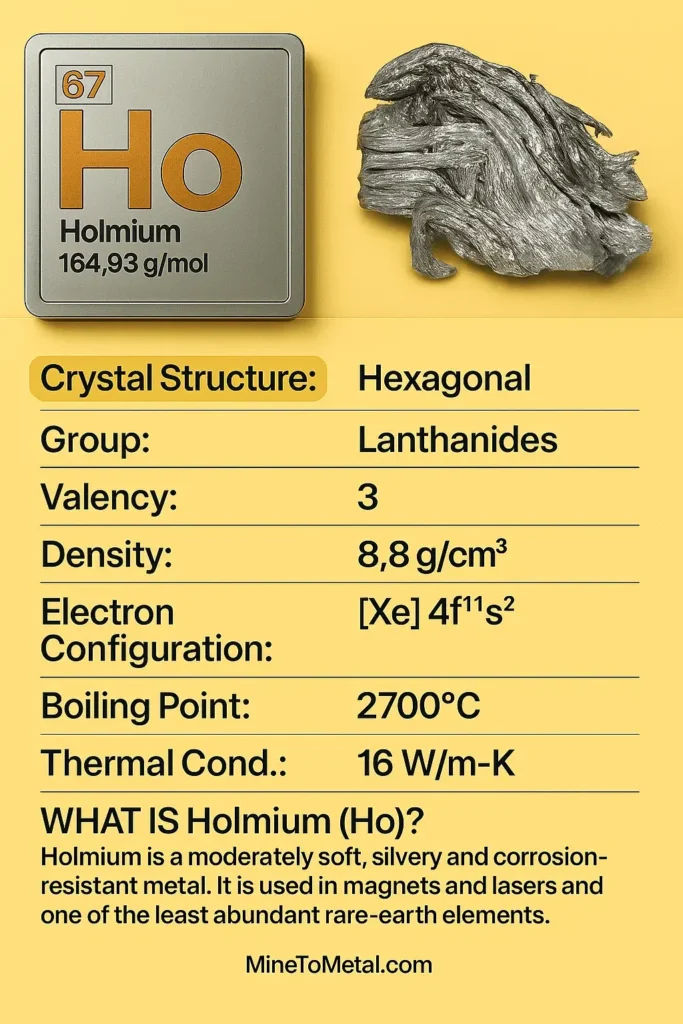
Holmium’s extraordinary properties emerge from its atomic architecture. This silvery-white, malleable metal within the lanthanide series possesses a specific electron arrangement that creates magnetic, thermal, and optical characteristics unmatched by other elements.
Electron configuration: [Xe] 4f¹¹ 6s²
Holmium, with atomic number 67, features an electron configuration of [Xe] 4f¹¹ 6s². The element carries thirteen valence electrons—eleven occupying the 4f subshell and two in the 6s subshell. When holmium forms compounds, it typically sheds three electrons to achieve the stable Ho³⁺ ion.
The 4f¹¹ configuration directly drives holmium’s unusual magnetic behaviour. These 4f electrons remain largely shielded from external influences by outer electron shells, yet their unpaired spins generate the intense magnetic moments that make holmium indispensable in high-field applications.
Stable isotope Ho-165 & radioisotopes Ho-166, Ho-163
Holmium exists as a single stable isotope: holmium-165 (¹⁶⁵Ho), comprising 100% of naturally occurring holmium. This monoisotopic nature simplifies its nuclear properties and applications. Two synthetic radioisotopes prove particularly valuable:
| Isotope | Half-life | Decay Mode | Decay Energy | Applications |
|---|---|---|---|---|
| Ho-166 | 26.824 hours | β- → ¹⁶⁶Er | 1.8547 MeV | Medical therapy |
| Ho-163 | 4570 years | EC → ¹⁶³Dy | 2.56 MeV | Research |
Ho-166’s 26.8-hour half-life provides an ideal balance for medical applications—long enough for surgical procedures yet short enough to minimise long-term radiation exposure. Ho-163’s extended half-life suits research applications requiring stable nuclear properties.
Hexagonal close-packed structure; density 8.795 g/cm³
Holmium crystallises in a hexagonal close-packed (hcp) crystal structure, where atoms arrange like efficiently stacked spheres. This atomic packing contributes to holmium’s density of 8.795 g/cm³—dense enough to provide structural integrity while remaining lighter than many transition metals.
The hcp structure influences holmium’s mechanical properties and magnetic anisotropy, affecting how magnetic domains align under external fields.
Magnetic moment: 10.6 µB, temperature-dependent behaviour
Holmium demonstrates remarkable magnetic complexity. Its magnetic moment measures approximately 10.6 µB, representing the highest value among naturally occurring elements. This exceptional magnetism stems from the unpaired 4f electrons that remain largely localised around the holmium nucleus. Earlier measurements sometimes reported ~6 µB, but modern consensus places the value at ~10.6 µB — the highest magnetic moment of any element
Temperature dramatically affects holmium’s magnetic behaviour. Above 133 K, it behaves paramagnetically. Between 20 K and 133 K, it becomes antiferromagnetic as magnetic moments align in opposing directions. Below 20 K, holmium transitions to ferromagnetic behaviour where moments align cooperatively. These transitions enable precise magnetic control in cryogenic applications.
Thermal conductivity & electrical resistivity
Holmium conducts heat at approximately 16 W/(m·K)—relatively modest compared to copper (401 W/m·K) but adequate for specialised applications. The thermal conductivity shows both linear and quadratic temperature dependencies, reflecting electron and phonon contributions to heat transport.
Electrically, holmium exhibits a resistivity of 814 nΩ·m at room temperature. Resistivity measurements reveal distinct changes at magnetic transition temperatures: subtle shifts at 20 K and more pronounced changes at the Néel temperature of 132 K. These electrical signatures help identify holmium’s magnetic state transitions.
Key Takeaway: Holmium’s 4f¹¹ electron configuration generates the highest magnetic moment among natural elements while enabling temperature-controlled magnetic transitions. This atomic foundation creates the precise magnetic, thermal, and nuclear properties that make holmium irreplaceable in applications from MRI systems to quantum computing.
Magnetism and Alloys
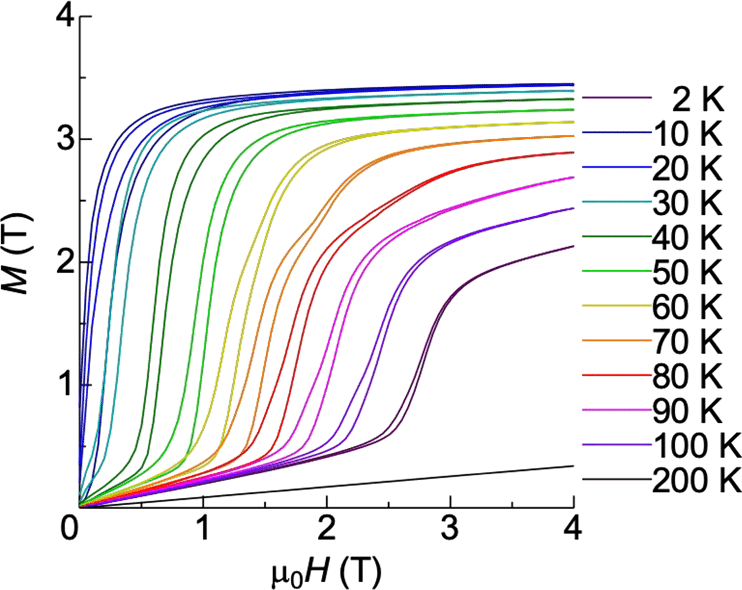
Image Source: ResearchGate
Holmium’s electron configuration creates magnetic capabilities that surpass every other element on the periodic table. The exceptional magnetic moment of 10.6 Bohr magnetons stems directly from its unique 4f¹¹ arrangement, where unpaired electrons create magnetic fields of extraordinary strength.
Holmium’s magnetic moment (~10.6 µB) exceeds iron (2.2 µB), cobalt (1.7 µB), and nickel (0.6 µB) by factors of four to seventeen, meaning that even a gram of holmium can rival several iron magnets of equal weight in field strength (ScienceDirect, 2019).
Temperature-Driven Magnetic States
Holmium exhibits remarkable magnetic behaviour that changes with temperature. At room temperature, it remains paramagnetic. Cool it below 133 K, and it shifts to antiferromagnetic alignment. Drop the temperature further below 20 K, and it becomes ferromagnetic. This temperature-dependent switching makes holmium invaluable for applications requiring precise magnetic control across varying thermal conditions.
Pole Pieces & Flux Concentrators in MRI Systems
Medical imaging relies heavily on holmium’s ability to focus and intensify magnetic fields. Magnetic Resonance Imaging (MRI) systems use holmium alloys as pole pieces and flux concentrators — components that must create uniform, powerful magnetic fields within the confined space of medical scanners. These are among the most important holmium applications in medical imaging
Holmium-based pole pieces solve three critical engineering challenges:
- Magnetic flux concentration: They channel magnetic field lines to strengthen intensity precisely where needed
- Field homogeneity: They ensure uniform magnetic fields for clearer image resolution
- System efficiency: They enable stronger magnetic fields using less material and energy
This translates directly to better diagnostic capabilities — more detailed images, faster scanning times, and improved patient outcomes.
Strategic Alloying for High-Performance Magnets
Holmium reaches its full potential when combined with complementary rare earth elements. These alloys demonstrate superior magnetic performance in demanding applications:
| Alloy System | Key Properties | Primary Applications |
|---|---|---|
| Ho-Y | Enhanced magnetic saturation, thermal stability | Research magnets, precision sensors |
| Ho-Dy | Exceptional coercivity, demagnetisation resistance | High-field instruments, specialised motors |
| Ho-Y-Dy | Optimised strength and stability combination | Scientific equipment, cryogenic systems |
The Ho-Dy system maintains excellent magnetic properties at elevated temperatures where conventional magnetic materials fail. Even more importantly, holmium alloys perform exceptionally well in cryogenic environments — essential for superconducting applications and research equipment operating near absolute zero.
These alloys enable magnetic systems that would be impossible with single-element magnets, opening pathways for more compact, powerful, and efficient magnetic technologies.
Key Takeaway: Holmium’s unmatched magnetic moment, combined with its temperature-dependent behaviour and alloying potential, enables critical advances in medical imaging, scientific instrumentation, and high-performance magnetic systems that conventional materials cannot achieve.
Holmium Lasers in Medicine
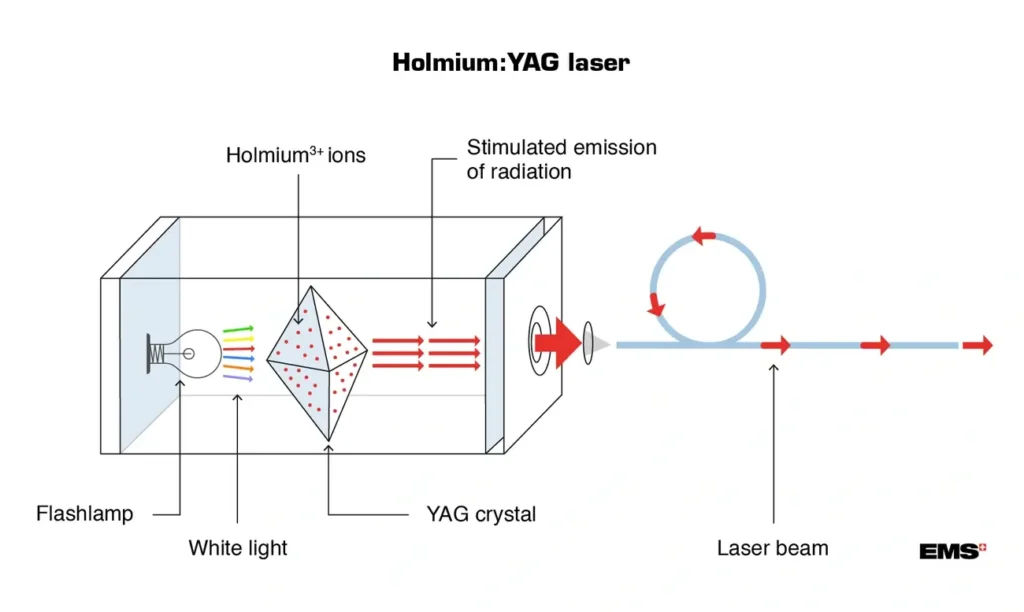
Image Source: EMS Urology
Holmium’s journey from obscure rare earth element to medical breakthrough centres on one remarkable property: its ability to generate laser light at precisely 2.1 micrometres. This wavelength, invisible to the human eye, has enabled surgical procedures that were impossible just decades ago.
The holmium-doped yttrium aluminium garnet (Ho:YAG) laser exploits a fundamental quirk of physics—at 2.1 micrometres, water molecules absorb infrared energy with extraordinary efficiency. Since human tissue contains roughly 70% water, this creates a precise surgical tool that can vaporise tissue within 0.4mm of depth whilst leaving deeper structures untouched.
The 2.1 Micrometre Advantage
Ho:YAG lasers operate through photothermal ablation—water molecules rapidly absorb the infrared energy, heat beyond vaporisation point, and create controlled tissue removal. This mechanism offers surgeons something unique: simultaneous cutting and coagulation with minimal collateral damage.
The precision stems from water’s absorption characteristics.A Ho:YAG beam travels thousands of kilometres through dry air yet stops within half a millimetre of water-rich tissue — a property that makes it ideal for surgical precision (EMS Urology, 2022).
Kidney Stone Treatment: Superior Outcomes
Holmium laser lithotripsy has become the gold standard for treating urinary stones, outperforming older technologies across multiple metrics. The laser’s dual-action capability enables two distinct approaches:
- Stone dusting: High-frequency, low-energy pulses (0.2-0.5 J) fragment stones into particles smaller than 0.2mm, allowing natural passage without additional procedures.
- Stone fragmentation: Higher-energy pulses (0.8-1.2 J) break larger stones into retrievable fragments whilst minimising retropulsion—the backwards movement that complicates stone removal.
| Technology | Stone Clearance Rate | Retropulsion Risk | All Stone Types |
|---|---|---|---|
| Ho:YAG Laser | 90-95% | Minimal | Yes |
| Pneumatic | 80-85% | High | Variable |
| Ultrasonic | 75-85% | Moderate | Limited |
Studies report stone-free rates exceeding 90% for properly selected cases, with the laser proving effective against calcium oxalate, uric acid, and cystine stones that resist other treatments. (see also Cobalt in Medicine and Radiological Science).
Prostate Surgery: HoLEP Technique
Holmium Laser Enucleation of the Prostate (HoLEP) demonstrates how precise energy delivery can transform surgical outcomes. This procedure treats benign prostatic hyperplasia by removing excess tissue whilst preserving the surgical capsule—a delicate operation requiring millimetre-level precision.
The technique works by using the laser to separate enlarged tissue from the prostatic capsule along natural anatomical planes. Surgeons then push the freed tissue into the bladder for morcellation and removal. The entire process typically requires 60-90 minutes, depending on prostate size.
HoLEP offers measurable advantages over traditional transurethral resection (TURP):
- Reduced bleeding: Simultaneous cutting and coagulation minimises blood loss
- Faster recovery: Catheterisation time drops from 3-5 days to approximately 24 hours
- Size independence: Effective for prostates from 30g to over 200g
- Lower retreatment rates: Complete tissue removal reduces recurrence
Precision Applications Across Specialities
Orthopaedic surgeons employ holmium lasers for arthroscopic procedures where traditional instruments cannot achieve sufficient precision. The controlled thermal effect enables cartilage debridement, meniscal repair, and capsular shrinkage with minimal damage to surrounding healthy tissue.
Ophthalmological applications, whilst less common, exploit holmium’s precise tissue interaction for vitreoretinal surgery and specific corneal procedures. The predictable penetration depth and controlled thermal zone prove valuable where precision matters most.
Key Takeaway: The Ho:YAG laser’s 2.1-micrometre wavelength creates ideal conditions for precise medical procedures by exploiting water’s absorption characteristics. This enables surgeons to achieve better outcomes with reduced complications across urology, orthopaedics, and ophthalmology.
Optics and Glass Applications
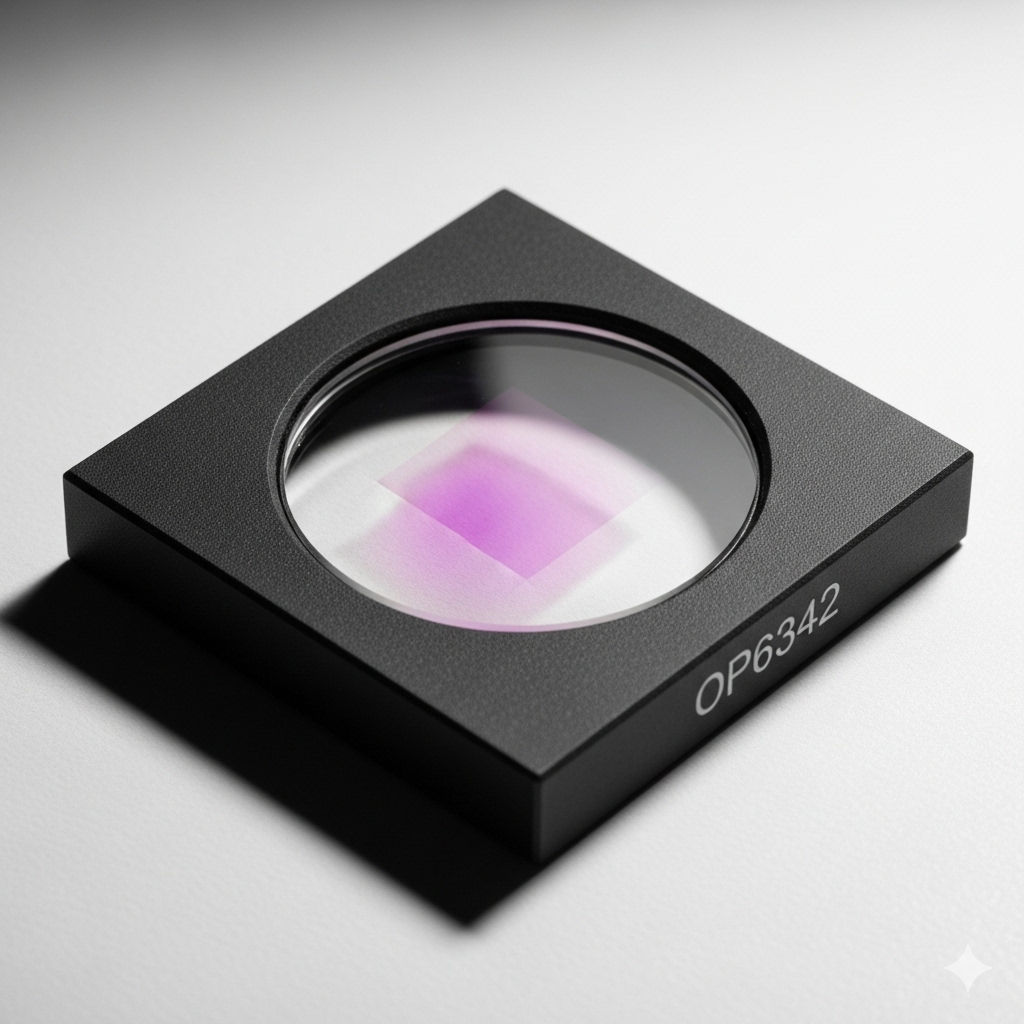
Holmium’s optical properties represent perhaps the most precise and stable characteristics in materials science. Where magnetic applications showcase raw power, holmium’s interaction with light demonstrates unmatched consistency and predictability that have made it the gold standard for scientific measurement. similar to Beryllium uses in precision optics
Holmium oxide in spectrophotometer calibration
Holmium oxide (Ho₂O₃) stands as the definitive calibration standard for ultraviolet and visible absorption spectrophotometers worldwide. The Standard Reference Material (SRM 2034) contains 4% (mass fraction) holmium oxide in 10% (volume fraction) perchloric acid solution, permanently sealed in quartz cuvettes that enable scientists to verify wavelength accuracy with exceptional precision.
Since 1961, the National Institute of Standards and Technology (NIST) has certified holmium oxide standards for wavelength calibration across spectral bandwidths not exceeding 3 nm. The material’s stability borders on the extraordinary: over 40 years of testing have revealed no recorded instances of spectral shifts in the certified bands. For analytical chemistry, this represents the closest thing to an immutable physical constant.
Sharp absorption peaks as reference standards
Holmium oxide delivers its value through a series of razor-sharp, well-defined absorption peaks across the ultraviolet and visible spectrum. The solution version exhibits 14 certified wavelengths of minimum transmittance spanning 240 nm to 650 nm, while the glass version provides 11 distinct peaks within the same range.
| Reference Material | Form | Number of Peaks | Wavelength Range | Stability |
|---|---|---|---|---|
| SRM 2034 | Liquid (Ho₂O₃ in HClO₄) | 14 | 240-650 nm | Excellent |
| Holmium Oxide Glass | Solid | 11 | 240-640 nm | Superior (>40 years) |
A single holmium oxide standard maintains its calibration accuracy for decades without recertification — making it one of the most reliable reference materials in analytical chemistry. This stability has enabled consistent measurements across laboratories worldwide for over four decades.
Colour-shifting behaviour under different light sources
Holmium oxide demonstrates a captivating optical phenomenon called metamerism — appearing as distinctly different colours depending on lighting conditions. Under natural daylight’s continuous spectrum, holmium oxide appears yellowish. Switch to fluorescent lighting with its characteristic emission peaks, and the same material shifts dramatically to a pinkish-red hue.
This colour transformation occurs because holmium possesses extremely sharp absorption bands that interact selectively with different light sources. The perceived colour changes without any chemical alteration of the material itself — a property that both fascinates researchers and serves practical applications in optical engineering.
Cubic zirconia & specialty glass manufacturing
Holmium oxide functions as a sophisticated colourant in cubic zirconia and specialty glasses, producing yellow to red colours that vary with concentration and lighting conditions. This controllable colour response makes holmium-doped materials particularly valuable in high-end jewellery manufacturing and decorative glass production where consistent appearance matters.
The predictable optical behaviour of holmium-containing glass enables specialised applications where precise colour stability and controlled light interaction become critical design parameters.
Optical filters for precision applications
Holmium-doped optical filters deliver another dimension of precision control. These filters, including Hoya Holmium filters, selectively transmit specific wavelengths while blocking others. Holmium-doped fibre filters exhibit strong rejection in stop bands and sharp absorption cutoffs — characteristics that make them ideal for filtering Raman spectra and other precision optical applications.
A 1-metre holmium-doped optical fibre provides an optical density of 2.6 at 633 nm whilst maintaining greater than 80% transmittance between 558-617 nm. This selective filtering capability proves indispensable in research applications demanding precise spectral control.
Key Takeaway: Holmium’s optical characteristics, particularly its sharp, stable absorption peaks and predictable metamerism, establish it as an irreplaceable element in scientific instrumentation and precision optics. Its decades-long stability as a wavelength reference standard ensures measurement accuracy from pharmaceutical testing to advanced materials research.
Nuclear Science and Isotope Applications

Image Source: Nevada Technical Associates, Inc.
Nuclear reactors operate on a knife’s edge — too few neutrons and the chain reaction dies, too many and it spirals out of control. Holmium’s extraordinary neutron-gobbling appetite makes it a silent guardian in this high-stakes balancing act, absorbing precisely the right number of neutrons to keep reactions stable and safe.
Burnable Poison in Nuclear Reactors
Holmium functions as what nuclear engineers call a “burnable poison” — a material that initially absorbs excess neutrons but gradually loses this ability as the reactor operates. This creates an elegant self-regulating system where fresh fuel starts with built-in neutron absorption that automatically decreases as the uranium fuel itself depletes.
The beauty lies in the timing: holmium absorbs neutrons that would otherwise drive the reaction too fast in fresh fuel, then depletes its absorption capacity at precisely the rate needed to maintain steady power output throughout the fuel cycle. No manual adjustments required — the physics handles itself.
Control Rods for Neutron Moderation
Beyond passive control, holmium appears in specialised control rod applications where precision matters most. Whilst boron and cadmium dominate conventional control systems, holmium’s neutron absorption characteristics enable fine-tuned reactivity control that can be partially inserted or withdrawn to adjust the neutron population with surgical precision.
n India, holmium’s neutron absorption traits are relevant to Pressurised Heavy Water Reactors (PHWRs) and research reactors, where it complements gadolinium in reactivity management at sites like Kaiga and Kudankulam.
Comparisons with Gd, Dy, Sm
| Element | Thermal Neutron Cross-Section (b) | Key Advantages | Primary Applications |
|---|---|---|---|
| Holmium | 59.0 | Consistent burnout rate | Burnable poison |
| Gadolinium | 49,000 (¹⁵⁷Gd) | Highest absorption | Control rods, burnable poison |
| Dysprosium | 2,653 (¹⁶⁴Dy) | Multiple isotopes active | Shutdown margin control |
| Samarium | 40,150 (¹⁴⁹Sm) | Self-shielding properties | Long-term reactivity control |
Thermal Neutron Capture Cross-Section Data
Holmium-165 exhibits a thermal neutron capture cross-section of 59.0±2.1 barns at the standard thermal energy of 0.0253 eV. This measurement, determined through activation analysis, confirms holmium’s significant neutron-absorbing capability. The resonance integral — which measures absorption across broader energy ranges — reaches approximately 650±31 barns, demonstrating holmium’s effectiveness across the entire neutron energy spectrum.
Ho-166 Beta Emitter in Liver Cancer Therapy
The same nuclear properties that control reactor physics also enable life-saving cancer treatment. Holmium-166, with its high-energy beta emissions (1.8 MeV) and 26.8-hour half-life, delivers concentrated radiation therapy directly to tumour cells. These beta particles travel just a few millimetres through tissue, creating a precise therapeutic effect whilst sparing healthy surrounding cells.
Microspheres in Brachytherapy
The most sophisticated application involves QuiremSpheres® — microscopic polymer beads containing radioactive holmium-166 encased in poly-L-lactic acid. Delivered directly to liver tumours through the hepatic artery, these microspheres lodge in tumour blood vessels and emit localised radiation that destroys cancer cells from within.
Clinical studies report tumour reductions of up to 83% following treatment, offering new hope for patients with inoperable liver cancers. Unlike alternative therapies, holmium microspheres enable post-treatment monitoring through both SPECT and MRI imaging, allowing doctors to track treatment effectiveness with unprecedented precision.
Key Takeaway: Holmium serves dual masters in nuclear applications,maintaining the delicate neutron balance that keeps nuclear reactors safe whilst simultaneously destroying cancer cells with pinpoint radiation therapy. This remarkable versatility showcases how the same atomic properties can both harness nuclear energy and fight disease.
Quantum and Nano Technologies
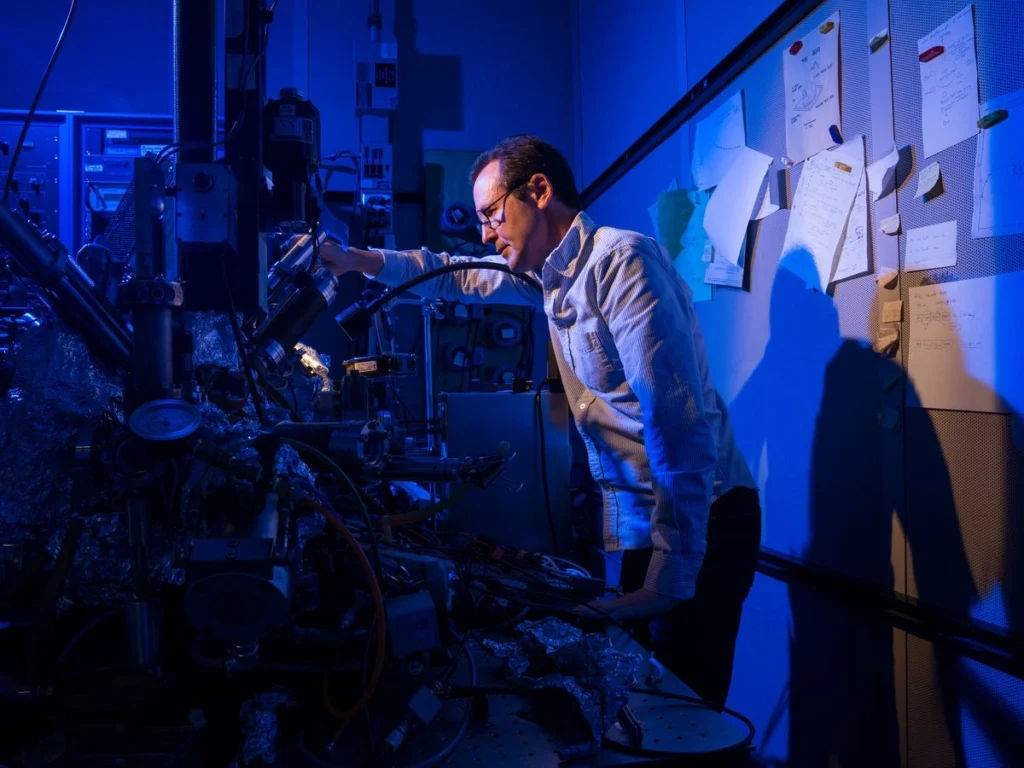
Image Source: CNET
The ultimate frontier for holmium lies at the atomic scale, where individual atoms become the building blocks of next-generation computing and imaging technologies that push the boundaries of physics itself.
Single-atom holmium data storage
Holmium atoms represent the theoretical limit of information storage density. When positioned on ultrathin magnesium oxide surfaces, each atom can maintain distinct magnetic states, storing one bit of data per atom. This atomic-scale precision means information density could approach physical absolutes—limited only by the size of atoms themselves.
The magnetic stability emerges from holmium’s exceptional magnetic moment interacting with quantum mechanical effects at atomic dimensions. Researchers have successfully demonstrated both reading and writing operations on individual holmium atoms using specialised scanning tunnelling microscopes in ultra-high vacuum environments.
IBM researchers demonstrated that just 12 holmium atoms can store one byte of data, a density millions of times greater than hard drives — theoretically enough to fit the iTunes music catalogue on a coin-sized device (CNET, 2017; IBM Research, 2017)
Hyperfine interaction for quantum state control
The nuclear spin of holmium interacts with its electron configuration through hyperfine coupling, creating discrete energy levels that can be manipulated for quantum computing operations. External magnetic fields and electromagnetic pulses allow precise control over these quantum states.
Holmium-based systems have achieved quantum coherence times of several microseconds—sufficient duration for fundamental quantum operations. The hyperfine structure provides multiple accessible quantum states within each atom, potentially enabling more sophisticated quantum processing than simple two-state systems.
IBM comparison with traditional storage media
| Storage Medium | Data Density (bits/inch²) | Stability | Access Speed |
|---|---|---|---|
| Hard Disc Drive | 1 trillion | Years | Milliseconds |
| Holmium Atoms | 1 quadrillion | Hours (current tech) | Microseconds |
IBM’s research demonstrated a holmium-atom storage array using just 12 atoms to store one byte of data, compared with roughly one million atoms required for conventional storage media. Practical limitations persist, as current systems demand near-absolute-zero temperatures and extremely controlled environments.
Holmium nanocrystals for NIR-II bioimaging
Holmium nanocrystals function as contrast agents in the second near-infrared window (NIR-II, 1000-1700 nm), offering superior tissue penetration and reduced background interference compared to conventional imaging approaches.
These nanoparticles produce distinctive emission signatures when excited by specific wavelengths, enabling high-contrast, deep-tissue imaging. The capability supports advanced diagnostic techniques for detecting tumours and visualising vascular structures with exceptional clarity.
These experiments highlight advanced holmium uses in quantum computing and data storage.
Key Takeaway: Holmium’s quantum properties position it at the convergence of theoretical physics and practical technology, from atomic-scale data storage approaching physical limits to biomedical imaging that sees deeper into living tissue than ever before.
Industrial, Chemical, and Defence Applications

Holmium’s industrial footprint extends far beyond laboratory curiosities into mission-critical defence systems and high-performance manufacturing processes where failure isn’t an option.
Holmium acetate, chloride, iodide in ceramics, phosphors, and lamps
Holmium compounds serve specialised roles in advanced ceramics and optical systems that demand precise wavelength discrimination. When incorporated into zirconia ceramics, holmium oxide exhibits varying fluorescence colour tones depending on the excitation wavelength used. This wavelength-sensitive behaviour makes holmium-doped ceramics valuable for discriminating between UV light wavelengths, specifically the third, fourth, and fifth harmonics of Nd:YAG lasers.
These ceramics find applications in laser safety systems, optical component testing, and UV radiation monitoring equipment where precise wavelength identification is critical. Unlike conventional UV sensors, holmium-doped ceramics provide immediate visual indication of specific laser harmonics without requiring electronic detection systems.
High-power holmium-doped fibre lasers in defence systems
Defence contractors increasingly rely on holmium fibre lasers for applications where conventional laser systems fall short. Operating at 2.1 μm wavelength, these systems achieve continuous wave outputs exceeding 400W or pulse energies above 2 mJ. The wavelength choice isn’t arbitrary—it exploits atmospheric transmission windows whilst offering improved eye safety compared to near-infrared alternatives.
Holmium lasers demonstrate superior performance in challenging environments, showing reduced sensitivity to atmospheric water vapour and carbon dioxide compared to 1 μm sources. This advantage proves crucial for long-range targeting systems, battlefield communications, and surveillance applications where atmospheric conditions can degrade conventional laser performance.(see Remarkable Niobium Uses)
The U.S. Department of Defense has tested holmium-doped fibre lasers for eye-safe long-range systems, while DRDO in India is exploring holmium photonics in directed energy applications. The strategic importance of these systems has prompted several nations to classify holmium fibre laser technology under export control regulations, recognising its potential military applications.
Aerospace alloys for thermal/magnetic control
Spacecraft and satellite designers face unique challenges—materials must maintain precision performance across temperature swings of hundreds of degrees whilst operating in vacuum for decades. Holmium alloys meet these demands through exceptional thermal stability and predictable magnetic behaviour across extreme temperature ranges.
These specialised alloys enable precision attitude control systems in satellites, where even microscopic thermal expansion can compromise mission objectives. The magnetic properties of holmium alloys also support navigation equipment that must function reliably in Earth’s varying magnetic field environment.
Stealth and acoustic dampening in submarines
Modern naval warfare depends heavily on acoustic stealth, where detection often means mission failure. Holmium compounds contribute to anechoic coatings that reduce submarine acoustic signatures by absorbing and scattering sonar waves. The effectiveness of these coatings varies significantly depending on their application to rigid pressure hulls, bridge fins, or other structural elements.
These acoustic dampening systems represent some of the most classified applications of holmium technology, with performance specifications closely guarded by naval forces worldwide (Sciencedirect, 2017; Defence Review Asia, 2020)
Key Takeaway: Holmium’s role in defence and industrial applications demonstrates how seemingly obscure materials become strategically vital in high-stakes environments. From laser systems that penetrate battlefield conditions to stealth technologies that protect naval assets, holmium enables capabilities that conventional materials simply cannot match.
Environmental and Biological Safety

Image Source: Microbe Notes
Holmium’s expanding role in medical and industrial applications requires careful consideration of its safety profile. Unlike some rare earth elements that pose significant health concerns, holmium presents a relatively manageable risk profile when proper protocols are followed.
Low Acute Toxicity & Minimal Uptake in Humans
According to NIOSH and REACH, holmium demonstrates low acute toxicity compared to many industrial metals, with minimal biological uptake reported in PubChem toxicology data.
The element serves no biological function in humans, though certain holmium salts can stimulate metabolic processes. Most people unknowingly consume approximately one milligramme of holmium annually through regular dietary intake—primarily from trace amounts in food and water.
Vegetables contain minimal holmium concentrations, measuring roughly 100 parts per trillion. This extremely low environmental presence means background exposure remains negligible for most populations.
Solubility significantly influences holmium’s toxicological behaviour. Soluble salts exhibit slight toxicity if ingested, while insoluble compounds remain effectively non-toxic. Plants demonstrate minimal uptake from soil environments, limiting bioaccumulation through agricultural pathways.
The average person consumes more holmium over their lifetime than laboratory workers typically handle during routine operations.
Fire Hazard in Powdered Form
Bulk holmium metal poses minimal fire risks, but powdered holmium presents considerable safety challenges. Holmium dust becomes readily flammable when exposed to heat, sparks, or flame. Under fire conditions, it may react with water to release flammable hydrogen gas, creating secondary explosion hazards.
Fires involving holmium typically emit holmium oxide fumes, requiring appropriate ventilation and respiratory protection during emergency response.
Toxicity Comparison: Holmium vs Other Lanthanides
| Lanthanide | Acute Toxicity | Environmental Persistence | Bioaccumulation Potential |
|---|---|---|---|
| Holmium | Low | Long-term | Minimal |
| Gadolinium | Moderate | Long-term | Higher (renal concerns) |
| Lanthanum | Low-moderate | Long-term | Moderate |
Most rare earth elements, including holmium, follow a hormetic concentration-related pattern—potentially beneficial at extremely low doses yet adverse at higher concentrations. However, the biological effects of long-term holmium exposure remain incompletely characterised, highlighting the need for continued research as applications expand.
Holmium’s safety profile compares favourably to gadolinium, which has raised concerns about renal toxicity in patients with kidney disease, and other lanthanides that demonstrate higher bioaccumulation potential.
Key Takeaway: Holmium’s favourable safety profile, featuring low acute toxicity and minimal biological uptake, supports its expanding medical applications. Proper handling protocols must address flammability risks in powdered form while recognising that long-term exposure effects require further investigation.
India and Global Supply Context
!World map showing rare earth metal mines: operating, under development, and new deposits, with a detailed inset of India’s deposits.
Image Source: PMF IAS
Holmium supply chains expose the fragility of modern technological dependence. Three countries control nearly the entire global production of this critical element, creating strategic vulnerabilities that extend far beyond simple economics.
Extraction from monazite & bastnaesite
Holmium extraction relies almost entirely on two mineral sources: monazite and bastnäsite. Bastnäsite accounts for approximately 70% of total rare earth elements extracted globally . The processing involves thermal treatments including oxidative roasting, followed by acid leaching to separate individual rare earth content.
This concentration in just two mineral types creates inherent supply bottlenecks. Unlike diversified commodity markets, holmium producers cannot easily switch sources or processing methods when geopolitical tensions disrupt established supply routes.
Global producers: China, USA, Brazil
| Country | Production Share | Processing Capacity | Notable Features |
|---|---|---|---|
| China | 60% | 90% | Bayan Obo deposit |
| USA | 16% | Limited | Mountain Pass mine |
| Brazil | Growing | Developing | 23% of global reserves |
China’s dominance extends beyond raw production into processing capacity, controlling 90% of global rare earth refining despite holding 60% of production . This processing monopoly creates dependencies even for countries with their own deposits.
Brazil holds nearly a quarter of the world’s rare earth reserves yet struggles to compete with China’s integrated supply chains and processing expertise . The gap between reserves and production capability illustrates how resource ownership doesn’t guarantee supply security.
India’s reserves, IREL processing, and KABIL initiatives
India possesses 8% of global rare earth reserves yet contributes less than 1% to worldwide mining . This stark imbalance reflects broader challenges in developing domestic rare earth capabilities.
IREL (India) Limited operates with a processing capacity of 6 lakh tonnes annually , producing minerals including ilmenite, rutile, and zircon. However, the company’s focus remains primarily on beach sand minerals rather than rare earth specialisation.
India launched the National Critical Mineral Mission in 2025 alongside Khanij Bidesh India (KABIL) initiatives to acquire foreign mineral assets . These programs represent strategic shifts toward securing critical material access through both domestic development and international partnerships.
Holmium in India’s nuclear energy strategy
Holmium holds particular strategic importance for India’s nuclear program, where its neutron absorption properties support reactor control systems . This classification as a critical mineral aligns with India’s broader energy transition goals: reducing emissions intensity by 45% by 2030 and achieving net-zero emissions by 2070 .
Nuclear energy remains central to India’s clean power strategy, making secure holmium access essential for long-term energy independence.
Supply risk index & recycling bottlenecks
China’s export restrictions have prompted countries worldwide to develop alternative supply chains, yet technical challenges in recycling rare earths persist . Holmium recycling faces particular difficulties due to its dispersion across diverse applications and the complex separation processes required.
Current recycling rates for rare earths remain below 5%, creating sustained dependence on primary extraction despite growing demand from quantum computing, medical devices, and clean energy applications. Holmium’s dispersive use in lasers, magnets, and alloys makes recovery even harder, with the EU listing it among rare earths requiring urgent recycling research.
Key Takeaway: India’s substantial holmium reserves mean little without processing capabilities that match strategic needs. Building domestic refining capacity while securing international partnerships represents the only viable path to reducing dangerous supply dependencies in this critical technological material.
Sustainability and Future Outlook
Holmium occupies a unique position among the elements — simultaneously one of the rarest materials on Earth and one of the most strategically important for advanced technologies. This rare earth metal, despite its scarcity at just 1.3 parts per million of the Earth’s crust, quietly enables capabilities that would be impossible with any other element.
The magnetic moment of 10.6 Bohr magnetons — the highest among naturally occurring elements — creates opportunities that extend far beyond conventional applications. Ho:YAG lasers operating at precisely 2.1 µm wavelength now achieve stone-free rates exceeding 90% in kidney stone treatment, while holmium oxide calibration standards maintain their accuracy for over 40 years without recertification. Single holmium atoms can store one bit each — approaching the physical limit of information density demonstrated in IBM’s single-atom memory experiments (Nature Nanotechnology, 2017).
Yet this remarkable versatility comes with significant strategic vulnerabilities. Global production remains limited to just 10 tonnes annually, with China controlling approximately 60% of extraction and 90% of processing capacity. Brazil holds nearly 23% of global reserves but lacks the processing infrastructure to compete effectively.
India’s position reflects this broader challenge. Despite possessing 8% of global rare earth reserves, the country contributes less than 1% to worldwide production. IREL (India) Limited operates processing facilities, but holmium’s classification as a critical mineral under India’s nuclear energy strategy highlights the gap between domestic demand and supply capabilities.
The National Critical Mineral Mission launched in 2025, alongside KABIL initiatives to acquire foreign mineral assets, represents India’s recognition that holmium access will determine competitiveness in quantum computing, advanced medical technologies, and precision manufacturing. These efforts align with India’s emissions reduction goals — 45% intensity reduction by 2030 and net-zero by 2070 — where holmium-enabled technologies play essential supporting roles.
Supply chain resilience emerges as the critical factor determining which nations can fully exploit holmium’s potential. China’s export restrictions have prompted alternative supply chain development globally, yet technical challenges in rare earth recycling remain substantial. The element’s extraordinary properties that make it indispensable also make it difficult to substitute or recover efficiently.
Current applications span from the devices in our pockets to satellites in orbit, yet holmium’s most significant impact may still lie ahead. Quantum computing advances, fusion energy research, and precision medical procedures all depend on holmium’s unique characteristics. The element bridges atomic-scale phenomena with macroscopic applications in ways that few materials can match.
Key Takeaway: Holmium demonstrates how a seemingly obscure element can become strategically vital in ways that transcend its abundance. For countries like India, developing processing capabilities and securing reliable supply chains for this remarkable material will determine access to next-generation technologies across medicine, computing, and energy sectors.
Key Takeaways
Holmium’s extraordinary properties make it indispensable across cutting-edge scientific applications, from medical treatments to quantum computing breakthroughs.
• Holmium possesses the highest magnetic moment among natural elements, enabling powerful MRI systems and precision magnetic field applications despite its scarcity at just 1.3 ppm of Earth’s crust.
• Ho:YAG lasers operating at 2.1 µm wavelength revolutionise minimally invasive medicine, achieving 90-95% success rates in kidney stone treatment and transforming prostate surgery outcomes.
• Single holmium atoms can store individual data bits, representing the ultimate physical limit of information density—potentially storing entire music libraries on coin-sized devices.
• Holmium oxide serves as the gold standard for spectrophotometer calibration, maintaining accuracy for over 40 years without recertification across 14 certified wavelengths.
• Despite holding 8% of global reserves, India produces less than 1% of rare earths, highlighting critical supply chain vulnerabilities that require strategic development of domestic processing capabilities.
The convergence of holmium’s unique magnetic, optical, and nuclear properties positions this remarkable element at the forefront of next-generation technologies, from quantum computing to precision medicine, making it increasingly vital for addressing 21st-century scientific challenges.
FAQs
What is holmium used for?
Holmium is used in surgical lasers, nuclear reactor control rods, magnetic flux concentrators in MRI systems, optical calibration filters, ceramics, and advanced defence applications.
What are the primary applications of holmium in modern technology?
Holmium applications span nuclear reactors for controlling chain reactions, production of powerful magnets, medical imaging technologies like MRI, solid-state lasers, and optical spectrophotometers.
How does holmium contribute to advancements in medical treatments?
Holmium:YAG lasers are widely used in urology, prostate surgery, orthopaedics, and ophthalmology. Its radioisotope, holmium-166, is employed in radioembolisation and brachytherapy for liver cancer, where microspheres target and destroy tumours.
What makes holmium unique among the elements?
Holmium possesses the highest magnetic strength of any element, with a moment of ~10.6 µB. This makes it invaluable in creating powerful magnets and magnetic pole pieces. Its sharp optical absorption bands also make it essential for spectrophotometer calibration.
Why is holmium important in nuclear reactors?
Holmium acts as a burnable poison and neutron absorber, helping stabilise the fission chain reaction and extend fuel life. In India, holmium’s traits complement gadolinium in Pressurised Heavy Water Reactors (PHWRs) such as Kaiga and Kudankulam.
Is holmium safe?
Holmium shows low acute toxicity and minimal biological uptake compared to many metals. However, its powdered form poses inhalation and fire hazards, requiring careful handling under Class D fire protocols.
Which countries produce holmium?
China dominates global production, with additional contributions from the USA, Brazil, and Australia. India processes smaller amounts via IREL, extracting holmium from monazite sands.
What makes holmium unique among the elements?
Holmium possesses the highest magnetic strength of any element, with a moment of ~10.6 µB. This makes it invaluable in creating powerful magnets and magnetic pole pieces. Its sharp optical absorption bands also make it essential for spectrophotometer calibration. This makes it more valuable in magnets and optical calibration compared to other lanthanides like erbium or dysprosium.
Is holmium recyclable?
Recycling of holmium and other rare earths remains below 5%. Its dispersive use in lasers, magnets, and alloys makes recovery challenging, and research is ongoing to improve recycling technologies.


![The Surprising Truth About Beryllium Applications in Modern Technology [2025 Guide]](https://ik.imagekit.io/lxsotwajc/wpmedia/wp-content/uploads/2025/06/featured-Image3-440x264.webp)