
Last Updated on September 2, 2025 by Hemanth
Table of Contents
Graphene may be just one atom thick, but its impact is anything but small. Stronger than steel yet lighter than paper, and with conductivity that leaves copper behind, this “wonder material” is quietly reshaping industries.
From faster-charging EV batteries to foldable displays, stronger concrete, and life-saving medical tools, graphene’s hidden applications are setting the stage for a multi-billion-dollar market. In this article, you’ll discover how a material you can’t see is becoming impossible to ignore
Overview
You’ve likely never seen graphene, yet this single layer of carbon atoms—just 0.345 nanometres thick—quietly powers everything from smartphone touchscreens to the advanced composites used in Formula One racing cars.
Graphene is often described as graphite’s atomic cousin, sharing the same carbon structure but with dramatically enhanced properties. To put these fundamentals in perspective, here’s a quick property snapshot of graphene as a material.
![Graphene properties chart showing crystal structure, group 14, valency 4, density 2.267 g/cm³, electron configuration [He]2s²2p², solid state at 20°C, and discovery by Andre Geim.](https://ik.imagekit.io/lxsotwajc/wpmedia/wp-content/uploads/2025/07/elemnt-card-683x1024.webp)
While graphite consists of stacked layers of carbon atoms, graphene is a single layer peeled from that stack. This seemingly small difference gives it extraordinary strength, flexibility, and conductivity compared to its bulkier counterpart.
The global graphene market tells a story of rapid acceleration: from USD 598.29 million in 2025 to USD 6,979.95 million by 2034, advancing at a CAGR of 31.7%. Applications span energy storage, electronics, healthcare, and composites—all driven by its unmatched conductivity, strength, and surface area.
Graphene’s properties read like a materials engineer’s wish list: electrical conductivity 200 times greater than copper, thermal conductivity exceeding 5,000 W/mK, and a tensile strength of 130 GPa (200x stronger than structural steel). No wonder it is already reshaping industries that demand performance beyond what conventional materials can deliver.
What makes graphene particularly intriguing is how much of its impact remains invisible to end users. Graphene nanoplatelets captured 59% of the market in 2024, yet its true value lies in versatility—enabling high-speed transistors in electronics while reinforcing composites that require both strength and weight reduction. The composites segment alone accounted for 52% of market share in 2024.
This article reveals the hidden graphene applications driving its market expansion, explores regional growth patterns, and shows how this nearly invisible material has become essential to modern technology infrastructure.
Global Graphene Market Forecast and Growth Drivers
Market analysts tracking graphene’s commercial trajectory reveal an industry at an inflection point, where laboratory breakthroughs are finally achieving meaningful commercial scale. Multiple forecasting models point to exceptional expansion, though the variation in projections reflects both the nascent nature of widespread graphene adoption and the potential for disruptive applications across critical industries.
Graphene Market Size Projection: £5.5 Billion by 2030
Graphene’s commercial momentum is unmistakable, with global projections showing exponential growth through 2034—driven by rising demand in energy, electronics, and advanced composites.
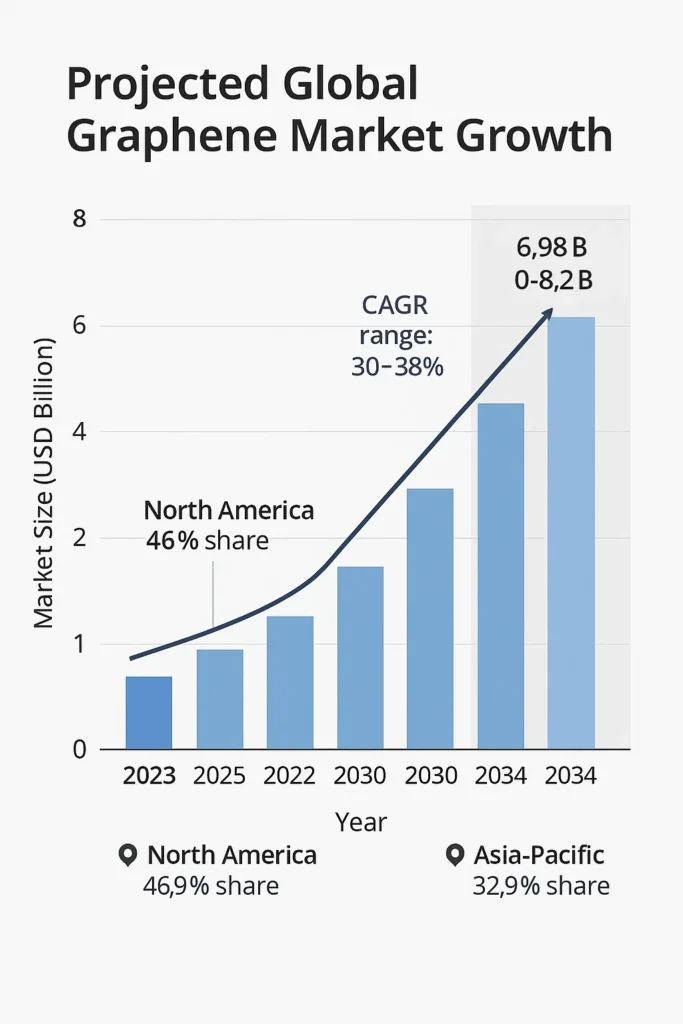
The graphene market presents a fascinating case study in rapid materials commercialisation. Starting from USD 195.7 million in 2023, projections indicate growth to USD 1,609.3 million by 2030 — a CAGR of 35.1%. More aggressive forecasts suggest the market could reach £5.5-6.5 billion (approximately USD 6.9-8.2 billion) by 2032-2034, representing a CAGR of 36.5%. Conservative estimates place the 2029 market at USD 2.94 billion, growing at 24.0% CAGR from 2024.
“The graphene industry is poised for a 30-38% compound annual growth rate through 2030, making it one of the fastest-growing advanced materials markets globally.”
This substantial variation in forecasts reflects the challenge of predicting commercial adoption timelines for breakthrough materials — where single applications can dramatically shift market dynamics.
| Forecast Source | Current Valuation (2023-2024) | Projected Value (Year) | CAGR |
|---|---|---|---|
| Grand View Research | USD 195.7M (2023) | USD 1,609.3M (2030) | 35.1% |
| Fortune Business Insights | USD 694.0M (2024) | USD 8,329.9M (2032) | 36.5% |
| Markets and Markets | USD 1.0B (2024) | USD 2.94B (2029) | 24.0% |
| Mordor Intelligence | USD 1.66B (2025) | USD 9.28B (2030) | 41.2% |
Key Drivers: Energy Storage, Electronics, and Composites
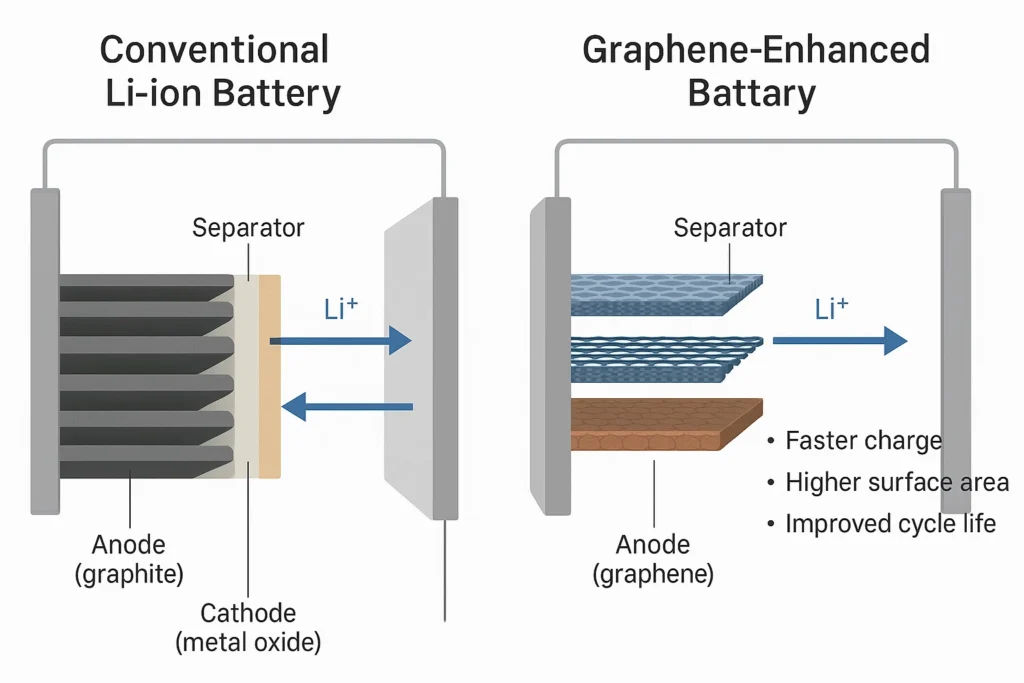
Three application sectors drive graphene’s market acceleration, each exploiting different aspects of the material’s unique properties. Energy storage applications have emerged as particularly significant growth drivers. Graphene-enabled silicon batteries demonstrate capacity improvements of up to 30%, solving critical swelling issues that have limited silicon-based anodes in lithium-ion systems.
More significantly, graphene-stabilised lithium-sulphur cells are scheduled for 200 MWh pilot output by late 2025 — a milestone that could unlock grid-scale energy storage applications.
Electronics applications continue expanding as manufacturers recognise graphene’s exceptional electron mobility and thermal management capabilities. The material enables high-frequency transistors operating beyond traditional silicon limits, while serving as interconnects in integrated circuits and heat dissipation layers. These properties are particularly valuable as device miniaturisation pushes conventional materials toward their performance boundaries.
The composites sector commanded 36% of graphene market share in 2024, with automotive applications accounting for 30.5% of composites revenue in 2019. The global graphene composites market, valued at INR 1105.38 million in 2019, is projected to reach INR 9231.22 million by 2027 — a CAGR of 37.5%. This growth reflects graphene’s ability to enhance both mechanical strength and electrical conductivity simultaneously, eliminating trade-offs that have historically limited materials selection.
Government Funding and R&D Initiatives (EU Graphene Flagship)
Strategic government investments have been instrumental in accelerating graphene’s transition from research curiosity to commercial reality. The European Union’s Graphene Flagship, launched in 2013, represents one of Europe’s largest research initiatives with a €1 billion budget. This programme encompasses over 170 academic and industrial partners across 22 countries, creating a coordinated ecosystem that has accelerated both fundamental research and industry adoption.
The UK government allocated £38 million for graphene research within a broader £50 million materials investment, complemented by £23 million from the European Regional Development Fund. This multi-source funding approach reflects graphene’s recognition as a strategic technology with implications beyond single industries.
India’s 2024 establishment of the India Graphene Engineering and Innovation Centre (IGEIC) marks another significant strategic commitment, with R&D positioned in Trivandrum and manufacturing capabilities planned for Palakkad. This geographical distribution suggests India’s recognition of graphene’s dual importance in both research advancement and industrial sovereignty.
Key Takeaway: Graphene’s market trajectory reflects the convergence of breakthrough material properties with strategic government investments, creating conditions for rapid commercial scaling across energy, electronics, and composite applications.
The material’s progression from laboratory to commercial applications demonstrates how strategic investments can accelerate adoption timelines, particularly when multiple governments recognise a technology’s implications for industrial competitiveness and technological sovereignty.
Product Segmentation: Nanoplatelets, Oxide, and Beyond
Three distinct graphene variants drive commercial applications, each engineered for specific performance requirements. The global graphene market segments into Graphene Nanoplatelets (GNPs), Graphene Oxide (GO), and reduced Graphene Oxide (rGO), with vastly different properties and industrial applications.
Graphene Nanoplatelets in Structural Composites
Graphene Nanoplatelets captured the largest market share in 2024 and maintain dominance through projected 2032 growth. These multilayer structures, typically 1-2 nanometres thick, deliver thermal conductivity of 5000 W/mK and modulus of elasticity approaching 1 TPa.
The performance advantage is quantifiable: adding just 0.3 wt.% graphene particles to carbon-fibre composites produces a 70% increase in flexural strength and modulus. This enhancement stems from GNPs creating a bimodal microstructure that simultaneously improves strength while preserving ductility.
Automotive and aerospace manufacturers exploit these properties for lightweight composite materials where surface hardness, strength, and stiffness requirements are non-negotiable. The material’s ability to enhance multiple properties through a single additive eliminates the complexity of multi-component reinforcement systems.
Graphene Oxide in Biomedical and Coating Applications
Graphene Oxide’s oxygen-containing functional groups — hydroxyl, carboxyl, and epoxide — enable exceptional chemical versatility. This functionalisation creates water dispersibility and compatibility across diverse processing environments.
Biomedical applications exploit GO’s surface chemistry and biocompatibility:
- Drug delivery systems targeting cancer treatments with controlled release mechanisms
- Biosensors employing fluorescence resonance energy transfer (FRET) for molecular detection
- Tissue engineering scaffolds that actively promote stem cell proliferation
Coating applications benefit from GO’s protective properties against environmental degradation. The functional groups facilitate chemical modification, improving adhesion with polymers and resins in demanding automotive and aerospace environments. GO-based coatings form physical barriers that demonstrate exceptional corrosion resistance against aggressive media.
Reduced Graphene Oxide in Conductive Inks
Reduced Graphene Oxide bridges the gap between graphene’s electrical conductivity and GO’s processing advantages. The reduction process restores moderate conductivity suitable for electronic applications while maintaining processability.
Printed electronics applications utilise rGO’s unique properties for flexible, lightweight circuitry across various substrates. The material creates interconnected, uniform printed layers with superior performance compared to carbon nanotubes or nanowires.
Environmental considerations drive recent innovations in water-based rGO formulations that eliminate harmful organic solvents. These eco-friendly inks achieve long-term stability through natural surfactants including gum arabic and cellulose nanocrystals.
Key Takeaway: Each graphene variant targets specific performance requirements — nanoplatelets for structural reinforcement, oxide for biomedical applications, and reduced oxide for electronic systems — enabling the material’s expansion across diverse industrial sectors.
End-Use Industry Analysis: Where Demand is Rising
Four industries have emerged as primary drivers of graphene adoption, each exploiting specific properties of this remarkable material. Automotive, electronics, healthcare, and construction sectors demonstrate how graphene’s unique characteristics translate into measurable performance gains.
Automotive Sector: Lightweight Panels and Batteries
Briggs Automotive Company (BAC) achieved a breakthrough that illustrates graphene’s automotive potential. The world’s first car featuring graphene-enhanced carbon fibre panels in the Mono’s rear wheel arches delivered dramatic results: panels weighing 41kg were reduced to just 32kg, representing a 22% weight saving.
This wasn’t simply about using less material — graphene panels required two sheets of carbon fibre rather than three, delivering 200 times the strength of steel while cutting weight by 20 percent.
Electric vehicle batteries represent another frontier where graphene’s properties create tangible advantages. Graphene-enhanced batteries demonstrate faster charging capabilities, higher energy density, and longer operational life compared to conventional lithium-ion batteries.
Researchers are also exploring germanium-based anodes, which offer very high capacity but face challenges in cost and durability. These systems could potentially charge within minutes rather than hours, addressing one of electric mobility’s most significant practical barriers.
Electronics: Flexible Displays and Sensors
Electronics applications showcase graphene’s durability under mechanical stress. Graphene-coated copper structures withstand 200,000 folds without damage, whereas traditional copper structures begin cracking after just 20,000 folds. This extraordinary resilience enables flexible touchscreens and foldable displays that maintain electrical integrity through repeated use. In parallel, gallium-based compounds play a crucial role in powering and cooling these next-generation electronics.
Sensor applications exploit graphene’s two-dimensional structure, where every atom remains exposed to its environment, enabling detection of single molecules. This molecular-level sensitivity has created ultra-sensitive sensors for environmental monitoring, healthcare diagnostics, and industrial process control.
Healthcare: Drug Delivery and Biosensors
Graphene oxide (GO) has established itself as an efficient nanocarrier for drug delivery, particularly beneficial for anticancer drugs with low water solubility. Its large surface area enables high drug loading capacity, while pH-sensitive properties allow controlled release at specific treatment sites — targeting diseased tissue while minimising systemic exposure.
Electrochemical biosensors benefit from graphene’s hydrophilicity and exceptional electron transfer properties. These devices detect biomarkers for cancer, cardiovascular conditions, and other diseases with unprecedented sensitivity, often identifying molecular signatures before conventional diagnostic methods.
Construction: Graphene-enhanced Concrete
Construction applications reveal graphene’s most unexpected industrial impact. Adding just 0.03% graphene oxide to concrete increases flexural strength by over 40%. More remarkably, graphene-enhanced concrete requires up to 50% less cement, substantially reducing the carbon footprint of construction projects.
| Property | Conventional Concrete | Graphene-Enhanced Concrete |
|---|---|---|
| Flexural Strength | ~5 MPa (baseline) | Up to 79.5% increase |
| Water Permeability | ~1.0 × 10⁻¹² m/s | 4× less permeable |
| CO₂ Emissions | 100% (cement-based) | 20-30% reduction |
These improvements address two critical challenges: structural performance and environmental impact. Stronger concrete with reduced cement content creates buildings that last longer while generating fewer emissions during construction.
Key Takeaway: Graphene applications across automotive, electronics, healthcare, and construction demonstrate how a single material’s properties can simultaneously address performance requirements and sustainability goals across multiple industries.
Commercial Breakthroughs: From Laboratory to Market Reality
Three breakthrough applications demonstrate how graphene has moved beyond research laboratories into commercial production, each addressing specific industrial challenges with measurable performance improvements.
Samsung-backed Graphene Cooker: 50% Energy Reduction
South Korea’s Graphene Square has developed a cordless, transparent cooker that consumes just 600 watts—half the energy of conventional cookers. Backed by an £8.5 million investment from Samsung, this innovation exploits graphene’s thermal conductivity of 5,000 W/mK to optimise mid-infrared wavelengths. The transparent heating film allows real-time monitoring while maximising natural flavours through precise heat distribution.
The technology earned TIME magazine’s “Best Inventions” recognition and the 2024 CES Innovation Award. Pilot production began at Graphene Square’s Pohang facility in late 2024, marking the first mass-market application of graphene heating elements.
BeDimensional’s Industrial-Scale Production
Italian startup BeDimensional secured £16.8 million from the European Investment Bank to expand beyond its current 3 tonnes annual capacity. The company’s new Genoa facility will produce over 30 tonnes by 2028—a tenfold increase that addresses the EU’s strategy to reduce critical material import dependence.
This plant is among the first globally to produce two-dimensional crystals with atomic-level precision at industrial scale. This production capacity directly supports the automotive and electronics sectors’ growing demand for high-quality graphene materials.
Graphenea’s IoT Sensor Integration
Graphenea’s S11 and S12 sensor line demonstrates graphene’s capabilities in Internet of Things applications. The S11 chip contains 31 graphene devices with van der Pauw geometry across three sizes, while S12 features interdigitated contact geometry optimised for gas sensing. These sensors exploit graphene’s two-dimensional structure, where every atom remains exposed to environmental changes.
The result: Internet of Things applications with unprecedented sensitivity for gas detection, chemical analysis, and magnetic sensing—capabilities that traditional silicon-based sensors cannot match.(Graphenea, 2024).
Key Takeaway: These commercial applications prove graphene’s transition from theoretical material to practical solutions, with measurable energy savings, production scalability, and enhanced sensing capabilities driving adoption across industries.
Regional Market Insights and Competitive Landscape
Three continents have carved distinct roles in graphene’s global ecosystem, each building strategic advantages that reflect their industrial strengths and policy priorities.
North America: Research Leadership Meets Commercial Scale
North America controls over 46% of revenue share in 2024, a dominance rooted in advanced research infrastructure and early commercial adoption. The U.S. graphene market alone projects growth from USD 144.11 million in 2024 to approximately USD 2,300.08 million by 2034, representing a CAGR of 31.90%.
This leadership stems from established technology corridors where universities, national laboratories, and corporations collaborate on graphene applications. Silicon Valley’s electronics expertise, Detroit’s automotive innovation, and Boston’s biotech cluster have each adapted graphene for sector-specific needs, creating a diverse commercial foundation.
Europe: Policy-Driven Research Excellence
Europe positions itself as the global centre for graphene research excellence, targeting the fastest expansion among all regions. The European Research Council’s Graphene Flagship project commands €1 billion—the largest research initiative in European Union history. This commitment has established research networks spanning 22 countries, where academic institutions collaborate with industry on applications across electronics, automotive, and energy storage.
European policy emphasises strategic autonomy in advanced materials, positioning graphene research as essential to reducing dependence on critical material imports. This approach has created a research-intensive ecosystem that prioritises breakthrough applications over immediate commercial scale.
Asia-Pacific: Manufacturing Dominance and Scale Economics
Asia-Pacific accounts for 32.9% of the global graphene market in 2023, projected to reach USD 587.1 million by 2030. China’s manufacturing capabilities control more than 60% of global production capacity, supported by government funding under the 14th Five-Year Plan that earmarked INR 177.20 billion for nanomaterials R&D.
This regional strength reflects established supply chains for carbon materials, chemical processing expertise, and manufacturing scale that can translate laboratory breakthroughs into commercial products rapidly.
Competitive Leaders: Scale, Specialisation, and Integration
| Company | Specialisation | Notable Achievement |
|---|---|---|
| NanoXplore | Graphene powder production | 4,000 metric tonnes annual capacity |
| Talga Group | Graphene-enhanced batteries | Completed AINR 3375.22 million institutional placement |
| Graphenea | High-quality graphene films | Graphene oxide production capacity of one tonne annually |
| Directa Plus | Chemical-free graphene nanoplatelets | Applications in textiles, tyres, paints and composites |
> “The combination of our graphene production capacity with our financial strength makes NanoXplore the industry leader and a de facto partner for any major OEM within the transportation or industrial sector.”
These market leaders demonstrate different strategic approaches: NanoXplore focuses on volume production, Talga targets energy storage applications, Graphenea emphasises quality and purity, while Directa Plus develops application-specific solutions.
Key Takeaway: Geographic specialisation has created complementary strengths across regions—North American commercial leadership, European research excellence, and Asian manufacturing scale—establishing a global ecosystem where companies succeed through focused expertise rather than broad market presence.
Conclusion
Graphene’s journey from a laboratory breakthrough to an industrial workhorse reflects how extraordinary properties can translate into real-world performance. Stronger than steel yet lighter than paper, it is already reducing automotive weight, boosting battery capacity, and reinforcing next-generation composites.
Unlike many advanced materials, graphene’s growth is not speculative—it is backed by government programs, corporate investments, and manufacturing scale-ups across North America, Europe, and Asia. From Samsung’s energy-saving devices to Europe’s €1-billion Graphene Flagship, institutional confidence shows that graphene has moved beyond hype into practical adoption.
What makes graphene unique is its hidden influence: consumers rarely see it, yet industries increasingly depend on it for strength, conductivity, and thermal management. As supply chains expand and production scales, graphene is set to become a foundation of modern engineering—quietly powering the technologies that define the future.
FAQs
1. What are some future applications of graphene?
Graphene has potential applications across various industries. In electronics, it could enable faster transistors, flexible displays, and bendable devices. In the automotive sector, it’s being used for lightweight panels and advanced batteries. Healthcare applications include drug delivery systems and biosensors. The construction industry is exploring graphene-enhanced concrete for stronger, more environmentally friendly buildings.
2. How is the graphene market expected to grow in the coming years?
The graphene market is projected to experience significant growth. Forecasts suggest it could reach £5.5 billion by 2034, with a compound annual growth rate (CAGR) of around 30-35% between 2024 and 2030. This growth is driven by increasing demand in sectors such as energy storage, electronics, and composites.
3. Which regions are leading in graphene production and innovation?
North America currently dominates the global graphene market with about 46% market share. Europe is experiencing rapid growth, largely due to significant research and development investments like the EU’s €1 billion Graphene Flagship project. Asia-Pacific, particularly China, leads in manufacturing capacity, producing over 60% of the world’s graphene.
4. How is graphene being used in the automotive industry?
In the automotive sector, graphene is being utilised for lightweight panels that can reduce vehicle weight by over 20% without compromising strength, thereby improving fuel efficiency. It’s also being explored for use in electric vehicle batteries, potentially enabling faster charging times and higher energy density compared to conventional lithium-ion batteries.
5. What are some recent commercial breakthroughs in graphene technology?
Recent commercial applications include a Samsung-backed graphene cooker that reduces energy consumption by 50% compared to conventional cookers. Companies like BeDimensional are scaling up production, with plans to increase output from 3 to 30 tonnes annually. In the sensor market, Graphenea has introduced new graphene-based sensors for IoT devices, demonstrating graphene’s transition from laboratory to commercial products.