Last Updated on September 1, 2025 by Hemanth
Table of Contents
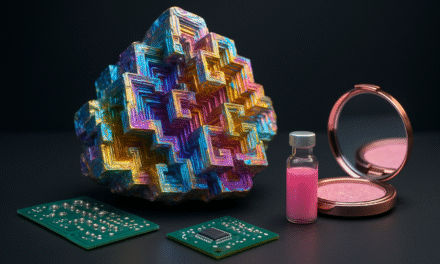
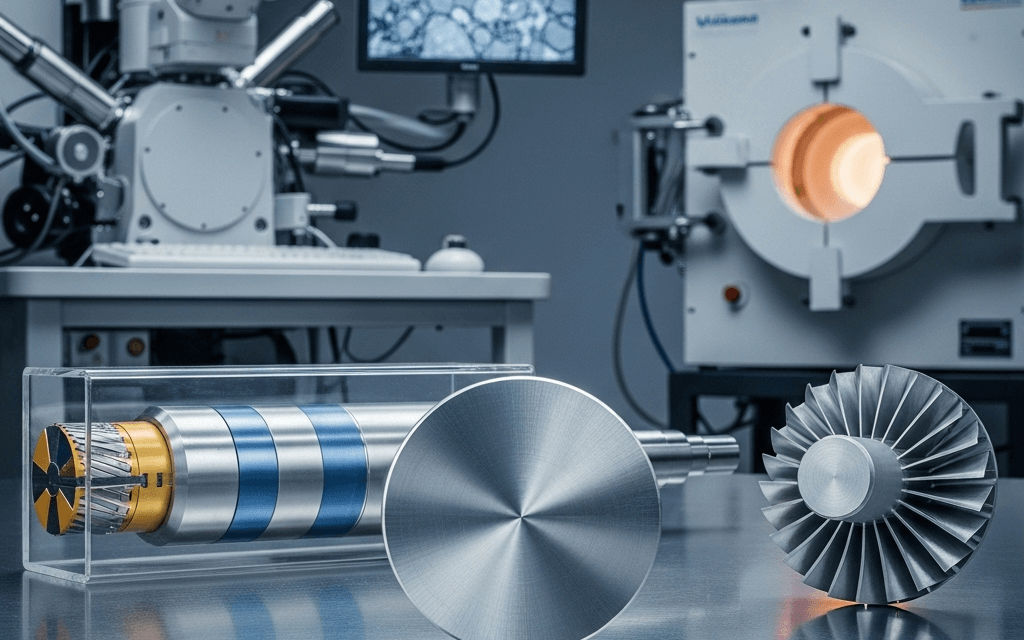
From nuclear submarines to space rockets to smartphone chips, one rare element quietly holds these technologies together: hafnium. Its neutron absorption, heat resistance, and chemical stability make it indispensable — even if it remains almost unknown to the public. In this guide, we explore the most important hafnium uses across nuclear energy, aerospace, electronics, and even geochemical research.
The name comes from Hafnia — the Latin name for Copenhagen — where it was first discovered in 1923 by Dirk Coster and George de Hevesy. Hafnium (atomic number 72) is a shiny, silvery-grey transition metal that sits in Group 4 of the periodic table, closely tied to zirconium with which it naturally co-occurs.
Its primary source is zircon (ZrSiO₄), where hafnium atoms substitute for zirconium at levels of 1–5%. Extracting pure hafnium is technically challenging because the two elements are chemically almost identical — a fact that makes hafnium rare, costly, but strategically vital. Despite its modest crustal abundance (~3 ppm), hafnium has carved out a place in some of the world’s most advanced technologies.
Key Properties That Drive Its Uses
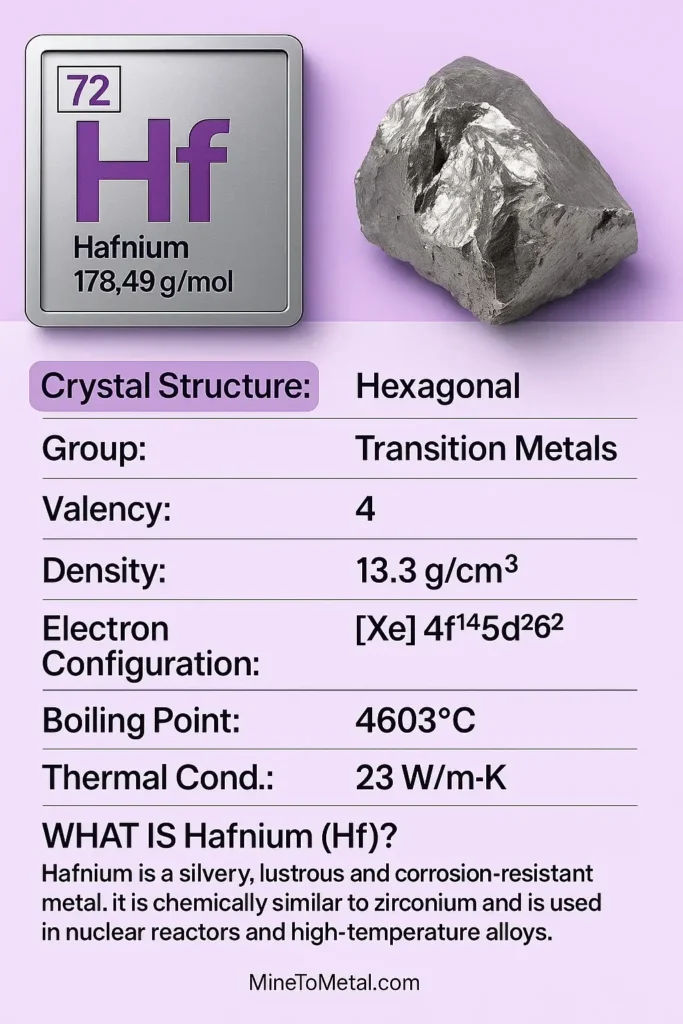
Hafnium is lustrous, ductile, and corrosion-resistant, with a high density of 13.3 g/cm³. Its most striking feature is its very high melting point of 2,233 °C and its ability to remain stable under extreme heat. Combined with strong oxidation resistance, this makes hafnium essential in aerospace superalloys and ultra-high-temperature ceramics.
afnium has a neutron absorption cross-section of ~105 barns (1.15 × 10⁻²⁸ m²), around 600 times higher than zirconium’s near transparency — making it ideal for control rods. This property underpins its role in control rods for nuclear power plants and submarine reactors, while its close twin zirconium is deliberately chosen for fuel cladding due to its transparency to neutrons.
Chemically, hafnium forms highly stable compounds.
- Hafnium oxide (HfO₂) has a high dielectric constant, making it indispensable in semiconductor transistors at 45 nm and below.
- Hafnium carbide (HfC) holds the record for the highest melting point (~3,990 °C) of any known binary compound, while hafnium diboride (HfB₂).
- Hafnium nitride (HfN) are used in protective coatings for hypersonic flight.
👉 Its unusual combination of heat resistance, neutron absorption, and chemical stability gives hafnium a dual role, shielding nuclear reactors while also enabling the hottest aerospace alloys and the smallest microchips.
In practical terms, this means hafnium sits at the crossroads of safety and performance, the same element that can shut down a reactor can also keep a rocket nozzle intact during re-entry.
Hafnium in Nuclear Reactors
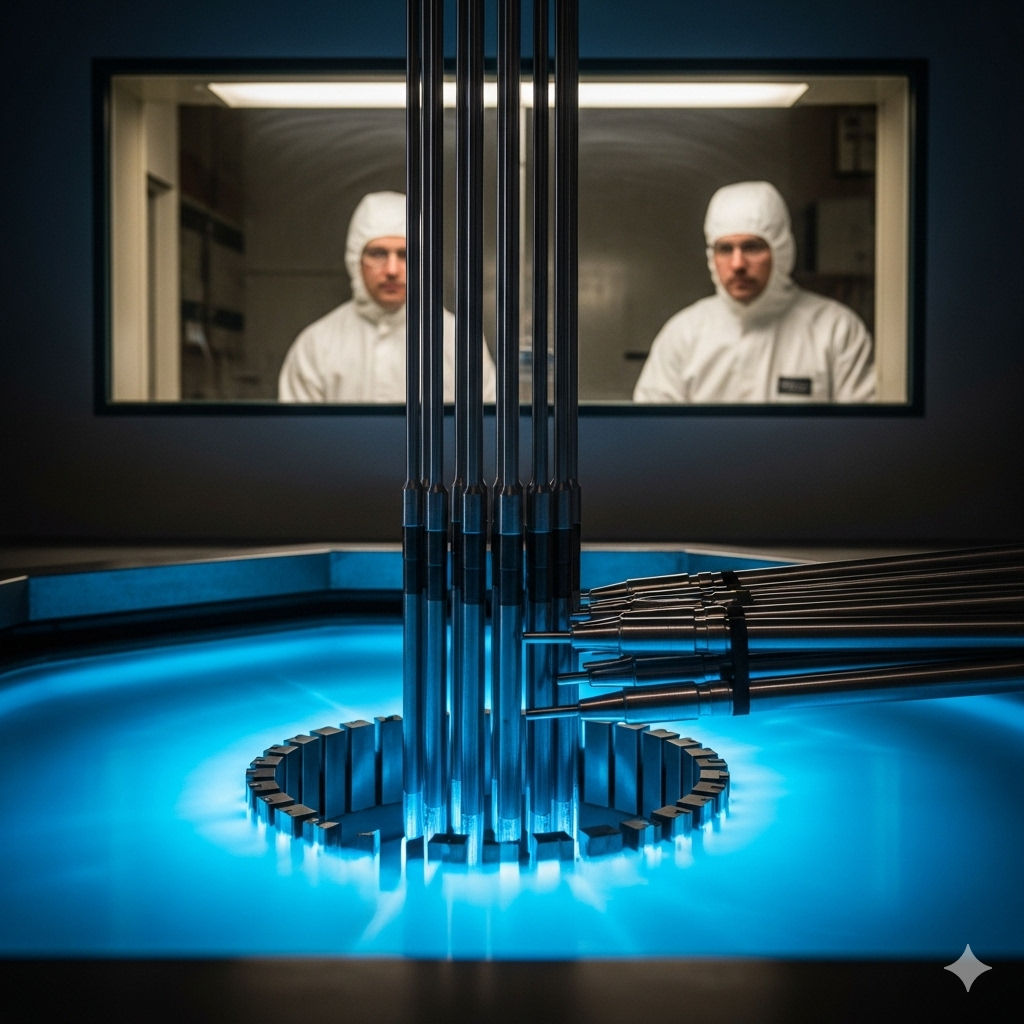
Nuclear power demands materials that perform flawlessly under conditions that would obliterate conventional metals. Since the late 1950s, hafnium has carved out an essential niche in nuclear reactor technology, where its neutron-absorbing properties make it irreplaceable for the most critical safety systems.
Control Rods and Neutron Absorption
Nuclear engineers prize hafnium for its remarkable thermal neutron absorption cross-section of approximately 115 × 10^-28 m². This property—roughly 600 times greater than that of zirconium—allows hafnium to capture neutrons efficiently without undergoing fission itself. Control rods containing hafnium regulate nuclear reactions by managing neutron flux, essentially serving as the reactor’s braking system.
What distinguishes hafnium from other neutron absorbers is its exceptional longevity under radiation. Hafnium control rods can function effectively for approximately 40 years without excessive reactivity loss or damage, essentially lasting the entire operational lifetime of many nuclear plants. This longevity translates into reduced replacement costs and fewer shutdowns, a clear advantage for both safety regulators and utility operators managing billion-dollar assets.
“Hafnium is considered an ideal neutron absorbing material due to its combination of large thermal neutron absorption cross-section, satisfactory corrosion resistance, high radiation resistance and good mechanical machining performance.”
The metal’s radiation resistance stems from a unique characteristic: as hafnium isotopes undergo irradiation, they form new isotopes that also possess high neutron-capture cross-sections, maintaining effectiveness throughout their operational life. Even after extensive exposure to neutron fluence of 7.5 × 10^25 m^-2 (E < 0.625 eV), hafnium control rods maintain complete serviceability.
Naval vs Civilian Reactor Roles
Cost considerations create a sharp divide between military and civilian applications of hafnium in nuclear technology:
| Reactor Type | Hafnium Application | Notable Examples | Strategic Rationale |
|---|---|---|---|
| Naval/Military | Primary control rod material | Submarine 571 Nautilus (1950s) | Performance justifies high cost |
| Civilian PWR | Limited deployment | Shippingport-1, Indian Point Unit-1, Yankee Rowe | Economic constraints limit adoption |
| Research Reactors | Dual-function material | RBT-6, FRM II (Germany) | Lower temperatures enable versatile use |
| BWR/PHWR | Enhanced longevity components | GE Marathon control rods | Specialised designs for extended service |
Naval reactors have historically chosen hafnium despite its premium cost. The German research reactor FRM II also relies on hafnium as a neutron absorber. Civilian power plants use hafnium sparingly, with the first core of the Shippingport Atomic Power Station, originally a naval reactor design, representing a notable exception. This split highlights the trade-off: navies prioritize compact, long-lived reactors where cost is secondary, while civilian utilities remain constrained by economics even if hafnium offers superior performance.
Since the early 1990s, research programmes at CEA have investigated hafnium as a potential replacement for steel-cladded Ag-In-Cd control rods in next-generation Pressurised Water Reactors, aiming to improve neutron efficiency while enhancing control system longevity and safety.
Examples include the USS Nautilus submarine reactor, the Shippingport-1 civilian plant in the US, and the FRM II research reactor in Germany, all of which relied on hafnium for efficient control
Zirconium Separation – A Technical Challenge
The contrasting nuclear properties of hafnium and zirconium create a fundamental separation challenge. For nuclear fuel applications, zirconium cladding must contain less than 100 ppm hafnium to preserve neutron economy. Zirconium’s minimal neutron absorption keeps neutrons available for nuclear reactions, while hafnium would capture them.
Separating these chemically identical twins ranks among metallurgy’s most demanding challenges. For nuclear suppliers, this challenge isn’t just technical — it directly affects reactor economics, since the purity of zirconium fuel cladding determines both efficiency and licensing approval.
Both elements exhibit nearly identical chemical behaviour due to the lanthanide contraction phenomenon, with atomic radii differing by merely 0.01 Å. Current separation methods include:
- Ion-exchange in sulfuric acid solution
- Molten salt distillation
- Solvent extraction
These processes remain expensive and environmentally challenging. According to USGS Mineral Product Statistics, global zirconium dioxide production reaches 1.4 million tonnes annually, yet hafnium dioxide production stands at merely 1,500-2,000 tonnes—meaning approximately 90% of potential hafnium resources remain unextracted.
Key Takeaway: Hafnium’s neutron-absorbing capabilities make it indispensable for nuclear reactor control systems where reliability cannot be compromised. However, the economic and technical challenges of separating hafnium from zirconium create supply constraints that limit broader adoption, despite growing strategic demand for this critical nuclear material.
Hafnium in Electronics and Semiconductors
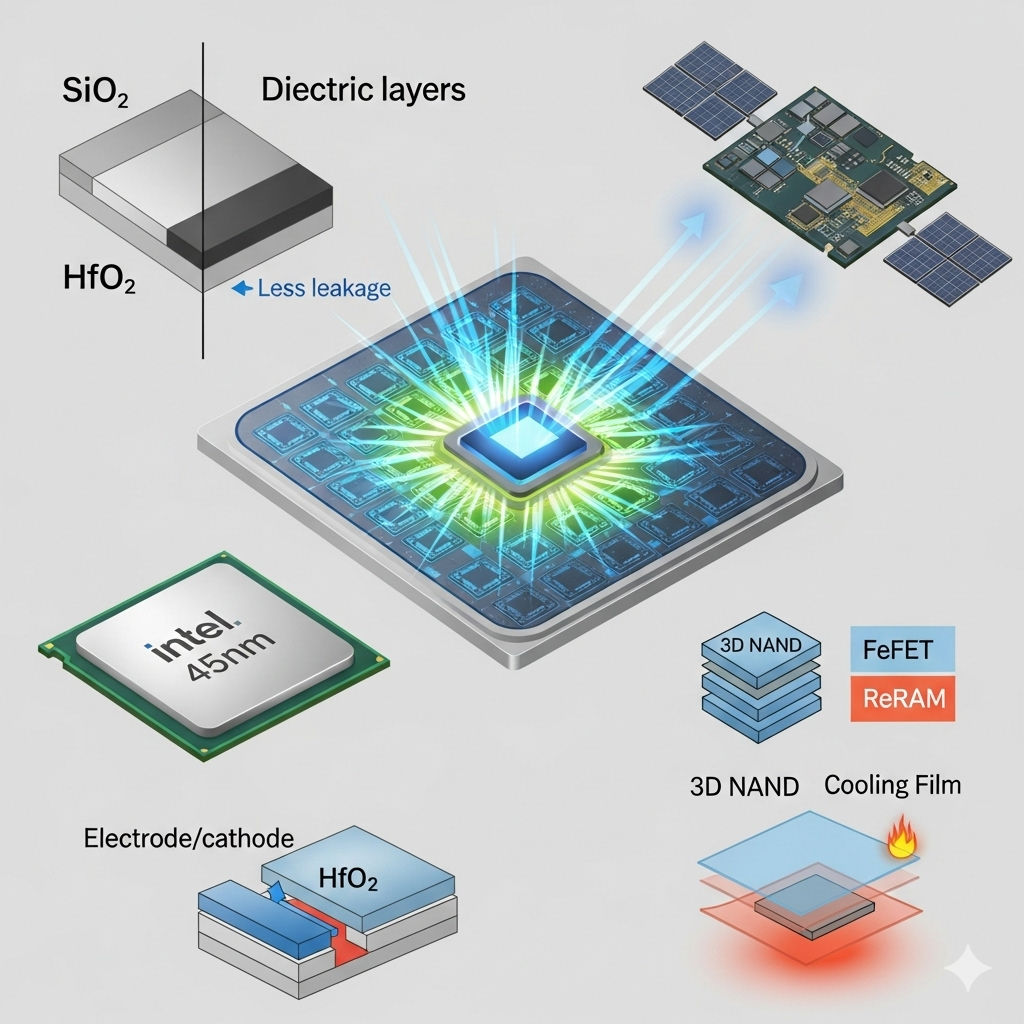
Silicon dioxide ruled semiconductor manufacturing for decades until it hit a wall. Below 1.2 nm thickness—just five atomic layers—electron leakage became unmanageable, threatening the relentless march of Moore’s Law. The industry needed a solution that could maintain performance whilst allowing continued miniaturisation.
Enter hafnium oxide (HfO₂): a material that would redefine the boundaries of what semiconductors could achieve.
HfO₂ – The High-κ Dielectric Revolution
HfO₂ delivers a dielectric constant of ~25 compared with SiO₂ at just 3.9—reducing leakage currents 5–10× in modern transistors. This allows thicker insulating layers that prevent electron leakage whilst maintaining the same electrical capacitance. Combined with its wide bandgap (5.7 eV), excellent thermal stability, and large barrier heights at silicon interfaces, HfO₂ offered exactly what the industry needed.
| Property | HfO₂ | SiO₂ | Strategic Advantage |
|---|---|---|---|
| Dielectric constant (κ) | ~25 | 3.9 | Higher capacitance, same thickness |
| Bandgap | 5.7 eV | 9 eV | Optimal insulation properties |
| Leakage current | 5-10× reduction | Baseline | Lower power consumption |
| Heat of formation | -271 kcal/mol | -218 kcal/mol | Superior thermal stability |
The numbers tell the story: hafnium-based dielectrics reduce leakage current by five to ten times whilst improving device performance across multiple metrics. This improvement was the difference between Moore’s Law stalling in the mid-2000s and continuing another decade, making hafnium one of the unsung enablers of today’s smartphone era.
Intel & IBM Breakthroughs in Chip Scaling
The semiconductor industry’s biggest players recognised hafnium’s potential early. Intel called it “the biggest change to computer chips in 40 years” when both Intel and IBM announced successful implementation of hafnium-based high-κ dielectrics in their 45 nm process technology in 2007. This breakthrough addressed what had been the silicon industry’s “single biggest technical challenge”.
Intel’s approach combined hafnium-based dielectrics with proprietary metal gate materials in 2007, reducing source-drain leakage by more than five times whilst improving transistor drive current by over 20%. IBM, partnering with AMD, Sony, and Toshiba, developed similar hafnium-based high-κ systems with metal gates.
“After more than ten years of effort, we now have a way forward,” noted T.C. Chen, VP of science and technology at IBM Research.
Intel began production of 45 nm chips using hafnium in 2007, with IBM following in 2008. This wasn’t just a technical achievement—it extended silicon-based transistor viability for another decade and continues shaping chip design today.
Radiation-Resistant Electronics for Space
Where conventional semiconductors fail under cosmic radiation, hafnium-based materials maintain stability. This radiation resistance proves crucial for deep space missions, where standard electronics degrade rapidly under constant bombardment from high-energy particles.
Private space companies pursuing human missions to Mars face this exact challenge. Hafnium-based electronics could provide the solution, maintaining operational integrity during long-duration space travel where traditional components would fail.
Cathodes, Filaments, and Electrodes in Devices
Different hafnium-based electrode configurations deliver distinct performance characteristics tailored to specific applications:
- Ag/HfO₂/Si devices: Larger memory windows and self-compliance behaviour
- Au/HfO₂/Si devices: Cycle-to-cycle variation in ON-state conductance
- TaN/HfAlOₓ/TiN structures: Enhanced ferroelectric polarisation strength and extended endurance cycles with nitrogen plasma treatment
These properties enable customisation for memory storage, security applications, and sensing devices.
Emerging Roles – Ferroelectric FETs, ReRAM, Cooling Films
Ferroelectric field-effect transistors (FeFETs) represent hafnium’s most promising frontier. Discovered in 2011, ferroelectric HfO₂ enables non-volatile memory with sub-5V write voltages, switching times under 10 nanoseconds, and excellent on/off ratios. Unlike traditional perovskite ferroelectrics, HfO₂ maintains ferroelectricity at thicknesses down to 1 nm.
Resistive switching memory devices using HfO₂ offer multi-level storage capabilities with low power consumption. These characteristics position them as promising candidates for neuromorphic computing applications, potentially overcoming the “memory wall” and von Neumann bottleneck that limit current computing architectures.
Industrial demonstrations from Intel, TSMC, and others have shown functional FeFET arrays at 28 and 22 nm nodes, with commercial FeFET-based storage-class memory products expected between 2028 and 2030.
Key Takeaway: Hafnium rescued Moore’s Law when silicon dioxide reached its physical limits, enabling continued miniaturisation through superior electrical properties. Its impact extends beyond traditional computing into radiation-resistant electronics, next-generation memory technologies, and neuromorphic computing paradigms that will define the electronics industry’s future.
Aerospace and Superalloys
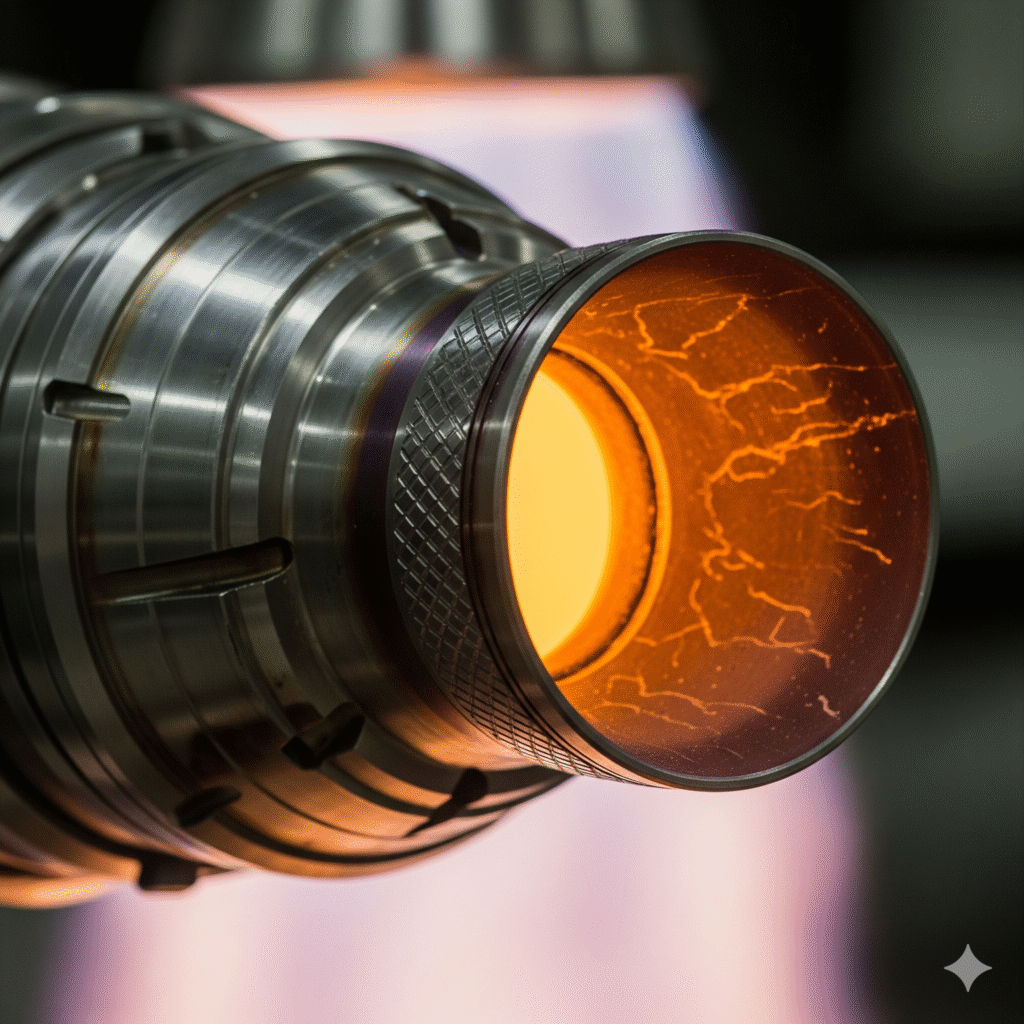
Aerospace engineering demands materials that perform flawlessly where failure isn’t an option. Hafnium’s exceptional thermal stability and mechanical properties make it indispensable for components subjected to conditions that would destroy virtually any other material.
Rocket Nozzles and Turbine Blades (C-103 Alloy)
C-103, a niobium-based alloy containing approximately 10% hafnium and 1% titanium, has emerged as the material of choice for critical aerospace components. This remarkable alloy boasts a melting point of roughly 2,340°C and maintains structural integrity at temperatures between 1,200°C and 1,400°C whilst under significant mechanical stress.
Hafnium’s addition to C-103 strengthens grain boundaries, substantially improving high-temperature creep and tensile strength. The performance gains are evident across demanding aerospace applications:
| Application | Operating Temperature | C-103 Advantage | First Major Use |
|---|---|---|---|
| Rocket nozzles | Up to 1,480°C | Double the strength of Ni718 or Ni625 at 1,093°C | Apollo lunar module (1965) |
| Thrust chambers | >1,200°C | Resistance to decomposition by heat and pressure | Space launch vehicles |
| Jet engine components | 1,100-1,400°C | Excellent vibration resistance at both high and cryogenic temperatures | Afterburner flap sections |
“C-103 was used for the first time in the Apollo-manned lunar module rocket engine in 1965. It has since been adopted for various ultrahigh-temperature applications.”
Apollo Lunar Module Case Study
The Apollo Lunar Module stands as one of the earliest and most successful applications of hafnium-containing alloys in aerospace history. This spacecraft—the first designed to operate exclusively in space—achieved an impressive weight-to-structure ratio of approximately 1:15.
Throughout the Apollo missions, the primary structure experienced no significant problems, partly thanks to hafnium-containing alloys in critical components. The descent engine, particularly challenged by extreme temperature variations, utilised C-103 alloy for its nozzle, enabling reliable operation during the critical lunar landing manoeuvres. This case demonstrates how hafnium-containing alloys turned theoretical metallurgy into a milestone in human spaceflight, showing the element’s impact far beyond laboratory experiments.
The C-103 alloy nozzle operated reliably between 1,200–1,400 °C, with peak tolerance up to ~1,480 °C, balancing heat resistance with lightweight performance in one of history’s most demanding engineering tests. For aerospace engineers, this meant confidence that a lunar landing engine could fire precisely when needed, no margin for error, and no alternative material with comparable reliability at the time.
Re-entry Shields and Hypersonic Vehicles
Vehicles travelling at hypersonic speeds (Mach >5) face formidable challenges from extreme aerodynamic heating. Thermal protection systems (TPS) must withstand temperatures approaching 4,000°C whilst remaining lightweight.
Recent research has found that hafnium carbide (HfC) melts at 3,958°C—the highest melting point ever recorded for a material. This property makes HfC-based ceramics prime candidates for heat-resistant shielding on hypersonic space vehicles.
Coatings for Extreme Aerospace Environments
Hafnium-based thermal barrier coatings (TBCs) protect critical components throughout the aerospace industry. Adding even small amounts of hafnium (≤1%) to bond coats significantly improves:
- Cyclic oxidation resistance
- Adhesion of thermally grown oxide layers
- Overall coating strength
Nickel-based superalloys in turbine blades typically contain 1-2% hafnium. MAR-M 247, a nickel-based alloy used in land-based turbines operating at temperatures up to 1,038°C, contains 1.5% hafnium.
Oxidation Resistance Under Cyclic Thermal Loads
Hafnium’s most valuable contribution to aerospace materials lies in its ability to enhance oxidation resistance under fluctuating thermal loads. When added to thermal barrier coatings, hafnium ions segregate at alumina grain boundaries, inhibiting aluminium’s outward diffusion and decreasing oxidation rates.
Studies demonstrate that uniformly dispersed hafnium-rich precipitates fundamentally alter thermally grown oxide (TGO) formation, creating a double-layer scale structure with both equiaxed and columnar grains. This structure dramatically improves adhesion—hafnium-doped coatings significantly outperform undoped counterparts during cyclic oxidation testing at 1,100°C. In practice, this means jet engines can run hotter and longer between overhauls — a direct economic gain for airlines and a strategic edge for defense programs where maintenance cycles define readiness.
Key Takeaway: Hafnium’s unique properties enable aerospace materials to function in environments where others would disintegrate, allowing aircraft engines to operate at higher temperatures with increased safety and efficiency.
As aerospace engineering continues pushing the boundaries of speed, altitude, and duration, hafnium remains irreplaceable for creating materials capable of withstanding the most extreme conditions imaginable.
Refractory Compounds and Ultra-High-Temperature Ceramics (UHTCs)
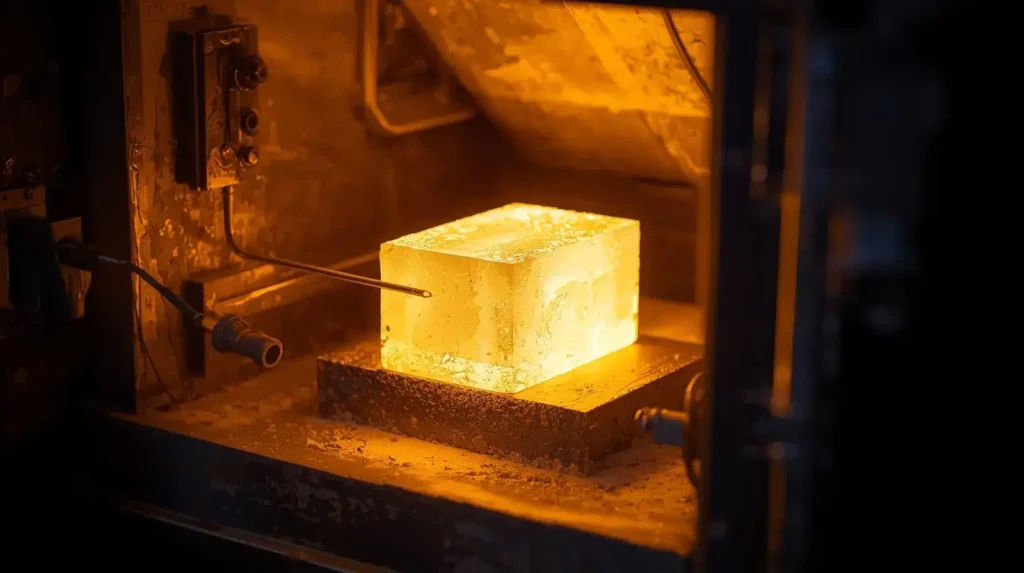
Hafnium compounds occupy the extreme end of materials science—the realm where conventional metals melt like ice cream and ceramics crumble like chalk. These ultra-high-temperature ceramics (UHTCs) represent the pinnacle of thermal endurance, functioning in environments that would instantly vaporise most other substances.
Hafnium Carbide (HfC) – The Thermal Endurance Champion
Hafnium carbide holds the crown for thermal resilience among binary compounds, with a melting point approaching 3,990°C. This extraordinary temperature tolerance surpasses the surface of many stars. The tantalum-hafnium carbide system (Ta₄HfC₅) pushes these limits even further, achieving 4,215°C—hot enough to withstand the core of a nuclear reactor.
Beyond its extraordinary melting point, hafnium carbide also combines hardness of 20–23 GPa, density of 12.7 g/cm³, and thermal conductivity around 22 W/m·K, properties that explain why it outperforms other refractory materials in aerospace and nuclear systems.
To put this in perspective: while steel melts at 1,370°C and tungsten—previously considered the ultimate refractory metal—succumbs at 3,414°C, hafnium carbide remains solid at temperatures that would challenge the engineering limits of spacecraft heat shields. This resilience explains why research agencies treat hafnium carbide not as a laboratory curiosity but as a potential gatekeeper material for the next generation of hypersonic and re-entry vehicles.
| Property | Value | Where It Matters |
|---|---|---|
| Melting point | ~3,990°C | Rocket thrust chambers |
| Thermal conductivity | 22 W/m·K | Heat dispersion in hypersonic vehicles |
| Hardness | 20-23 GPa | Cutting tools for superalloys |
| Density | 12.7 g/cm³ | Ballistic protection systems |
Hafnium Diboride and Nitride—The Supporting Cast
HfC doesn’t work alone. Hafnium diboride (HfB₂) brings a melting point of 3,250°C combined with electrical conductivity—a rare pairing in ceramics that allows components to dissipate both heat and electrical charge simultaneously. This dual functionality proves crucial for atmospheric re-entry vehicles where plasma formation creates both thermal and electrical stresses.
Hafnium nitride (HfN), though “only” stable to 800°C in oxidising environments, contributes through exceptional hardness (16-20 GPa) and chemical stability. When integrated into composite systems, HfN can triple component lifespan under repeated thermal cycling—the difference between mission success and catastrophic failure.
Hypersonic Vehicle Protection
These hafnium compounds don’t exist merely as laboratory curiosities. Leading edges of hypersonic vehicles—those travelling beyond Mach 5—experience temperatures exceeding 2,000°C during atmospheric re-entry. Conventional materials would fail within seconds. HfC and HfB₂-based ceramics maintain structural integrity throughout these punishing thermal events, protecting the vehicle and its occupants from destruction.
Modern thermal barrier coatings (TBCs) incorporating hafnium compounds can reduce heat flux by up to 60% compared to traditional ceramics. This performance advantage translates directly into mission capability—longer flight times, higher speeds, and improved safety margins for both crewed and uncrewed vehicles. Put simply, without hafnium-based ceramics, hypersonic flight would remain a theoretical ambition rather than an operational reality.
The Bottom Line: Hafnium compounds define the absolute limits of material thermal performance. Without them, hypersonic flight remains a laboratory curiosity rather than an operational reality. They represent the thin line between technological breakthrough and physics-imposed barriers that no other materials can cross.
Industrial Hafnium Uses and Chemical Applications
Beyond the spotlight of nuclear reactors and spacecraft, hafnium quietly powers everyday industrial processes that most people never notice. This versatile metal tackles mundane yet essential tasks—from purifying manufacturing environments to enhancing cutting tools—proving its worth extends far beyond glamorous high-tech applications.
Getters in Vacuum Systems
Hafnium serves as an industrial janitor in vacuum chambers, efficiently scavenging unwanted gases like oxygen and nitrogen without releasing any gases of its own. Scientific instruments and precision manufacturing depend on these ultra-clean environments, where even trace contamination can ruin entire production runs.
The metal’s aggressive reactivity with atmospheric gases gives it a significant edge over competing getter materials. Research comparing non-evaporable getter (NEG) films found hafnium, alongside titanium and zirconium, delivers superior performance with activation temperatures below 400°C—low enough to avoid damaging sensitive components.
“Hafnium getters create microscopic clean rooms, maintaining near-perfect vacuum conditions that enable everything from electron microscopy to semiconductor fabrication.” For manufacturers, this translates into fewer defects, higher yields, and reliable performance in industries where a single microscopic contaminant can ruin million-dollar equipment batches.
Hafnium Tetrachloride (HfCl₄) in CVD/ALD
Semiconductor manufacturers rely on hafnium tetrachloride (HfCl₄) as a chemical building block for creating hafnium dioxide films through atomic layer deposition (ALD) and chemical vapour deposition (CVD) processes. The reaction is straightforward:
HfCl₄ + 2H₂O → HfO₂ + 4HCl
Production teams meticulously control HfCl₄ pulse timing during deposition, optimising film thickness, composition, and electrical properties while minimising waste. This precision chemistry enables the high-performance gate dielectrics that form the backbone of modern computing.
Plasma Torch Tips and Welding Electrodes
Hafnium inserts sit at the heart of plasma cutting torches, acting as tiny heat shields that protect electrodes from plasma arcs reaching thousands of degrees. The metal’s exceptional melting point allows it to maintain the arc while surviving conditions that would vaporise most other materials. This property directly reduces downtime in fabrication shops and aerospace workshops, where electrode failure can halt production lines and inflate costs.
| Electrode Configuration | Hafnium’s Role | Performance Benefit |
|---|---|---|
| Copper-based systems | Thermal barrier between electrode wall and arc | Standard operational life |
| Silver-enhanced designs | Forms protective silver oxide layer | Double the lifespan in high-heat applications |
Hydraulic Oil Additives
Hafnium appears in hydraulic fluid formulations, where its anti-volatility properties prevent oil evaporation during high-stress operations. Industrial machinery and medical equipment benefit from this enhanced reliability, particularly in applications where fluid loss could cause catastrophic failures.
Key Takeaway: While hafnium’s industrial applications lack the drama of space missions or nuclear reactors, they demonstrate the metal’s versatility in solving practical engineering challenges across manufacturing, processing, and precision machinery—often in ways that remain completely invisible to end users.
Hafnium in Scientific and Geochemical Research
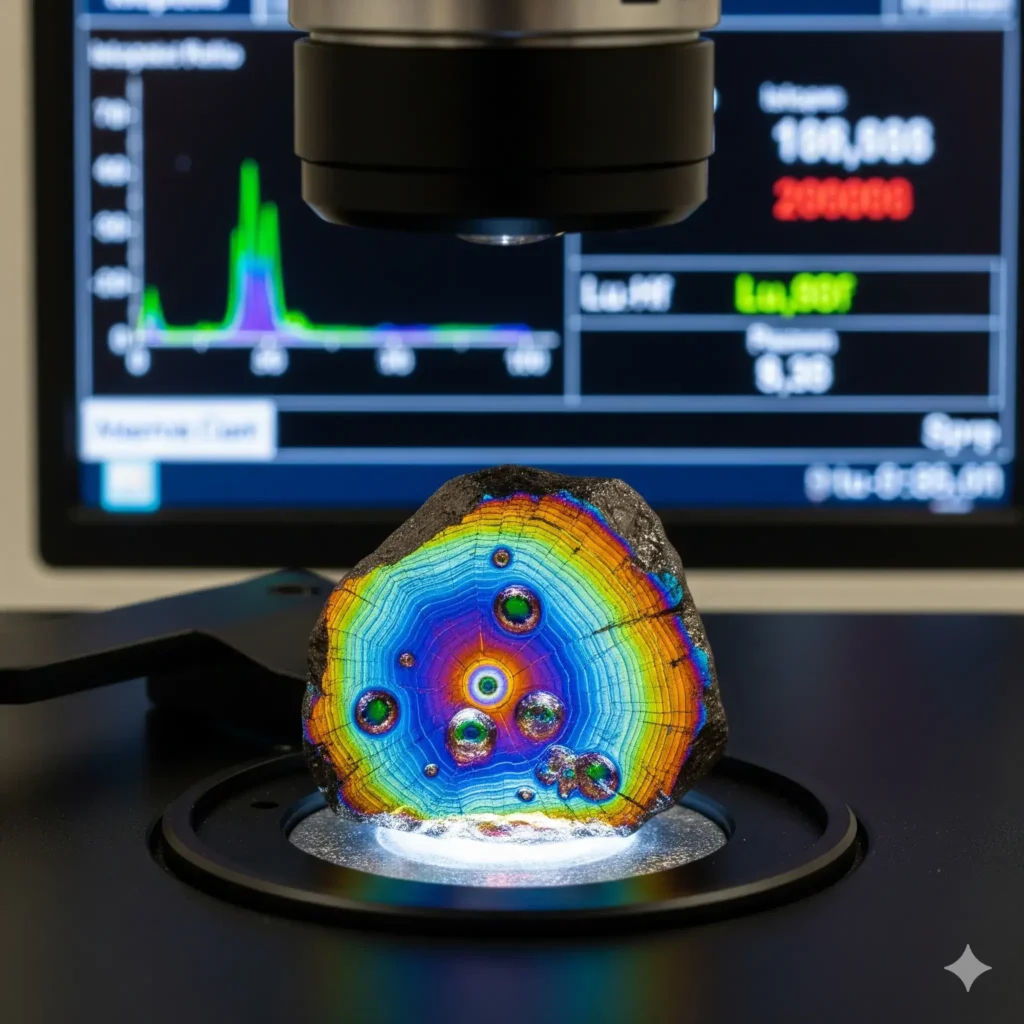
Beyond powering modern technology, hafnium serves as Earth’s most reliable historian. Geochemists have discovered that hafnium’s radioactive decay patterns function as cosmic timekeepers, preserving evidence of planetary formation processes that occurred billions of years ago in zircon crystals and ancient rocks.
Lu–Hf Isotope Dating for Earth’s Mantle Evolution
The lutetium-hafnium isotopic system offers geologists an extraordinary window into Earth’s deep past. This natural chronometer relies on the beta decay of ¹⁷⁶Lu to ¹⁷⁶Hf with a half-life of approximately 37 billion years—nearly three times longer than Earth’s entire existence.
What makes this system particularly powerful is how Earth’s crustal and mantle reservoirs developed distinct Lu/Hf ratios over geological time, causing their ¹⁷⁶Hf/¹⁷⁷Hf compositions to diverge like diverging evolutionary branches. Scientists can measure these subtle differences in ancient zircon crystals, which typically contain about 1% hafnium with extremely low Lu/Hf ratios—to reconstruct planetary evolution. For geologists, hafnium isotopes serve as a forensic tool, allowing them to piece together Earth’s early history much like archaeologists reconstruct ancient civilizations from pottery fragments.
“The Lu-Hf isotope system offers a natural companion to Sm-Nd, both providing independent systems with starting points and reference baselines to track isotope evolution of Earth’s reservoirs.”
Recent zircon studies reveal Earth’s dynamic history through hafnium signatures:
| Time Period | Hf Isotope Evidence | Geological Implication |
|---|---|---|
| Hadean (~4.0-4.56 Ga) | Vigorous mantle convection | Early plate tectonics |
| Early Mesoarchean (~3.2-3.0 Ga) | Initiation of supercontinent cycles | Continental formation |
| Neoproterozoic (~1.0-0.54 Ga) | Significant εHf shift | Change in subduction modes |
Hf–W Isotopic System in Planetary Differentiation
The hafnium-tungsten (Hf-W) isotopic system serves as the gold standard chronometer for determining when Earth’s core separated from its mantle. This system utilises the decay of ¹⁸²Hf to ¹⁸²W with a half-life of just 8.9 million years—a relatively short timespan that makes it perfect for dating early solar system events. Recent isotopic studies further constrain the Moon’s formation to either 53–62 million years or 143–183 million years after the start of the Solar System, depending on modelling assumptions
The chemical behaviour of these elements during planetary formation creates the perfect experimental setup: hafnium prefers to remain in silicate mantles while tungsten moves preferentially into metallic cores. This natural separation allows scientists to constrain core formation timing with remarkable precision.
The ¹⁸²W anomalies preserved in Earth’s mantle provide direct evidence of our planet’s most violent early period, when massive impacts and metal-silicate separation shaped the world we know today. This makes hafnium not just a tool for engineers, but also for planetary scientists — one of the few natural “clocks” precise enough to time the birth of the Moon itself.
Researchers have used this hafnium-tungsten clock to estimate that the Moon formed either 143-183 million years or 53-62 million years after the solar system’s beginning—resolving one of planetary science’s most fundamental questions.
Key Takeaway: Hafnium isotopes function as Earth’s memory bank, recording the timeline of planetary evolution from core formation through continental assembly to modern geology, providing insights into processes that would otherwise remain forever hidden in deep time.
Supply, Criticality, and Strategic Outlook
The global hafnium supply chain reveals a paradox: whilst hafnium enables some of humanity’s most advanced technologies, its production remains concentrated in the hands of just four countries. Behind every hafnium-powered nuclear submarine or space telescope lies a precarious journey from beach sands to high-purity metal.
From Zircon Sands to Strategic Metal
Hafnium extraction begins where most people wouldn’t expect, in ordinary zircon beach sands, where hafnium hides at a ratio of approximately 1:50 with zirconium. The separation process demands multiple technical steps: solvent extraction for purification, preparation of hafnium oxide, chlorination, and the Kroll’s reduction process to produce metal sponge.
India recently established its first indigenous hafnium sponge pilot plant at C-MET, Hyderabad, primarily to serve ISRO and the Department of Atomic Energy. This move signals recognition that hafnium represents more than just another industrial metal—it’s a strategic enabler of national capabilities.
The Byproduct Bottleneck
Global pure hafnium metal production stands at merely 70-75 tonnes annually, a supply smaller than a single subway car’s worth of material. This scarcity stems from hafnium’s byproduct status; no mines exist solely for hafnium extraction. Production centres remain concentrated among four players:
France: 30 tonnes annually, expanding to 45 tonnes by 2026 United States: Two primary producers eyeing a potential 50-tonne increase
China: Rapidly expanding capacity toward 140 tonnes yearly Russia: Limited transparency, with export restrictions now in place
This concentration creates strategic vulnerabilities that extend far beyond simple supply economics. For countries reliant on advanced reactors, chips, or defense technologies, this means hafnium access is no longer a technical matter but a national security question.
Price Volatility Signals Market Stress
Hafnium prices have demonstrated exceptional volatility throughout 2023-2025. Indian market prices reached ₹4,323,600 per metric tonne in June 2025, representing approximately 400% growth within two years. For semiconductor giants like Samsung Electronics and SK Hynix, each consuming an estimated 100 tonnes annually, such price swings directly impact manufacturing costs for the chips powering everything from smartphones to data centres. In effect, hafnium’s price volatility acts as a hidden tax on innovation, shaping the economics of semiconductors and slowing down scaling efforts when costs spike.
Strategic Independence Through Beach Sands
Recognising these vulnerabilities, India has pursued hafnium self-sufficiency through its substantial zircon deposits found in coastal beach sands. The Nuclear Fuel Complex in Hyderabad now processes zirconium scrub raffinate to develop NIOBHAT 101 alloy for space applications and nuclear control rods. These initiatives represent more than industrial policy—they constitute strategic hedging against supply disruption in a critical technology enabler.
Beyond domestic processing, India has also turned outward. Through Khanij Bidesh India Ltd (KABIL)—a joint venture of NALCO, HCL, and MECL—the government is building partnerships to secure critical minerals, including hafnium, from international sources. These efforts complement India’s zircon-based capacity, ensuring that supply security is treated as a question of technological sovereignty rather than simple industrial policy.
With global demand projected to approach 180 tonnes by 2030, India’s ability to combine domestic zircon sands with international partnerships may determine its long-term position in nuclear, aerospace, and semiconductor technologies.
Key Takeaway: Projected global demand approaches 180 tonnes by 2030—a 40% increase that will likely widen existing supply gaps. Countries that secure hafnium access today will maintain technological advantages in nuclear energy, aerospace, and advanced semiconductors for decades to come.
Conclusion
Hafnium is one of the least known yet most indispensable elements of modern industry. In practical terms, it underpins safety-critical systems and performance thresholds that other materials can’t meet. Its exceptional neutron absorption (~105 barns) secures nuclear reactors and submarines, while hafnium carbide’s 3,990 °C melting point defines the limits of materials science.
In semiconductors, hafnium oxides enabled Intel and IBM to overcome silicon’s scaling barrier, extending Moore’s Law into the 21st century. That shift didn’t just solve leakage—it preserved the cost-performance roadmap that made today’s smartphone and AI eras economically viable
From Apollo’s lunar module to today’s turbine blades and hypersonic vehicles, hafnium alloys deliver performance where conventional metals fail. For engineers, this reliability shortens certification timelines and reduces redesign risk at extreme temperatures
Ultimately, hafnium is more than a periodic table entry. It is a strategic enabler—and a potential bottleneck—at the heart of nuclear safety, aerospace resilience, and semiconductor progress. For policymakers and industry leaders, that means hafnium access is a strategic variable—not just a procurement line item.
As technology pushes further into extreme environments, hafnium’s importance will only grow, making this obscure metal a silent cornerstone of 21st-century innovation. The logical response is dual: secure supply via beach-sand zircon chains and invest in recycling/purification capacity to buffer price shocks
Key Takeaway : Hafnium’s rare mix of neutron absorption, heat resistance, and stability ensures it will remain a critical, strategically sensitive metal as industries push the boundaries of technology.
FAQs
What are the main hafnium uses and applications?
Hafnium is mainly used in nuclear control rods, aerospace superalloys, semiconductors (HfO₂ gate dielectrics), and ultra-high-temperature ceramics like hafnium carbide and diboride. It also has industrial uses in vacuum systems, welding electrodes, and isotope geochemistry.
What are the primary applications of hafnium in aerospace engineering?
Hafnium is crucial in aerospace for creating superalloys used in turbine blades, vanes, and industrial gas turbines. Its high melting point and strength at extreme temperatures make it ideal for components that must withstand intense heat and stress in aircraft and spacecraft.
How is hafnium utilised in nuclear reactor technology?
Hafnium is widely used in nuclear reactor control rods due to its exceptional ability to absorb thermal neutrons. Its high neutron absorption cross-section allows it to effectively regulate nuclear reactions, making it invaluable in both civilian and military nuclear applications, including submarines.
What role does hafnium play in modern semiconductor manufacturing?
In the electronics industry, hafnium dioxide (HfO₂) has become essential as a high-k dielectric material. It allows for thinner insulating layers in transistors while preventing electron leakage, enabling the continued miniaturisation of semiconductor devices and extending Moore’s Law.
Why is hafnium important for hypersonic vehicle development?
Hafnium compounds, particularly hafnium carbide, are crucial for hypersonic vehicles due to their extremely high melting points. These materials can withstand the intense heat generated during hypersonic flight, making them ideal for thermal protection systems and leading edges of such vehicles.
How does the global supply of hafnium impact its industrial use?
The limited global supply of hafnium, with annual production around 70-75 tonnes, poses challenges for industries relying on it. As demand is projected to increase significantly, particularly in semiconductor and aerospace sectors, there are concerns about potential supply shortages and price volatility, which could impact technological development in these areas.
Is hafnium toxic or safe for humans?
Hafnium metal is considered relatively low in toxicity, though fine powders and some compounds can cause lung or skin irritation, so industrial handling requires precautions.